
Where have you gone, John Sayles? We need you.
Where have you gone, John Sayles? We need you.
By GORDON GLANTZ
Gordonglantz50@gmail.com
@Managing2Edit
GORDONVILLE — When it comes to our general managers’ credibility, the Philadelphia fan base sets its bar in curious places.
The Flyers’ Ron Hextall? Jury is out, but it is legitimate to be concerned that he’ll follow the same old approach of drafting 7-foot-6, 300 pound defensemen from Saskatoon instead of a skilled skater from Stockholm.
The Eagles’ Howie Roseman? Although his track record seems pretty sound, most of the Iggles’ faithful can’t get past the fact that he looks like he should be doing your taxes and not building your football team. A little unfair, perhaps, but that will be the reality until there is the long-awaited parade down Broad Street.
The Phillies’ Ruben Amaro? Hah!
He graciously accepts interview requests, but the more Amaro talks, the deeper the hole gets. At this lowest of low points, both in his tenure and in current franchise history, he is to the local sports community what Barack Obama is to the Tea Party.
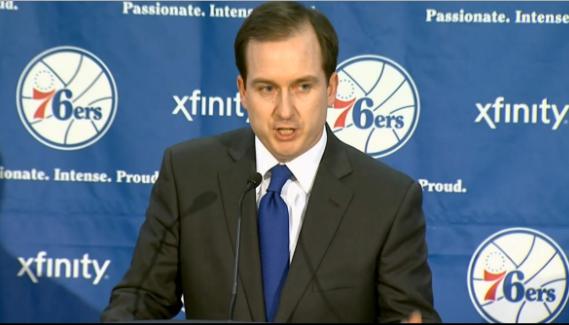
And then we have the curious case of Sam Hinkie.
Unlike Amaro, constantly jabbering about the sorry state of the Phillies, the 76ers GM says very little. And when he does open up, we don’t understand what the heck he is talking about anyway.
His track record? At face value, pretty lame. He traded away an all-star in Jrue Holiday for the draft rights to a guy, Nerlens Noel, who played as many minutes last season as Andrew Bynum did the year before. The team was so bad that it sparked arguments as to whether the 2013-14 Sixers were going to be worse than the ignominious1972-73 version that managed a grand total of nine wins.
And yet, Hinkie gets a pass.
And rightfully so.
The NBA is a dysfunctional league, and he is in the midst of beating it at its own game. The only way to make the journey to the top-heavy circuit is to tear the team completely apart, get lottery picks and create cap space.
Presuming Noel comes back next season – and we all know he could have played a little this year, but the risk-reward factor was clear on Hinkie’s AC (analytics calculator) – he will join forces with rookie of the year Michael Carter -Williams to form a formidable nucleus.
The impending 2014 draft (june 26), which is touted as a once-in-a-decade collection of talent, will ultimately define where this team goes.
The Sixers finished with the second-worst record, and got the third pick. The Holiday deal netted them the No. 10 pick from New Orleans. Wheeling and dealing has also left the Sixers with a grand total of five second-round picks.
The intrigue grows daily. The speculation du jour is that the Sixers are so enamored with Andrew Wiggins, who could conceivably fall to them at No. 3, that they would consider moving up to No. 1 to get him from Cleveland.
The cost? It would have to add up to a plus on Hinkie’s AC.
Because he has the Sixers so far under the salary cap that they are flirting with being at the mandated minimum, Hinkie can afford to take on a “bad” contract to consummate a deal. That is crucial in the NBA, and he knows it, having played the rest of the league like a fiddle.
It is conceivable then that the Sixers could put together a package of the No. 3 pick, solid forward Thaddeus Young and something else (one of their seconds, the rights to Iranian forward Arsalan Kazemi, etc.) and send it to Cleveland for the top pick and a player the Cavaliers want to unload (Jarrett Jack, or last-year’s No. 1 overall bust-in-the-making Earl Bennett).
If it were a different GM, one that has left us rightfully gun-shy, we wouldn’t trust such a move.
But not with Uncle Sam.
In Hinkie we trust.
As we should.
For now.
The purported infatuation with Wiggins, which could be more smoke than fire, is logically more from the head coach, Brett Brown, than Hinkie.
Again, for whatever reason, Brown inspires enough confidence that we believe he foresees Wiggins as the best fit – short- and long-term – while some might see him as of equal value to one of the others considered in the top three of the class (center Joel Embiid or swing forward Jabari Parker) and not worth the cost of trading up.
No matter which of those three the Sixers eventually come away with, this draft may ultimately be defined by who they pick – or pass on – at the No. 10 spot.
And no one says they have to stay at that spot, either, where they could land a much-needed sharp-shooter (Nic Stauskas, Doug McDermott, Rodney Hood). Can they trade up a few slots – maybe high enough to get power forward Julius Randle, a human double-double who would instantly put an end to the opposition feasting on second-, third- and 18th-chance buckets?
Can they target a player that they like, but believe will be there in the middle of the first round, and trade back?
Do they take a page from the book of the San Antonio Spurs, the team where Brown honed his craft as an assistant, and select a European, like forward Dario Saric, and not even pressure him to come over this year?
Keep in mind, there is still no major incentive to make the playoffs in 2014-15. (If the Sixers do sneak in, they would owe their first round pick to Miami for the underachieving albatross Arnett Moultrie.) Considering another abysmal season doesn’t help morale or inspire confidence of an eventually bright future, just being more competitive on a nightly basis and winning in the range of 30 games would be a ray of necessary sunshine while keeping a first-round pick for 2015 in the arsenal.
And then there is the question of what to do with the plethora of second-round picks, and don’t necessarily expect Hinkie to follow conventional wisdom that he is going to be careless with them.
In most years, second-round picks are treated almost like gnats to swat away at a July 4th picnic.
This year, though, with the first round being so deep, players that would normally be drafted between 20 and 30 are those still in play between 30 and 40. The Sixers, in addition to the third and 10th picks, have picks at 32 and 39 overall. The others are at 47, 52 and 54.
New York Knicks president Phil Jackson, in stupefying arrogance, wants to “buy” his way into the draft and hopes the Sixers – among others with several picks – are selling.
“We have a limited amount of funds that we can use,” Jackson told New York reporters early this month. “It’s been prorated now to every team. You know, teams do sell draft picks.
“We are going to approach teams and ask them if they’re willing to allow us to buy a draft pick if we feel like there’s a player we want to have at a position that comes up.”
There were no reports if Jackson, who has admitted to using LSD in the past and is an advocate of legalizing marijuana, was in an altered state at the time.
His rationale, other than that the world revolves around him and his objective of getting into a loaded draft where the Knicks have no picks, is that the Sixers can’t fit seven new players – the two firsts and five seconds – onto a roster that can max out at 15.
Actually, Mr. Zen, your math is wrong.
Noel, Carter-Williams,Young, Tony Wroten, and Moultrie are the only Sixers signed to guaranteed contracts next season.
That’s five (actually 4½, if counting Moultrie, but five against the roster and salary cap).
Two others – has-been Jason Richardson and never-was, Byron Mullens – have until the end of the month to decide on staying, which would only be logical if they find no other place to go. The Sixers have the same deadline to pick up team options for next season on Elliot Williams and James Anderson, two players whose talent is about the level of any second-rounder in this year’s pool.
If all options are accepted – which is not likely, especially if Hinkie plays the under-the-cap card and takes on a “bad/expiring” contract or two to consummate a deal – that puts the roster at nine.
Seven picks equals 16, one over the limit.
So, in reality, the Sixers could – and probably should – retain all their second-round picks. Two, if not three, can be spent on foreign players whose rights can be carried over without counting against this year’s roster.
That would allow for retaining a player or two of minor consequence – the list includes Henry Sims, Hollis Thompson, Jarvis Vernado, etc. – who finished out the season here on non-guaranteed deals.
In other words, Phil, make an offer. How about an ascending player for two seconds? How about a “protected” first rounder (either a pick not in the top five, or in the lottery), to be used in the next several years, for the same price?
The Sixers aren’t selling picks for cash, like beggars on the street.
And, if they are, we are trusting in Hinkie more than we should.
This is what we have all been waiting for, after a laughable season of “tanking.”
It’s an exciting draft, one that will define where this once-proud franchise goes more than last year, so let’s place our faith in the hands of the one GM who seems to register the highest on the credibility meter right now.
The column initially appeared at http://www.phillyphanatics.com

By GORDON GLANTZ
Gordonglantz50@gmail.com
@Managing2Edit
By GORDON GLANTZ
GORDONVILLE – A lot of writer types spend Father’s Day looking at the past, with dear-old-dad yarns, and I have done my share of that as well.
That is particularly true in more recent years. My father died in 2008, father-in-law in 2010 and stepfather in 2011.
But I feel myself pulled by a force keeping me in the present, and focused on the future.
That force is the greatest of all: My daughter, Sofia, and my love for her.
Last Father’s Day, I suppose I was still in a state of semi-shock, having recently joined the ranks of the unemployed and trying to find my footing in a New World Order.
Priority No. 1 was simply to make up for lost time with Sofia.
As it was, I was seeing her for a grand total of 45 minutes a day – including 10 to 15 minutes of just watching her sleep, kissing her cheek and stroking her hair – when I would return home from the salt mines well after she ventured off to Dreamland.
In the time since, I have completely wrapped my arms around the role of stay-at-home dad. Ironically, I have been able to do this while doing twice as much writing – not to mention different types of putting pen to paper (actually fingers to keyboard, as old-fashioned writing actually give me hand cramps) – as I did when employed by a newspaper.
It is the best of both worlds, because no writer’s soul is complete without love.
I know it sounds corny – even in a John Lennon kind of a way – but Sofia turns me to a bowl of mush.
I have always loved her so much that it often hurts.
For those of you who thought I would grow weary of driving her to and from school and her myriad of diverse activities – not to mention play dates, negotiated pit stops for snacks, monitoring homework progress, brushing her hair and giving allergy pills – keep on thinking.
It has been the best time of my life.
When Sofia was born, I professed pleasure that she was a girl. It was not just a cover story, as I felt being a daddy to a little girl was easy.
Just let her be “daddy’s little girl” and let the chips fall where they may.
A boy? With me? The sports pressure might have reared its head.
No, I wouldn’t have made a theoretical mini-G2 do anything against his will, but I would have made him try – and keep trying – before waving the white flag.
I know that sports are how boys are defined, and how they define themselves.
Without sports, I know I would not have had some modicum of self-esteem. I would have wanted the same for him, but surely would have relented if it was there without it.
With a girl, in these times, the whole playing field is open. Dance, music, art … you name it, you got it.
And she got it.
Sofia started with dance lessons two years ago.
We say that is her passion, but we can modify that a bit to her “first passion.”
Sports dabbling started last spring with coach-pitch baseball. She was one of only two girls on her team. She wasn’t very good, but she always kept a good attitude and a smile on her face.
She tearfully confessed last summer that she wanted to learn how to do a cartwheel like some of the girls in her dance class, so we signed her up for gymnastics.
She will never be on the platform of the Olympics hearing the national anthem, but she has gotten 100 percent since she first walked into the Little Gym of Spring House last summer.
She enjoys it so much that we had her birthday party there, and any suggestion of crossing it off of her hectic agenda gets met with protest that would make Abbie Hoffman proud.
Although my wife sees it differently, Sofia had no qualms about moving on to play Rookie Softball this spring. It was all girls, which was a plus. I was told it was “exactly the same” as last year, but with girls and a softball, so I was comfortable with the format.
No more boys saying stuff like: “Why do we have to have girls on our team?” (“Why do we have to have boys on our team?” Sofia snorkeled back.).
But there were some discernible differences. These girls, mostly in second grade (Sofia and a few others were in first), could play much better than the kindergarten and first-grade boys in coach-pitch. And unlike coach-pitch were strike outs. Not after three pitches, but you still had to humbly take a seat after swinging and missing too much in an at-bat (the amount of times varied, depending on variables like the number of kids there and how much time was left in the game).
The first two games, after some spring training in the backyard, Sofia put the ball in play in seven at-bats.
I’d like to say they were tape-measure shots, but you would probably only need a ruler to measure how far they traveled.
But she was happy. And I was happy to see her happy.
And then, fateful game No. 3.
Cruella De Vil’s evil twin, coaching for the team from Plymouth Township, insisted on strikeouts after five swings.
Sofia had a rough day, striking out four out of five times. The next game, the struggles continued and the confidence began to wane.
That was on a Saturday of a weekend I had her alone (her mommy left town for a girls-only weekend and I was gleefully tasked with “daddying” her up). I don’t know if the slump bothered her as much as it bothered me, but she seemed more than willing to go the next day for some swings in the batting cage at Freddy Hill Farms.
We went to what we were told was the slowest machine, but the ball came out pretty fast. Before she was ready, she got beaned in the thigh. She started to cry and wanted to go home. I explained to her that she had to stay in the batter’s box and she wouldn’t get hit.
After some coaxing, she got back in. I told her she didn’t have to hit the ball, since it was going so fast, but to just give me good level swings.
Lo and behold, she hit the ball a few times. And then, it struck her in the hand.
She was legitimately injured, with a formidable bruise on her thumb.
I got some first-aid stuff from the staff and we sat on the bench near the cage while she cried it out (giving me a chance to hold her tight, which was my lemonade out of the lemons).
Meanwhile, a young lady in North Penn High softball attire stepped into the same cage and began working on her swing. I told Sofia to watch how she batted, but Sofia was quick to point out that she was older and could handle the faster pitching.
And it struck me — as if I had been beaned — that I was bordering on being guilty of treating Sofia how I would a boy.
I needed to reel myself in.
She thought softball was fun, and didn’t seemed too bothered with her slump (she is more into being a fashionista on the field, making sure her headband and sunglasses matched the lime-green uniform).
We played two rounds of miniature gold, got some ice cream and didn’t talk softball.
Three days later, we were back at the field. My job — as a low-level assistant — was to keep the scorebook and make sure the girls stayed in their predetermined batting order, had their helmets on and didn’t swing their bats until they were in the on-deck cage. As fate would have it, Sofia was batting first that game and was at the plate before I could even say anything.
They gave her well more than five swings, but she struck out anyway.
Things were more settled before the second at-bat, so I called her over and channeled my inner Mike Brady (dad on “The Brady Bunch”).
“If you do your best, honey, it’s the best you can do, so just do your best,” I said.
The look on her face was worth the 6,000 cutie-pie pictures I take — and post to Facebook at an obnoxious rate – on a per-week basis.
It was like a cloud had been lifted.
And she hit the ball.
And she kept on hitting it – sometimes so far that you could measure the distance with a yardstick – for the rest of the season.
She started showing more confidence in the field, being a sure bet on soft grounders in her zip code while knowing which base to go with the ball (even with an arm almost as bad as Ben Revere’s).
She played all the positions. I thought she was best at second base, but she seemed to get a kick out of catcher after I told her that I played there (I actually played more first, but I want no part of her playing there for now).
The softball season, which was pretty much our activity together, was probably as much of a learning experience for me as it was for her.
All I want her to do – no matter the endeavor — is her best.
And I promise I will do the same.
In the present, and in the future.


By GORDON GLANTZ
Gordonglantz50@gmail.com
@Managing2Edit
GORDONVILLE – Been hearing a lot about education these days.
Seeing studies the US ranks in the world, where our state would rank in math if it were its own country, etc.
The election season brings out the beast in all candidates, as they massage the facts to fit the talking point of the choir for which they preach.
And the Common Core debate has grown from a whisper to a scream.
Here is my common core: For better or worse, for richer or poorer, our school systems provide more than just a place to learn.
They are a safe haven, a place for caring and responsible adults – as opposed to what may or may be serving as primary caretakers on the home front – stepping up to the plate.
This support system goes beyond teachers teaching. It is those in the cafeteria providing perhaps the only sustenance some of those in the next generation get all day. It includes counselors listening to problems. It includes school nurses.
Or so we thought.
A day after the election, when Tom Wolf won the Democratic nod to unseat Tom Corbett for governor, we were greeted with the back-page news that served as a startling reminder of how vital the issue should be.
At a Philadelphia public school in South Philadelphia, a 7-year-old first-grader died of what was later ruled as an previously undetected congenital heart condition.
You can’t directly blame Corbett, or the parents, for the cause of death.
He is not off the hook.
Corbett says he is all about education, almost like a mantra, but actions speak louder than words.
“I do know that the building is woefully under-resourced. And now we have lost a baby,” said Jerry Jordan, the president of the teachers’ union said in aPhilly.com article, adding that the district was contemplating more staff cuts if it does not get at least $216 million in extra money from the city and state for the 2014-15 school year.
“This is horrific.”
Yes, it is.
Before the cause of death was released, it was revealed that there was no nurse present in the school.
No nurse?
Not to sound nostalgic, but in the pre-iPad days of my youth, you went to the nurse if you felt sick.
And this was in the same Philadelphia Public School System that is so woefully underfunded that 7-year-old first-graders are left unguarded.
Perhaps I’m ultra-aware of this story, and others like it, because my own daughter is a 7-year-old first-grader. I drop her off at school every day knowing that trained personnel — including nurses (plural) — are on the premises.
Why shouldn’t every child of every parent have the same level of assurance? Who is Tom Corbett, and those who support his draconian measures, to decide which parents do or do not get to be in the same comfort zone?
If this were an anomaly, it would be different.
Yes, it could happen anywhere – from South Philadelphia to South Bend to South Dakota – but one would hope that, in other places, one loss of life would lead to some enlightenment.
You see, folks, this was not the first time.
Not even the first time this year.
A sixth grader at another Philadelphia school died after suffering an asthma attack during the school day.
And no, there was no nurse.
“It’s a fundamental responsibility of the schools to provide for nursing care,” Helen Gym, a founder of Parents United for Public Education, told Philly.com. “You cannot take these reckless ideas that somehow you can slash essential people and personnel and staff at schools and not think that consequences won’t happen, that tragedies won’t happen.”
While the spin doctors peddling the propaganda machine talking about how there were CPR-trained staffers at the schools, and that the student was transferred to – and pronounced dead – at CHOP, something about the message rank hollow.
“It’s shocking, and it’s tragic, and we extend our deepest sympathies to the family,” School District spokesman, Fernando Gallard, was quoted as saying, adding that the school of 450 students only has a nurse every Thursday and every other Friday, meaning that if you fall seriously ill, you best do it on a Thursday or every other Friday.
And if something tragic happens at the school – like a student dying in front of his classmates while a sibling is a few classrooms away – they will send in a cavalcade of psychologists and bereavement counselors for a day or two.
They will be asked to talk about their feelings, and probably get those kid-shrugs.
In the end, I suppose, you get what you give.
You shrug off their lives as numbers on a debit sheet, and you are toying with the same response.
One wonders about the long-term feelings of abandonment, like they were left on a deserted island early in life because they happened to attend public school in Philadelphia, Pa. while Tom Corbett was governor.
“What are we going to do?” Gallard asked. “Just keep screwing around until we allow more terrible things to happen to children?”
By GORDON GLANTZ
Gordonglantz50@gmail.com
@Managing2Edit
GORDONVILLE – The song is called “Under The Gun,” by Little Steven and The Disciples of Soul, and it likely ranks among the best you’ve never heard.
A key line goes like this: “In the midnight hour, you find out what you’re made of.”
There are several holdover members of the Philadelphia Eagles who found themselves in such a scenario as soon as the 2014 NFL Draft, and follow-up frenzy of undrafted rookies, went into the history books.
Here is a closer look at jobs on the 53-man roster placed up for grabs as a direct result of the Eagles’ shopping spree, which has created healthy competition in head coach Chip Kelly’s second season:
Outside Linebacker: First-round pick Marcus Smith out of Louisville may not have been a popular choice for those looking for a bigger name, and he may have been Plan B for the Birds’ brass, but they are committed to him now. To the chagrin of the fan base, he will likely be brought along slowly, serving as an apprentice behind Trent Cole. With Connor Barwin at the other spot, this leaves a roster crunch.
Brandon Graham, a former first-round pick and a natural defensive end who fits their 3-4 system like the proverbial square peg in a round hole, was either shopped with no buyers during the draft or the Eagles are still hoping to make it work. However, they have also have Travis Long, who spent last season on the practice squad and may be a better long-term fit at a lower salary. And then there is free agent signee Bryan Braman. Although he is considered a special teams ace, his passport is stamped outside linebacker and has to be accounted for somewhere on the roster’s final head count.
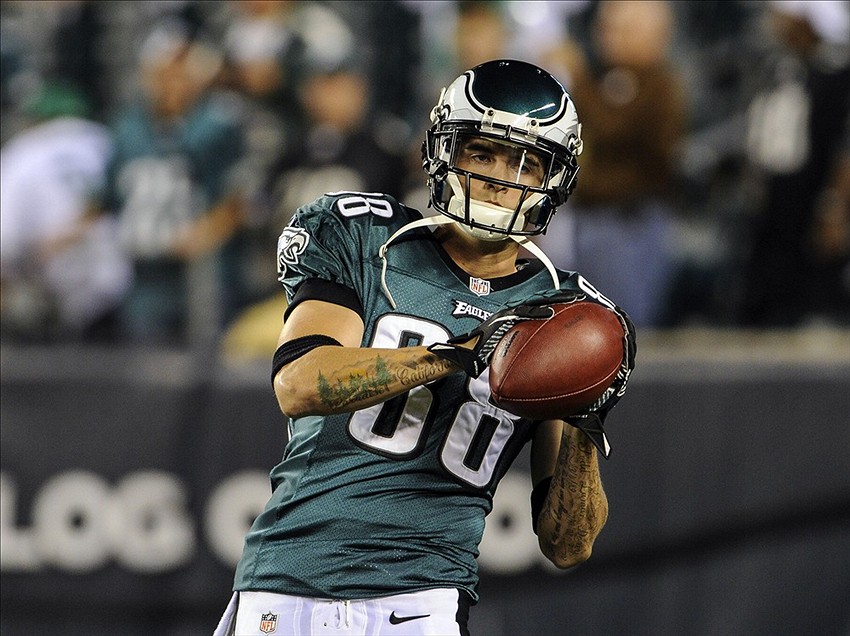
Wide Receiver: The Eagles passed on some “name” receivers in the first round in order to grab Smith, using the logic that the draft pool was deeper at receiver than at 3-4 outside linebacker. Time will tell if their calculated risk will pay dividends. As it is, they spent their second- and third-round picks on receivers – Jordan Matthews of Vanderbilt and Josh Huff of Oregon – and it would seem that they are locks to be the third and fourth receivers behind projected starters Riley Cooper and Jeremy Maclin.
Depending on how many players they won’t to carry at other spots – for an example, see above – they could justify going no deeper than five receivers on the active roster. The addition of all-purpose running back Darren Sproles and the break-out promise of second-year tight end Zach Ertz make it possible to carry just five receivers, with six being the absolute maximum. As such, the competition should be intense among a no-frills group. The frontrunners would be second-year Eagle Jeff Maehl, a good runner of routes who played for Kelly at Oregon and former 2010 Tampa Bay second-round pick, Arreloius Benn. Others with NFL experience are the well-traveled Brad Smith and third-year spare part Damaris Johnson. A wild card is B.J. Cunningham, a former sixth-round pick of the Dolphins who had a superlative collegiate career at Michigan State.
Cornerback: Behind returning starters Cary Williams and Bradley Fletchers, the Eagles have one of the league’s top slot corners in Brandon Boykin and a free-agent signee in Nolan Carroll, who has more than 20 career starts under his belt. In the fourth round of the draft, they positioned themselves to grab the first pick of the third day and drafted Jaylen Watkins out of Florida. Assuming those five make the roster, somewhat of a luxury already, the futures in midnight green don’t look so promising for returnees Roc Carmichael and Curtis Marsh.
Safety: Seen as the position of greatest need going into the offseason, the Eagles released the disastrous Patrick Chung and let Kurt Coleman and Colt Anderson ride off into the sunset of free agency. They spurned bigger names and signed Malcom Jenkins away from the Saints and decided to give former second-round pick Nate Allen a one-year deal. Meanwhile, 2013 fifth-round surprise Earl Wolff, who won a starting job before hurting his knee, is back in the fold. Chris Maragos, a free agent by way of Seattle, is a special teams ace by trade. However, like Braman, his papers say he is a safety. If the Eagles are going to carry five corners, it would seem that four safeties would be the max. This likely quartet was put on notice when the Eagles grabbed Stanford’s Ed Reynolds in what seemed like a draft steal in the fifth round. They also jumped on a priority undrafted safety in Daytawion Lowe of Oklahoma State. This would put Allen on the hot seat to win the starting job alongside Jenkins away from Wolff. If he can’t, he offers too little value on special teams to justify a roster spot.
Defensive End: This is a young group, headed by 2012 first-round pick Fletcher Cox and Cedric Thornton. Vinny Curry, once viewed as a poor fit for the 3-4 alignment, has worked his way into being a high-quality backup. They would likely carry one or two others at the position. Fifth-round pick Taylor Hart, an Oregon product, is well-known to Kelly and defensive line coach Jerry Azzinaro. However, the Eagles also return last year’s seventh-round pick Joe Kruger and Oregon product Brandon Bair from the practice squad. A lot of eyes will also be on sentimental favorite, Alejandro Vallanueva, the former Army standout and war hero.
Nose Tackle: The Eagles last pick of the draft, nose tackle Beau Allen of Wisconsin, may be among their most significant. If he can play 15-20 snaps per game, it frees up second-year man Bennie Logan to play some end. This would leave Damion Square without a real role on the team, barring a strong camp.
Kicker: A lot of media hype is swirling around kicker Carey Spear, a Vanderbilt product signed after the draft. Spear’s claim to fame, other than being a decent enough college kicker to be worked out by a handful of NFL teams and get a shot in a training camp, is making some terrific tackles that went viral on You Tube. A Vanderbilt student journalist dubbed him “Murder Leg,” and a legend was born. Now, for a dose of reality in the form of a question: Does “Murder Leg” have the length strength to kill the career of incumbent Alex Henery? Think it through as you watch You Tube. It is admirable that he hurled his chiseled body at returners, but let’s realize that he was making these tackles because his kickoffs were not reaching the end zone.
This analysis originally appeared on http://www.phillyphanatics.com
By GORDON GLANTZ
Gordonglantz50@gmail.com
@Managing2Edit
GORDONVILLE — The scene was the NFL Draft, 2014.
The Eagles sat at No. 22, the result of their mercurial rise from the outhouse to within one level of the penthouse.
Just as with property taxes, the change in address comes with a price.
The Eagles were just good enough to be picking post-20, but not good enough to mortgage the future to make a definitive move.
In a way, with more needs than the average 10-6 division winner, they were living in the slums of Beverly Hills.
All they could do was sit and waiting and listen to Dusty Springfield’s “Wishin’ and Hopin’” on repeat play as others in front of them mulled their choices.
And their hopes and wishes and prayers could not help them, as the script could not have gone any more awry.
The only player they probably would have traded up for, UCLA outside linebacker Anthony Barr, went at No. 9 to the Vikings. If he had drifted into the middle of the round, they could have made a move. To get into the top 10, it would have cost this year’s and next year’s first-round picks.
No can do.
As Eagles’ coach Chip Kelly admitted, the six players they targeted at No. 22 were all good when their turn in the chow line came around.
When the same New Orleans Saints team that eliminated them from the playoffs last year moved to No. 20 and snatched Oregon State receiver Brandin Cooks, the Eagles knew they gambled and lost.
Six minus six equals zero.
To their credit, they made a decisive move to Plan B.
While the television talking heads babbled about them drafting Johnny Manziel, the obvious move was to hold the pick hostage for a team that truly hungered for Johnny Football. They found a willing dance partner in the Cleveland Browns, moving back to No. 26 and picking up a third-round pick while they danced in the streets of Cleveland.
When their new turn rolled around, the possibilities seemed endless. There were still receivers, corners, defensive linemen and safeties available. They could even move back a few more slots, or into the early second round, for more picks.
And then Roger Goodell took to the podium.
“With 26th pick in the 2014 NFL Draft, the Philadelphia select “Mar …,” he said.
Thoughts immediately went through the permutations for the even the most casual observer. They were taking Marqise Lee, the USC wideout two years removed from finishing fourth in the Heisman balloting, and would come back in the second round – maybe packing one of their thirds with a second – for the coveted pass-rushing 3-4 outside linebacker.
And then Goodell continued.
“(Mar)cus Smith, linebacker, Louisville,” he said.
Who?
Eagles’ devotees who waited months for this moment probably grabbed their remote controls and wondered what happened, kind of like that final scene of the final episode of “The Sopranos.”
Not a bad player, all things considered, but it seemed like the panic button had been pushed. It seemed like a poorly played hand.
It seemed like if the word “reach” were four letters, it would fit.
But it is what it is.
In the interim, between picks 22 and 26, Auburn’s edge rusher, Dee Ford, went to Kansas City. There were rumors that the Super Bowl champion Seattle Seahawks were clamoring for Smith, albeit as a project.
For the Eagles, trading back too much further would leave them without him in midnight green.
While it takes a good three years to evaluate drafts, the early grade sits at a B-minus because the value chart shows they used a first-round pick on a guy rated as a late-second/early-third.
Some deft moves by GM Howie Roseman, like trading a third to Houston for fourth- (first pick of Day 3) and fifth-round picks, allowed them to add quality and avoid detention.
Aside from Smith, they did grab three other players – Vanderbilt receiver Jordan Matthews (second round), Florida defensive back Jaylin Watkins (fourth round) and Stanford free safety Ed Reynolds (fifth) – the consensus has as solid second-day picks.
That certainly helps the GPA, but not enough for the honor roll.
The Eagles, all told, seemed to have an uneven draft. The best-player-available format has seemingly morphed into the-best-player-available-for-our-scheme approach, which seems to be a trend around the league.
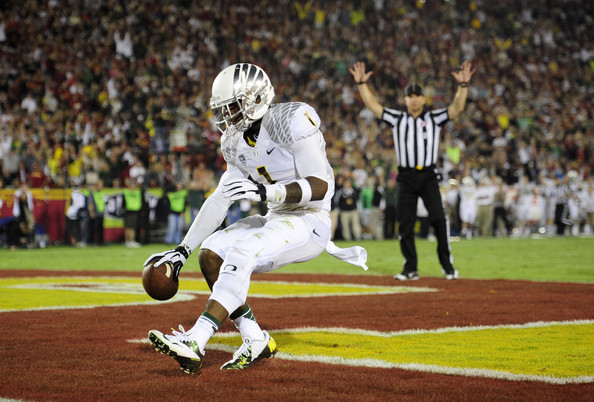
With the one third-round pick they kept, they made a slight reach for Oregon slot receiver Josh Huff, but you can almost issue a pass on it because he is a scheme fit, having played in Kelly’s offense in college.
That same could be said for fifth-rounder Taylor Hart, who will be reunited with defensive line coach Jerry Azzinaro. Hart, though, was rated as a seventh-rounder and could have likely been had there. Had they Eagles grabbed someone like Tennessee nose tackle Daniel McCullers in the fifth round and come back with Hart in the seventh, they would have gotten better value than Hart in the fifth and seventh-round nose guard Beau Allen of Wisconsin (moving up 13 slots after dealing running back Bryce Brown to Buffalo and getting back a mid-round pick either next year or in 2016).
There are no sure-fire immediate starters in this group, but we are talking about a 10-6 team that Kelly and Roseman are trying to build for the long haul.
The receivers – Matthews and Huff – are likely to make the most impact, but don’t discount the defensive backs, Watkins and Reynolds.
The reality is that NFL teams who miss on their first-round pick and nail all the rest do just fine, but we are talking about a fan base still haunted by the ghosts of Mike Mamula and Jon Harris.
Marcus Smith, for better or worse, has already been lumped into with Jerome McDougles and Danny Watkins.
He deserves more of a fair shake, because he is starting with an intense glare of naysayers on him. If you have any empathy in your football-lovin’ heart, you have to feel for Smith right now.
As the dust settles and the dawn rises on the aftermath of the 2014 NFL Draft, it will all be about him.
Free Birds
In the social media era, where undrafted players announce where they sign before teams can issue statements, the Eagles had no choice but to put out an official list of 15 undrafted players.
Perhaps because of the depth of the draft, or because of the scheme-fit trend around the league, the collection of players left undrafted was shocking.
Even more shocking was that the Eagles, usually one of the best at aggressively pursuing undrafted players, really didn’t rock the world here.
For example, Kelly singled out inside linebacker depth as a need. They didn’t draft one, but some big names – Stanford’s Shayne Skov, Florida State’s Christian Jones, Michigan State’s Matt Bullough, Penn State’s Glenn Carson, etc. – were out there to be had.
None came here.
With Brown gone, the Eagles did snare two running backs – Missouri’s Henry Josey and Toledo’s David Fluellen – that were generally graded as mid-round picks.
Daytawion Lowe, a hard-hitting safety from Oklahoma State who runs a 4.45 40, was also considered a late-rounder and is in the Bird house.
A kicker – Vanderbilt’s Casey Spear – was signed, but it seems they are trying to give Alex Henery token competition to placate a restless fan base.
The Eagles also brought in two tackles, USC’s Kevin Graf and Texas’ Donald Hawkins, with starting experience at big schools to compete for backup jobs.
Florida’s Trey Burton, despite being 6-2 and 225, will get a look at tight end after playing multiple positions for the Gators.
The column originally appeared at http://www.phillyphanatics.com


4/22/14
By GORDON GLANTZ
Gordonglantz50@gmail.com
@Managing2Edit
GORDONVILLE – It is better to give than it is to receive.
Yeah, well, maybe on the path to spiritual redemption, but not in the NFL.
There, in a modern-day survival-of-the-fittest model: the team that receives more than it gives away comes out on top.
By jettisoning pro bowl receiver DeSean Jackson, who promptly enlisted with the division-rival Washington Redskins, the Eagles left themselves an obvious hole in a receiving corps that seemed set.
Some felt they gave Jackson away, but that can’t be completely accessed until we know what they receive – by way of receivers – in the pending draft (May 8-10).
When Riley Cooper (17.8 yard average on 47 catches, including 8 touchdowns) was re-signed, as was Jeremy Maclin, it seemed the Eagles had the perfect pieces in place around Jackson. Veteran Jason Avant was even released, seemingly because his salary exceeded fourth-receiver money.
Then, after the Jackson bombshell, the whole picture changed.
At present, a once-clear picture suddenly looks a little murky.
Maclin has been a good, but not great player, but he missed all of last season with a torn knee ligament (the second since his college days). Cooper, it could be argued, had his career year because of space created by Jackson’s presence.
The holdovers on the roster – players like Damaris Johnson, Jeff Maehl, B.J. Cunningham, etc. – are either the best-kept secrets in the league or merely placeholders.
The team added the quintessential utility back in Darren Sproles, but is unclear if Kelly plans to use him as a slot receiver or as a much-needed option out of the backfield for less-than-mobile quarterback Nick Foles on obvious passing downs.
No matter what the role is for Sproles, who boasts such a full bag of tricks – including return skills – it is not likely Kelly will limit him to just being a slot receiver.
Top of the list
The general feeling, with what it is purported to be a draft class of incoming receivers that will make history, is that Eagles will retool with at least one – but maybe as many as three – at various points in the draft.
They can do so with a clear conscience, as the draft is so deep at receiver that one could theoretically be grabbed with each and every pick under their patented best-player-available explanation.
That won’t happen – too many glaring needs remain, particularly on the defensive side of the ball – but it is likely they will draft some receivers that fans can immediately dial up on You Tube and get excited about while watching clips that are more intriguing than pancake blocks.
Before we start naming names, a word of caution for rookie receivers is in order. No matter how talented – how freakish their size-speed ratio and vertical leaps – there is an adjustment to the NFL and the nuances of more complicated passing games. The defensive backs are equally athletic and more physical than in college, and the ball is coming out faster – and often with more velocity – from the quarterback.
In this sense, the Eagles are taking a gamble that they will get DeSean Jackson production, even if they spend their first-round pick (No. 22 overall) on the best stud wide receiver on the board.
The jewel of the class, Sammy Watkins of Clemson, is pegged to go in the top 5-10 picks. Most credible mock drafts slot him at No. 5, to the Oakland Raiders.
Next?
There are loud whispers that the Eagles are enamored with Texas A&M’s Mike Evans, who provided a big target (6-5, 225 pounds) for Johnny Manziel and knows how to use his size. However, following some strong personal workouts, Evans has moved from being projected in the middle part of the first round to the back end of the top 10. He could wind up going as high as No. 7, to Tampa Bay, where he can be teamed up with the receiver he’s most often compared to, Vincent Jackson.
That would remove two players from the Elite Eight, leaving six receivers that are all likely to be gone by the middle of the second round. Assuming the Eagles stand pat, a third could be off the board before their turn in the chow line.
Who will remain is uncertain.
Of the six remaining A-list receivers, three – USC’s Marqise Lee, LSU’s Odell Beckham and Oregon State’s Brandin Cooks – are created in the game-breaker image of DeSean Jackson.
Lee (6-0, 195), a 2012 Heisman Trophy finalist (he had 118 catches from Eagles’ backup Matt Barkley), is coming off a down year where he was battling injuries and was not in synch with Barkley’s replacement. Nonetheless, he is a top-end talent, with return skills, that Kelly knows well from coaching against him in the PAC-12.
The same could be said of Cooks, who switched places with Lee as the PAC-12’s premier receiver. The smallish (5-10, 186) speedster (4.49) led the BCS with, 1,670 receiving yards and claimed the Biletnikoff Award as the top receiver in college football last fall.
Beckham, like Cooks, is smaller (5-11, 193) and also runs a 4.49. He could project as a dangerous slot receiver with an array of decisive open-field moves. He also has extensive return game experience, having taken two punts to the house last season.
The other three top receivers who will likely be available – Florida State’s Kelvin Benjamin, Penn State’s Allen Robinson and Vanderbilt’s Jordan Matthews – are all at least 6-3. As such, they are considered in the mold of the big receivers – Antonio Bryant, Anquan Boldin, etc. – that teams covet. Another taller wideout, teamed with the nearly 6-4 Cooper and the 6-5 Ertz, could make the Eagles hard to defend in the red zone, with the 6-6 Foles looking over the defense and lofting the passes.
Best of the rest
If the Eagles elect to go defense in the first round, which is a distinct possibility, they would be doubling down on their roll of the dice of letting Jackson walk away for nothing but cap space, as it would be a big break if one of the top eight receivers would be on the board in the late second round.
The most likely to last would likely be Vanderbilt’s Matthews, who comes with some intriguing credentials. He is a cousin of Jerry Rice and, while they barely know one another, he reportedly has the same work ethic. He caught over 100 passes last season. His long-term ceiling might be the lowest, which is why he could last longer in the draft. However, his more developed route tree could see him as the most productive rookie, even more so than Watkins or Evans, out of the gate.
That group would include LSU’s Jarvis Landry, who is considered the best blocking receiver in the draft, which surely won’t be lost on Kelly, who puts a premium on that skill. Another is Mississippi’s Donte Moncrief. At 6-2 and 226 pounds, with jets timed at 4.49, he is considered to be a first-round talent who has yet to put it all together. And given Kelly’s penchant for Oregon players, Duck alum Josh Huff – another solid blocker who not only built like a running back (5-11, 211), but also runs like one after the catch – is a name to watch.
Draft wild cards are Wyoming’s Robert Herron, who is among the fastest (4.3 range) but among the smallest (5-9, 193), and South Carolina’s Bruce Ellington, an outstanding all-around athlete who played point guard for the Gamecocks during basketball season and could help immediately as a returner while learning the be a full-time receiver. Ellington, though, is also 5-9.
Names to Remember
The draft also includes the traditional boom-or-bust types, like Davante Adams, who is 6-2 and around 215 pounds and caught 233 passes from touted prospect Derek Carr for a Fresno State team that feasted on some inferior competition. Another is Colorado’s Paul Richardson, who is 6-3 but only 180 pounds and seems automatically pegged for a West Coast offense (Kansas City, Green Bay). Clemson’s Martavis Bryant is 6-4 and 200 pounds and runs a sub-4.4 40, but only started one year.
Conversely, guys were highly productive but don’t seem quite big or explosive enough to be starters. This list would include Mike Davis of Texas, Ryan Grant of Tulane, T.J. Jones of Notre Dame, Devin Street of Pitt, Cody Latimer of Indiana and Kevin Norwood of Alabama.
There are the smurf types that will get looks because of the success of Chief-turned-Titan Dexter McCluster as a slot receiver/returner. Kent State’s Dri Archer (5-7, 175) runs a 4.37 in the 40), Oklahoma’s Jalen Sanders (5-9, 164), Michigan’s Jeremy Gallon (5-8, 183) plays hard enough to earn a roster spot while Baylor’s Tevin Reese (5-10, 170) had 25 career touchdown passes, 22 of which were from more than 40 yards out.
There are also the crafty possession-type receivers that will have teams in search of the next Wes Welker. This list includes Jared Abbredris of Wisconsin, Michael Campanaro of Wake Forest and Alex Neutz of North Dakota.
Northwestern’s Kain Colter, the college quarterback who made news for organizing a push for college athletes to unionize, is just under 6-0 and 200 and hoping to “catch on” as a receiver (i.e. New England’s Julian Edelman, who played quarterback in college). Norman Rae’s attempts were somewhat derailed because an injury kept him from the combine and offseason workouts.
Late round steals could include Costal Carolina’s Matt Hazel and BYU’s Cody Hoffman, who had a 100-catch season as a junior but struggled as a senior (57 catches). Still, at 6-4 and 218 pounds – and with big hands and highlight-reel catches on his resume – he reminds scouts of Cooper.
Beyond Hazel, the small-school list includes Jeff Janis (6-2, 212) of Saginaw Valley State and Ryan Culbreath of Furman.
Because of the draft’s depth, the guys who never quite put it all together will get pushed down — or out — of the mix altogether, while probably being late-round picks in other years. That would include UCLA’s Shaquelle Evans, Brandon Coleman of Rutgers and L’Damian Washington of Missouri.
This analysis originally appeared at phillyphanatics.com

 ingordonville