
“Is a dream a lie if it don’t come true,
or is it something worse?”
-The River
By GORDON GLANTZ
Gordonglantz50@gmail.com
@Managing2Edit
GORDONVILLE – In 1970, John Lennon gave us a song called “Instant Karma.”
He said it was “gonna get you, gonna knock you right in the head.”
Came across as a positive song, but here we are – more than four decades down the road – and it sounds more like a warning.
While “karma” seemed like a cool word, with its groovy Age of Aquarius thing going on, it might be the word “instant” that resonates as a negative.
We have instant messages, instant food and instant replay.
In the sports world, we have something more insidious.
We have the scourge of instant glory.
Good athletes are dubbed “great” and, in some cases, instant cases are made that they are among the greatest of all time at their given craft.
Greatness, in the sports context, really shouldn’t be a matter of boiling some hot water and pouring into a powder of instant oatmeal.
But it is.
And it cheapens the definition. It equates to erecting a golden calf in lieu of instant answers while the obvious rules of law on these matters are etched into a tablet for posterity.
Halls of fame purposefully build in a waiting period, as they are designed to store only the legacies of the greatest of the great. Time – with hindsight, reflection and some meditation – needs to pass.
Individual sports franchises, however, can operate with a lowered bar and more gray area. They can go more with their gut, and do with increasingly mixed and sordid results.
Franchises grant immortality to their icons is by retiring uniform numbers. Many also have their own versions of halls of fame. And, without much rhyme or reason, they can do what they want within their fiefdoms.
If that means honoring a player who recently retired, which gives current fans instant attachment without having to search their memory banks or page through history books, so be it.
Time, and its natural portals and passages, gets snubbed.
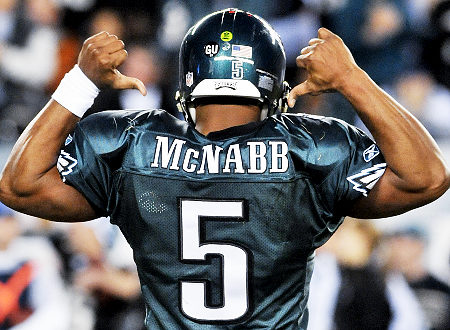
Which brings us to Donovan McNabb, the longtime Eagles quarterback who perfected the art of getting his team to the big dance – often while looking spiffy in a tux and limo – only to stand in a corner and become a wallflower once there.
On Thursday night, largely based on McNabb’s statistics – accrued in a pass-happy offense in a pass-happy era – he will be honored at halftime before what will likely be a tepid crowd.
Why now, when the ink isn’t even dry on his official retirement papers?
Instant marketing, that’s why.
His old coach, Andy Reid, is in town as the first-year guide of the Kansas City Chiefs. It’s on national television.
It’s an event.More Broadway than Broad Street.
It gives Eagles Nation something to cheer for after a 4-12 nightmare of a season; something to make them feel the emptiness of instant joy during what looks to be two or three more years of rebuilding in the wake of what Reid left behind.
McNabb, based on his tenure – 1999 to 2009 – and aforementioned stats, which include 14 franchise passing records, deserves a halftime ceremony at some point. He did get the team to five NFC title games and one Super Bowl, even though he came up empty in the Lombardi Trophy department.
But now? In 2013?
Tastes like instant coffee instead of brewed.
Moreover, they are not just bringing him out onto the field to be recognized, followed by a place in the team’s own little Hall of Fame, which is a rather harmless waltz.
They are going one step beyond, and across the line.
They are going so far as retiring McNabb’s No. 5.
It is a major stretch that borders on embarrassing.
When you go into any stadium or arena in this sports-crazed town, one common thread is that the retired numbers hanging from the rafters are beyond reproach.
Even with the passage of time. Even when Timmy Jr. has to ask Timmy Sr. who the player is or was and what that player accomplished. The father-son exchange happens with a lump in the throat and goose bumps.
Consider the names:
And Donovan McNabb, the first quarterback of the bunch.
Not Norm Van Brocklin (1960 championship). Not Tommy Thompson (1948 and 1949 championship teams). Not Ron Jaworski, the signal-caller on the other Super Bowl team that came up short.
Just McNabb.
Rings hollow, like a riddle that fails to rhyme.
Cull together a 10-person panel – drawing from national and local media, Elias Sports Bureau numbers crunchers and fans ranging from old to young and casual to intense – and you will get 10 viewpoints on McNabb’s legacy, whether it is fair and just to retire his number and if he is even a remote candidate for Canton, Ohio’s Pro Football Hall of Fame.
Just the fact that that opinion would be split should tell you all you need to know on whether he is worthy.
Could you imagine the same vibe when the Phillies retire Chas Utley’s number one day? If the answer is no, then it should be no to McNabb.
To be fair, Donovan McNabb was a good quarterback. He was the NFC Player of the Year in 2004, the same season the Eagles went to the Super Bowl, where he threw three interceptions in a 24-21 loss. He was in six Pro Bowls, although several appearances were as an alternate in place of quarterbacks who advanced deeper in the playoffs.
He had his chances to be great and, like so many others whose numbers are never even on the radar to be retired, and let a lot of people down. His penance should be an acknowledged legacy a step shy of a retired number.
But that’s not what is happening. We are in an era of instant everything, so we are being forced to swallow a microwaved legacy that has yet to be digested.
In an 80-year franchise history, one quarterback whose admirable physical toughness – his willingness to take a hit or play hurt, failed to match his mental toughness when it came to big moments – is not to blame for the 53-year drought since the last championship.
But he should not be honored without the proper passage of time.
Too much bitterness lingers.
And no instant recipe can make it taste sweet.

Gordonglantz50@gmail.com
@Managing2Edit
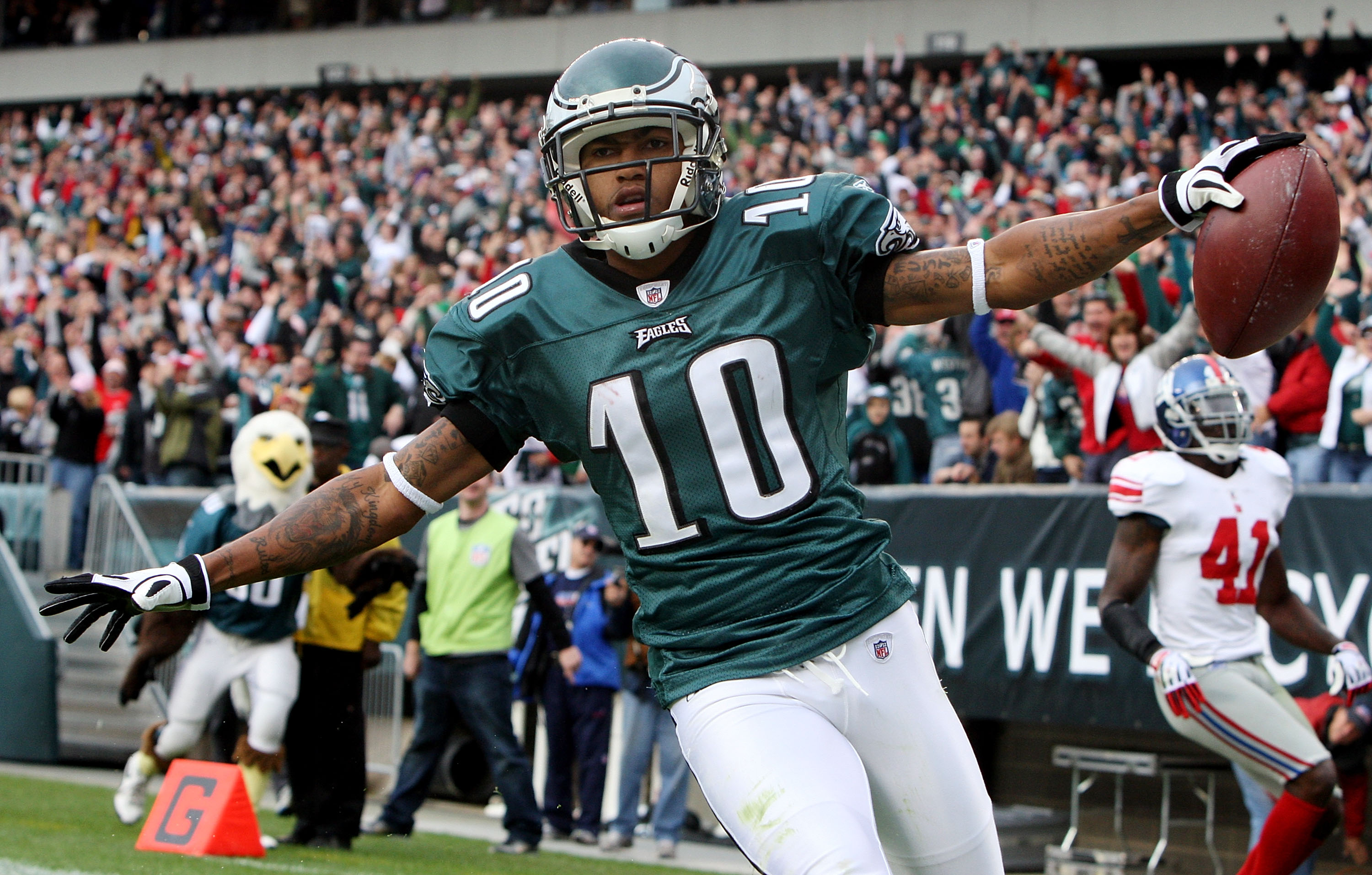
The unrelenting sports news cycle, which keeps its head on a swivel runs a 4.4 40 in the world of the NFL, got some mileage out of Monday night’s sideline skirmish between Eagles’ wide receiver DeSean Jackson and Redskins’ corner D’Angelo Hall.
Not only did Hall draw a mindless personal foul penalty for a late hit that was – both literally and figuratively – well out of bounds, but it came after Jackson had left Hall in the dust on a touchdown that was the centerpiece of the frenzied scoring spree that sent the Birds into halftime of their eventual 33-27 road win with a 26-7 lead and made them the source of league-wide buzz.
Jackson bounced right up and shoved back, but drew no flag.
The two notoriously impulsive players, known more for being temperamental than temporal, continued to jaw during and after the next play, exchanging another shove while Jackson allegedly took time to flash a gang sign at the same player who taunted him prior to a 2010 Monday night game that ended in a huge win for the Birds.
A bad sign.
For those who sit on their high horse and look down in disgust at such unsportsmanlike behavior, perhaps it was.
But this is Philly, the home of long-suffering fans impetuously waiting to end a 53-year championship drought of the franchise they would most like to see win a championship, if only because it is the team that has gone the longest without one.
If an opponent got under Jackson’s skin last year, it was because the Eagles were losing and he was frustrated. And because of the negative karma swirling around the team, like flies to you-know-what, he would have surely been flagged for retaliating.
This time around, the Eagles were winning and nobody was going to break his stride. Not even the official dared.
When Jackson got into Hall’s face, it was a statement: You may have pushed us around in the recent past, but not anymore.
Cast in that light, it was all good.
As Grace Slick of the Jefferson Airplane proclaimed to the rain-soaked throng at Woodstock: “It’s a new dawn.”
The Eagles are coming off a 4-12 season, the last of the unnecessarily prolonged Andy Reid era.
They have been that bad, record-wise, before. And they probably will be again. Who knows? Maybe even this year, meaning that Monday’s barrage was a mirage.
But last season was played with no heart, no soul.
It just wasn’t Philly, watching abominations like tacklers being dragged into the end zone and opposing receivers prancing across the middle like carefree kangaroos in the Outback.
This is supposed to be the place where the fictional Rocky Balboa was so believable because of the backdrop. Instead, it was like having a cheesesteak with tofu instead of whiz.
The Eagles were getting knocked down, and not getting back up.
They were throwing in the towel.
And the coach, Reid, uttered one-word answers and acted like the long-suffering fans wouldn’t understand the devilish details if he did care to explain.
He was canned on the last day of 2012.
Chip Kelly, after initially turning down the job, was hired a few weeks into 2013.
New Year, new life.
At his introductory press conference, the wunderkind from the University of Oregon, by way of New Hampshire, said he had spoken with a gracious Reid and declined to take the bait and say anything negative.
Owner/Whatever-Else-He-Calls-Himself Jeffrey Lurie spoke glowingly about Reid as well, talking about a day – certainly not next Thursday night, when Reid’s Kansas City Chiefs come to town – when the coach who went 1-4 in NFC Championship Games and 0-1 in Super Bowl appearances during his 14-season run would be honored by the franchise.
And then all hopeful, albeit skeptical, eyes turned toward the future.
There was a solid draft (on paper), post-workout smoothies, racial epithets at a country concert, a quarterback controversy, a 2-2 preseason and peculiar final cuts that left us with as many question as answers about an overhauled roster and new schemes on both sides of the ball.
In reality, it was a way to pass the time until the season-opener against the Redskins, which the rest of the nation saw as more of a return of Robert Griffin III from offseason knee surgery, with a cute sub-plot about Kelly’s fast-break offense that probably would come up short on the scoreboard but would be fun to watch.
And then came game time, and the clear signs that this Eagle team under Kelly couldn’t be any different than Reid’s.
Introductory press conferences and first days of mini and training camps aside, it marked Kelly’s arrival. And Reid’s departure.
The ghost of Big Red was officially put to rest Monday. Call it an exorcism.
Post-game, holdover players talked about having pure and unadulterated fun for the first time in their pro careers.
If that was enough of an indictment of Reid, and how stale of a soft pretzel with no mustard his approach had become, Kelly inadvertently kicked dirt on the grave of his predecessor with a comment in a post-game press conference in which he said more of substance than Reid probably did in a season.
“It is still a game. I think sometimes we take ourselves too seriously,” said Kelly, whose fast-talking – in full sentences, no less – is earning him the nickname “Machine Gun.”
He then added that he, like the players, had fun as well.
Reid, as we know, took himself way too seriously to have fun coaching what is a game. The players are professionals, not kids at recess, but it was still obvious they were following his dour lead in the way they went about their business.
Make no mistake, winning helps.
And the Eagles won Monday.
But the change in culture, which is probably more important than the won-loss record this season, is alive and real.
The standard prediction for the Eagles this season falls between 5-11 and 7-9, and Monday’s win – which was way closer than it needed to be – really shouldn’t change that gut feeling.
This team is much like the 1986 Eagles, which went 5-10-1 in the first year of Buddy Ryan’s coaching tenure but laid the groundwork as holes were filled to fit the new personality.
The year before, they were a boring 7-9 under Marion Campbell (technically 6-9 under Campbell, as they won the final game under interim coach Fred Bruney), but no one dare argue they were better off.
“You got a winner in town,” were Ryan’s first official words when introduced as the new coach.
Despite a step back on the tally sheet in the first year, no one dared to doubt it.
There was a new attitude, a new pride, a new sway.
They were young and tough and opponents, even more talented opponents, were not thrilled about having them on the slate.
The Eagles were getting their groove back.
What goes around generally comes around.
And it’s coming around again.
Enjoy.
“If there were an Olympic event for finding the one puddle in a driveway to throw the morning paper, I believe our delivery guy would win the gold medal …”
By GORDON GLANTZ
Gordonglantz50@gmail.com
@Managing2Edit
GORDONVILLE — The country elected its first Roman Catholic president.
The movie “Psycho” gave moviegoers thrills and chills.
A postage stamp cost four – yep, four – cents.
It was the year of the underdog. The Pirates topped the Yankees, 4-3, in the World Series while the U.S.A. Olympic hockey team believed in their own miracles at Squaw Valley by outlasting the likes of the Soviet Union and Canada to win the gold medal.
How many of you remember where you were for all these events in 1960, which, fittingly, was a leap year? Probably not too many. That was 53 years ago, so you were probably too young to fully comprehend what was going on, or not yet with us.
This is the hard historic fact facing the restless Eagles Nation, as 1960 was also the last year Philadelphia’s beloved professional football team – not counting the Stars (1984) of the USFL or the Soul (2008) of the Arena League – laid claim to the championship.
Heck, to put 1960 in historical perspective, there wasn’t even a Super Bowl yet. That didn’t come until 1967, when Vince Lombardi’s vaunted Green Bay Packers toppled the Kansas City Chiefs, 35-10.
The Packers would go on to win second Super Bowl (33-14 over Oakland). The trophy for winning the Super Bowl is named after Lombardi. Despite two appearances in the big dance, it is a trophy the Eagles have yet to hoist in front of their fans.
It should be noted that the 1960 Eagles, with a 17-13 win on Dec. 18 of 1960 at Franklin Field, were the only team to ever to beat Lombardi in a championship game.
That factoid, along with the ongoing wait, has made names like Bednarik and Van Brocklin and McDonald take on mythical proportions, like Greek gods who earned their legend in an ancient stadium.
In 1960, Eagles fans – our grandfathers and fathers – likely didn’t think it would be another half-century and counting until the Birds would win another championship. The franchise had won titles in 1948 and 1949 after coming up short in 1947, but the Eagles had become one of the worst teams in football by the end of the 1960s.
Until another Eagles’ team comes along to win it all – thus ending the longest championship drought of the city’s four major professional teams – that ghost of 1960 will continue to haunt.
A Super Bowl win – not just an appearance (1981, 2005) – remains at the top of the bucket list for the war-weary members of an Eagles Nation that is known more for its snowballs than its patience.
But here they are, with a new coach and new five-year plan to cross the desert and reach the Promised Land.
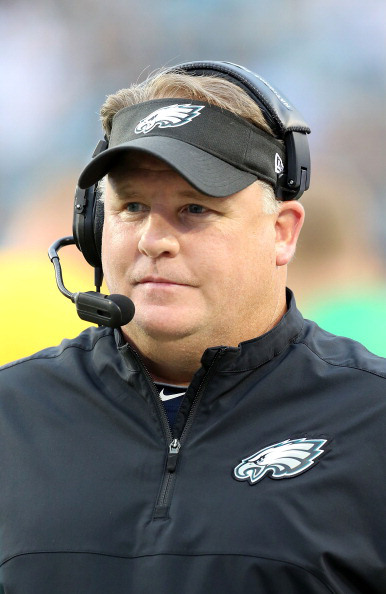
The new Moses figure is Chip Kelly, the coach the current ownership sweet-talked out of his college fiefdom at the University of Oregon.
Kelly said no to the initial prom invite, but changed his mind when owner Jeffrey Lurie and general manager Howie Roseman were about to pull the trigger on Gus Bradley. The defensive coordinator in Seattle, Bradley has since been hired as the head coach in Jacksonville, locking himself with Kelly forever as a point of comparison.
Kelly arrives with a promise to revolutionize the sport, with what amounts to a hurry-up offense that will be fun to watch – at least until defenses catch up to it – and provide more frank talk than his droll predecessor, Andy Reid.
Will the entertainment lead to the ultimate prize, or will the ghost of 1960 loom ever larger as the years flip on the calendar?
The first step begins Monday night in Washington, where their Redskins run a bastardized version of Kelly’s read-option attack.
The 16-game grind of Year One of the Kelly Era will likely be strewn with peaks and valleys and growing pains. The success will be measured by knowing how close, and yet how far, the team is from 1960.
Kelly enters this season with a mixed hand. Some of the cards were dealt to him by the last coach, while others he and Roseman culled together from the draft and the street corner.
As of Tuesday, there were 21 new players on the 53-man roster. There are nine rookies and 15 others with two or fewer years in the NFL. Still, many familiar faces are being counted on to play key roles in any possible taste of future glory.
Let’s take a closer look:
OFFENSE
Coordinator: Pat Shurmur (Kelly will still call the plays).
Key Assistant: Jeff Stoutland (the offensive line coach from Alabama brings in a new blocking scheme vastly from that of Howard Mudd).
System: Read option, with some West Coast elements in passing game.
Quarterback: Michael Vick seemed like the epitome of the Andy Reid regime and the player least likely to return. But here he is, after accepting a cut in salary and winning a battle with second-year man Nick Foles, to run the show. He is the clear-cut team leader, which is likely the hidden reason Kelly gave him the keys to the car with hopes he doesn’t get into too many fender benders. The system is quarterback-friendly, in terms of safety valves and options, but it remains to be seen if the 33-year old Vick will make the right choices. If the 12-year veteran is the proverbial leopard that doesn’t change his spots, Foles and rookie Matt Barkley are waiting in the wings. Grade: B

Running Back: The Eagles have one of the best groups in the league, boasting a top-five back in LeSean McCoy (above). Bryce Brown, the second-year backup, has starter talent, but is still working to cure his fumbilitis. Chris Polk, also in his second-year, is the most physical runner and best blocker of the group and should get a few totes each game. All will benefit from running behind what is generally considered one of the league’s 10 best offensive lines – if healthy – and a consistent commitment to the ground game, which is also something new to Philly. Grade: A-
Receiver: The team was dealt a big blow early in camp when Jeremy Maclin was lost for the season with a knee injury. DeSean Jackson, after several sub-par seasons, claims to be reborn under Kelly, who will likely make it a part of the game plan to use Jackson as more than just a go-deep-kid decoy. Expect a lot of designed bubble screens, quick hitches and reverses to make defenses readily aware of Jackson again. Riley Cooper received a battlefield promotion to the starting lineup when Maclin went down. While he lacks the same explosiveness, he is a stellar downfield blocker, which is a required skill in this offense. With his size (6-3, 222) and hands, Cooper should be a better option in the red zone than Maclin. Jason Avant continues to excel at slot receiver, finding open spaces and making all the catches. Fourth receiver Damaris Johnson may be used a bit in a similar fashion as Jackson and will likely be the primary return man. For now, at least, Oregon product Jeff Maehl is the fifth receiver but may not be activated on game day. Grade: B
Tight End: Kelly must have thought so much of his top three – veteran holdover Brent Celek, free agent signee James Casey and second-round pick Zach Ertz – that he let a legit NFL-caliber player walk in Clay Harbor in the final cuts, opting instead to keep blocker/special-teamer Emil Igwenagu (even though he retained practice squad eligibility). This isn’t a bad group. Expect to see two and three tight ends on the field a lot, but the lack of top-tier threat will not have opposing defensive coordinators tossing and turning at night. Grade: B-
Offensive Line: Keep those fingers crossed, fans. There are a lot of “ifs” around this group, but “if” it all works out, the Eagles can ride this group to some surprising victories by keeping their defense off the field and paving the way to plenty of points. Health is the main concern. Jason Peters returns for the first time in two seasons. When healthy, the left tackle is the quintessential man among boys. The claim is that he is looking good, so … fingers crossed. Center Jason Kelce (left), tabbed by experts at watching centers as a Jeff Saturday clone, is also coming off a knee injury that put him on the shelf last season. With the left-handed Vick winning the quarterback battle, rookie first-round pick Lane Johnson is charged with protecting his blind side instead of Peters. If he gets beat a few times, which is inevitable in the learning curve, will it change how Vick plays? Todd Herremans will play alongside Johnson at right guard. One of the better offensive linemen to have never made the Pro Bowl, Herremans has also battled dents and dings the last few seasons. Evan Mathis, the only starter to make it all the way through to last season’s ugly end, gets the pleasure of lining up between Peters and Kelce and should do well there. The backups are a little shaky. Dennis Kelly, who played a lot of right tackle last season, is currently hurt and won’t be ready for a few weeks. Julian Vandervelde, a guard by trade, was taught to play center in the offseason and it would be a big drop off if Kelce went down again. Rookie free agent tackle/guard Matt Tobin had a good camp and was kept over first-round bust Danny Watkins, but he is still a rookie free agent. Right now, the first man off the bench at tackle or guard will be six-year journeyman Allen Barbre. Grade: B+ (only because of the lack of depth)
OFFENSE GPA: 3.15
How to improve the grade: Stay healthy on the offensive line, allowing the running backs to gallop free in what should be a healthy 50-50 run-pass split in the game plan. McCoy could challenge for the league lead in rushing and yards from scrimmage, even with Brown and Polk getting some carries. If this happens, Vick should find a comfort zone. It he doesn’t, we’re revisiting a past we don’t want to see.
How to fail: Suffering injuries on the offensive line, and/or Johnson struggling, could spell doom. Also, if none of the receivers – including the tight ends — really step up and consistently hold onto the ball and make plays. Several guys in this group have the talent to make names for themselves (or in Jackson’s case, reclaim his place as an elite player), but there is no guarantee. The dink-and-dunk passing game, with the option for select shots downfield, could get predictable in a hurry without everything really clicking.
DEFENSE
Coordinator: Billy Davis
Key Assistant: Bill McGovern (Charged with coaching the suspect outside linebackers, he has coached on the collegiate level for 27 years but has no NFL experience).
System: 3-4 (most of the time, we think)
Defensive Line: This appears to be the strength of the unit, if only by default. If you don’t have a nose guard in a 3-4, you may as well scrap the whole system. Veteran Isaac Sopoaga, signed from the San Francisco 49ers, is not a superstar but he knows how to play the position. Oddly, if we see him taking around 30 percent of the snaps, it means he is doing his job on running downs and getting off the field to give way to others in different packages. Second-year man Fletcher Cox, the first-round pick from 2012, and self-made man Cedric Thornton both look like the real deal. Additionally, 2012 second-round pick Vinny Curry appears to be a better fit for the defense than anyone expected. Rookies Bennie Logan and Damion Square can play either nose or end and have promising futures. Clifton Geathers, perhaps because of his freakish size (6-8, 340), curiously remains on the roster. Grade: B
Linebacker: This is where it gets a bit dicey. Surprisingly, the Eagles kept only three outside linebackers on the roster, jettisoning both Chris McCoy and Everette Brown after strong preseasons. Only Connor Barwin, the free agent, has experience at the position. Longtime defensive end Trent Cole and third-year man Brandon Graham, who was coming into his own at the end of last season as a defensive end, are still learning on the job. They each seem fine going forward, stuffing the run and getting after the passer, but expect opposing quarterbacks to simply audible out of runs when Cole and/or Graham are on the field and throw swing passes to backs and tight ends out in the flat. Until they can prove they can handle the inevitable challenges, expect to see these types of plays a lot early in the season. Inside, DeMeco Ryans and Mychal Kendricks have looked comfortable. Kendricks, in his second year, is being touted as a three-down linebacker and don’t be shocked if he takes his share of snaps outside to help in coverage. Clay Matthews, rookie free agent Jake Knott and Najee Goode are the backups inside. Matthews and Goode – signed off waivers from Tampa Bay, prompting the semi-shocking release of Emmanuel Acho – may also see time on passing downs. All three should excel on special teams. Grade: C-

Secondary: The Eagles were one of the worst in the league last year, despite some big names at the cornerback position, giving up 33 touchdown passes. Brought in as free agents were Cary Williams and Bradley Fletcher, and each seem be cast in roles a notch above their comfort zones. Williams was the No. 2 corner with the Super Bowl champion Baltimore Ravens and now becomes the No. 1 here, drawing the opponents’ top receivers. His competitive fire is encouraging, but will wear thin with the fans if he reminds them of Izel “Toast” Jenkins. Fletcher, more of a nickel corner after a knee injury derailed a promising career in St. Louis, is the No. 2 corner. The most talented corner, Brandon Boykin, is deemed too small (5-10, 185) to play outside and is ticketed for the slot – for now. Shaun Prater, a special teams ace, was signed off waivers. Rookie Jordan Poyer, the seventh-rounder who seems like a slow-footed hustler, hangs onto a roster spot for now. Ditto for injured Brandon Hughes, who is known mostly for special teams play on what was a horrid unit the last two seasons. At safety, there are more questions than answers. Patrick Chung, the free agent from New England, has been christened the prize possession of the group, which is kind of like being the prettiest girl in Boys Town. Nate Allen (above) is the other starter – again – but only because he temporarily fended off a challenge from fifth-rounder Earl Wolff. Kurt Coleman returns, as does Colt Anderson, with the hopes that they do most of their chasing of the opposition on special teams. Grade: D+
DEFENSE GPA: 2.0
How to improve the grade: Be in the top 10 in the league in every category that equates to pressure on the quarterback – sacks, hits, hurries, pressures, knockdowns – to limit the outside linebackers and defensive backs being exposed. While the Eagles should be able to stop the run, this is a pass-first league and it could get ugly. A player like Cox or Kendricks needs to emerge as a budding star to build around, while Boykin pushes Williams or Fletcher out of the starting lineup.
How to fail: The line must fulfill its preseason promise, both in terms of generating pressure without the benefit of all-out blitzes and stuffing the run. If not, the record numbers of last year will not likely be reversed.
SPECIAL TEAMS
Coordinator: Dave Fipp
Kicking/Punting: Alex Henery is not considered an elite placekicker, but that is mainly because he hasn’t had the chance to put up gaudy numbers. He is accurate, particularly inside 50 yards, and a change in his approach on kickoffs has made him automatic lock for touchbacks on kickoffs (at least until the late-season winds swirl). Punter Donnie Jones fended off a strong challenge from rookie Brad Wing and looks to be the team’s most effective punter in years, maybe since Sean Landeta. Neither should have to worry about dealing with bad snaps. Long snapper Jon Dorenbos is of the best at his craft. Grade: A-
Coverage Units: With Henery looking strong on kickoffs and Jones able to consistently flip the field on punts, games can be stolen if the coverage teams perform an about-face from what we have seen from Bobby April’s units under Reid. With Fipp, there appears to be a culture change. The roster is loaded with players – Anderson, Coleman, Matthews, Goode, Prater, Boykin, Igwenagu, Hughes, etc. – known for being strong special-teams specialists. Rookies like Knott and Poyer and Wolff helped themselves by doing the same. Grade: A-
Return Game: While Johnson has been electric, picking up where he left off last season, ball security and judgment are concerns. Jackson, Kelly claims, will still get opportunities to reclaim the mantle of being one of the game’s most feared punt returners. Boykin, too, will get opportunities on kickoffs, and has some skills. Grade: A-
Special Teams GPA: 3.75
How to improve the grade: A lot of time has been invested in special teams since Kelly took the reins, and the back half of the roster clearly reflects that the units being a priority is not just lip service. All the players have to do is play how they have been coached. This is one spot in the team where the pieces are in place.
How to fail: Henery could hit a wall, but it’s unlikely. And the young players on the field could lead to some mental errors and costly penalties that ultimately turn possible wins into frustrating defeats.
SCHEDULE
The league has done the Eagles no favor with the schedule. After opening in Washington on Monday night, they return home the following Sunday to take on San Diego and, five days later, to welcome back Reid and the Kansas City Chiefs on a Thursday night. That is followed by three difficult road games – at Denver, in the Meadowlands against the Giants and at Tampa – before home games with Dallas and the Giants again. That’s a lot to ask from a young team still finding itself. What the Kelly-coached Eagles have on their side is the element of surprise, a polar opposite from the last few years when they were painfully predictable under Reid. They also bring an everything-to-gain-and-nothing-to-lose approach, which can be dangerous. If they can get through those first six games at 3-3 and can be 4-4 at the midway point, perhaps a playoff push in a weak division is not out of the question. Realistically, though, it’s not 1960. The next leap year is 2016, a more realistic target to break the spell and recreate the mythology for future generations.
THE CRYSTAL BALL
The X-factor in the NFL is always injuries. If a division foe gets ravaged, like the Eagles were last season, maybe a 9-7 ceiling exists, but that is extreme. This team, tops, is 8-8, with all the bounces and breaks that sometimes accompany beginner’s luck with rookie coaches. That would include the special teams units stealing a game or two and pulling out a few wins by virtue of having the ball last. The bottom, the floor, is 4-12. But that would only be with the injury bug hitting here – again – and/or the first-half schedule proved too tall of a mountain to scale. Realistically, this is a transition year. Despite having a Player of the Year candidate in McCoy, we are looking at 6-10.
Originally appeared at http://www.phillyphanatics.com.

“I don’t know why nobody told you
How to unfold your love
I don’t know how someone controlled you
They bought and sold youI look at the world and I notice it’s turning
While my guitar gently weeps
With every mistake we must surely be learning
Still my guitar gently weeps”
George Harrison (The Beatles)
-While My Guitar Gently Weeps
I know I should be paying closer attention to the actual Capitol Hill banter on the seriousness of a sticking our beak into Syria‘s Civil War, but I have been overcome with one overpowering question: How is it that that that women with Southern twangs sound so sweet and sexy and the men sound like such jackasses?
So tonight you better stop and rebuild all your ruins, because peace and trust can win the day despite of all your losing.
Led Zeppelin
-Immigrant Song
By GORDON GLANTZ
@Managing2Edit
GORDONVILLE – As we sat around the dinner table – you know, kind of like “The Waltons” (Sofia even insists we take turns saying grace, which is a challenge when it’s my turn because I feel I need to leave the word God out of it) – we commenced discussing this Syria situation.
It was Saturday, and my head was still spinning from Temple’s 28-6 loss/moral victory against Notre Dame (my young Owls were 30-point underdogs) and the Eagles’ inexplicable roster cuts (no Chris McCoy, really?), but CNN on in the background helped refocus the conversation.
My mother, Sofia’s Nana, seems the most obsessed about it (you know seniors, when they get stuck on something). The wife, Sofia’s Mama, seeks a solution as an intellectual challenge.
Me? I don’t see why the Eagles need six cornerbacks on the active roster when two have broken hands …
Oh wait, Syria.
Yeah, that’s a tough call.
Damned if we do, damned if we don’t (and damn, don’t I enjoy the freedom to use a word like “damned”).
“Kind of reminds me of the Kobayashi Maru,” I said.
“Wait … what?” said a little voice.
Yeah, that was Sofia, already talking like Taylor Swift as an incoming missile of a first-grader.
I know, right? (Yep, she says that, too).
So I had to explain that it was not a new Japanese restaurant, which was important to clarify since her Mama has a Sushi addiction (I’ll have to save that line for a song).
It derives from the alternate universe that is Star Trek. As Trekkies know – I am a hidden Trekkie, as I’ll watch the original series for hours but not be caught dead at a convention – the Kobayaski Maru, while not a bad name for a high-end Japanese food joint, is a Starfleet test.
Cadets, as shown in the opening scene of the fine flick “Star Trek II: The Wrath of Khan,” have to find a way to survive in a simulated no-win scenario.
After the commander in training, a fine Vulcan chick (despite the ears) named Saarek, flunks – and first-time viewers are led to believe everyone is really dead on the ship – Kirk walks through a door in the mock bridge and engages Saarek in constructive criticism.
“I don’t believe in the no-win scenario,” he says.
Kirk, as it turns out, is the only cadet to have avoided losing.
How so?
He cheated, programming the computer ahead of time, for which he received a commendation for “original thinking.”
As much of a glass-half-empty type of a guy as I am – particularly with sports and traffic jams – I am kind of with Kirk, a role model of sorts (although Mr. Spock, with his logic, appeals the most).
Syria might be a lose-lose – as most scenarios in the arcane Arab world are (Spring or no Spring) – but the president, blessed with an IQ double that of his predecessor, will at least join Temple and find a way to beat the spread and record a moral victory.
I think Obama should wait – at least until after the Eagles open the season on Monday Night Football, Sept. 9.
The wife thinks he should put the onus on Congress a little, as it is a political wedge issue at home as much as it is a moral one in Syria.
Nana, she just holds her head, not knowing what to do.
“I would attack now,” says a little voice.
Why? We ask.
“To surprise them,” she responds.
And it’s not like she hasn’t been giving it some deep thought.
As soon as she heard about it, she said: “Another war? Not again. I don’t believe it.”
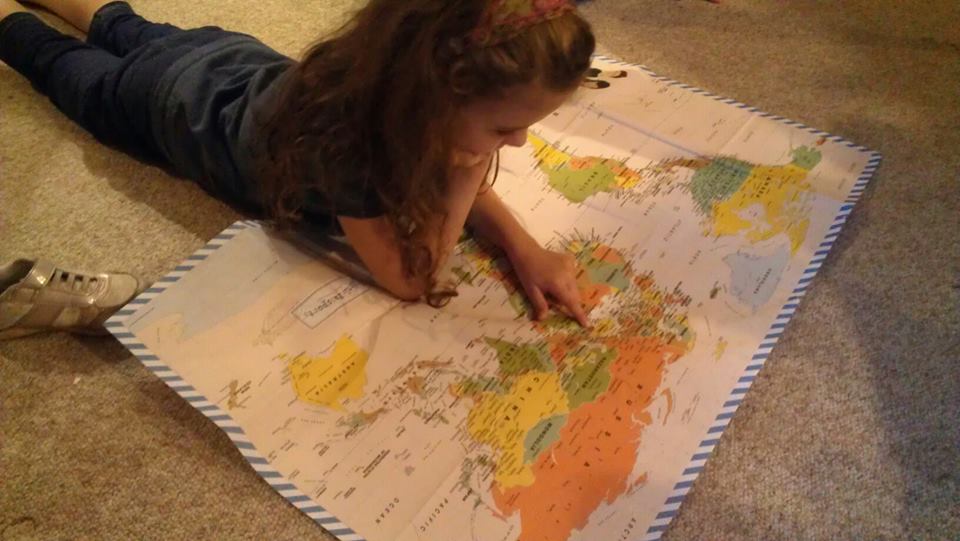
And then she broke out her map to locate Syria and study the logistics.
While she was more upset Saturday afternoon that Disney Jr. did away with her favorite game on its website, our little Hillary Clinton was refocused on world affairs come dinner time.
The question arose about whether or not Syria bordered Israel. I said it did, but Nana dared to doubt me (I guess that’s fair, considering the grades I brought home). Sofia backed her Daddy up, breaking out her trusty map (after grilling me over where I put it after tidying up the family room that often looks like Hurricane Katrina blew through and George W. Bush sent “Brownie” to deal with it).
After she put it away, the question arose as to whether Syria was also bordered by a body of water. In an instant replay, my affirmative response was not good enough. Sofia went for the map again and pointed it out.
“See, Nana, the Mediterranean Sea,” she replied.
And yes, she rattled off that word – with its 13 letters and six syllables – as if it were “gaga.”
It’s been that kind of summer with Sofia.
For me, she has found a way to help me win the no-win scenario.
And I will be so eternally grateful that I vow to spoil her rotten forever.
I know I was already doing that, but you get the point.
That car at 16 is looking good, even if she isn’t allowed to drive it until she is 30.
Meanwhile, at 6, she continues to do and say amazing things – like the morning she got up first (a true rarity, as she is a night owl like her Daddy) and sat quietly under a hallway light and made a list of all the states and their capitals.
Or like the time she got her dolls ready for a tea party for hours, including writing up invitations (she tried to make the cats sit still for the party but it didn’t work).
Or the time I came home late from the recording studio and she scurried out into the hall to issue a whispered warning: “Mommy’s not happy with you.”
It’s terrific that Sofia is smart, but even better that she has – at least so far – a desire to learn.
She had a summer reading list knocked out by June, and her math workbook nailed by July. She has a first-grade primer she does just for fun. Ditto for drawing and crafts.
She also throws the cutest tantrums when she doesn’t get her way, or when she is misunderstood or rushed, and it’s hard to get her off the computer and/or iPad.
She can be bad.
But it’s all good.
She is better than any mind-numbing tranquilizer. It has been the best, most carefree summer of my “adult” life.
We have gone on multi-night stays in Hershey and the Eastern Shore of Maryland (she was a little bored at Annapolis, but was a good sport for my sake). She also took day trips to Dutch Wonderland and Crystal Cave.
She got a new kitten, Hershey, giving us a feline hat trick (even though Sofia is a little allergic).
In between, I have been her chauffeur for all kinds of stuff – piano lessons, swimming lessons, music camp and gymnastics.
But it’s not just about where she has gone and what she has done. It has been a blessing – there I said it – to be in the here and now with her, without having to worry about rushing off to work all the time and coming home after she is already asleep.
There have been glimpses into the future, too. In tears, she confessed that some of the girls in her dance class this past year could do cartwheels and that the teacher praised them – and one specifically – for being graceful.
You could see the betrayal in her face when Nana let it slip, after pinky-swearing not to tell, which kid from Kindergarten Sofia considered her boyfriend (this happened while Sofia was pretending to be at a café in France and making Nana be the waitress).
I played dumb, telling Sofia I didn’t hear what Nana said because my hearing aid wasn’t in, but I don’t think she bought it.
Being able to share this extended quality time with her – negotiating like union-versus-management to get her to practice the piano and watching “The Family Guy” from 11 to midnight (although she thought it was a good idea to put on Al-Jazeera to get “their point of view” Saturday night) – has taken the losing hand I was dealt by being left jobless and turned it into into a royal flush.
They say that it is he who laughs last, laughs the loudest.
I have had some loud laughs this summer, so I guess I’m laughing last.
And it’s all because of Sofia and her ability to turn my my Kobayashi Maru into a win — without even cheating.

 ingordonville