By GORDON GLANTZ
In a move that was approved at the highest level of the organization – that being Eagles’ team owner Jeffrey Lurie – former linebacker/special teamer Ben VanSumeren is now a fulltime fullback.
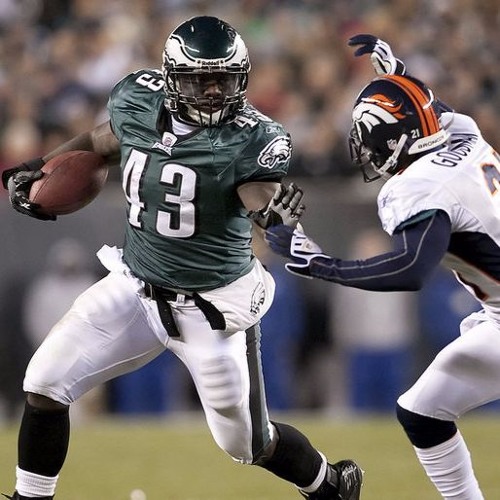
Just to make it officially official, the third-year man out of Michigan State (by way of Michigan) saw his jersey number switched from 57 to 43 (meaning his doesn’t have to declare himself eligible as a receiver).
VanSumeren (6-2, 231) will surely still be a core special teamer, but he is caucusing with the other running backs.
The move isn’t random. There is some offensive pedigree here, as VanSumeren – aka BVM – was a top-notch receiver in high school.
He was initially recruited to play running back at Michigan, where he gained 20 yards and scored a touchdown on five carries as a true freshman. VanSumeren was then moved to fullback and then linebacker before transferring to Michigan State, where he started 10 games as a senior linebacker and recorded 81 tackles and two sacks before being signed by the Eagles as an undrafted free agent in 2023.
It was last season, before going down a knee injury, that VanSumeren was inserted into the lineup as a fullback and laid down some key lead blocks, primarily for Saquon Barkley (while catching a pass for a gain of one yard).
While VanSumeren will not likely play more than a handful of offensive snaps per game, the commitment to resurrect the fullback in Philly allows us to look back at the top fullbacks in franchise history, which also sadly reveals the sheer brutality of the position.
Honorable Mention (alphabetical order):
Cecil Martin (1999-2002): A 6th round pick out of Wisconsin, Martin – a 6-0, 235 pounder – Martin was the first of many fullbacks in the Andy Reid, starting 38 games in four seasons, running for 103 yards and catching 81 passes with 2 touchdowns. Martin also caught a 13-yard touchdown pass in a 33-19 playoff win at Chicago, where he was born and spent time in homeless shelters.
Jon Ritchie (2002-03): While the Stanford product’s best years were with the Raiders, then of Oakland, Ritchie was the fullback on a 2002 Eagles’ team than gained more than 2,000 yards on the ground. He also caught 3 touchdown passes.
The native of Mechanicsburg, Pa. Ritchie became a broadcaster on TV and radio, and has the ignominious distinction of repeatedly calling for Howie Roseman to be replaced.
Owen Schmitt (2010-11): In two seasons with the Eagles, Schmitt never did a whole lot with the ball in his hands.
While he had 19 catches and a touchdown on a 10-6 team in 2010 and turned three catches on an 8-8 2011 team into two more TDs, his main contribution was as a lead blocker for LeSean McCoy, who ran for 2,367 yards combined in those two seasons.
At 6-2 and 251 pounds, Schmitt fit the part of a vintage fullback, as a surgery for a cleft palate when he was younger left a menacing scar under his nose to his upper lip.
And now, the Top 10 …
No. 10) Thomas Tapeh (2004-07): When Brad Childress went from being the Eagles’ offensive coordinator to the head coach of the Vikings, Tapeh was signed on the first day of free agency. That was a sign of his value.
It was no secret that Tapeh, who had battled hip and knee issues just to get back onto the field, played a key part in Brian Westbrook having his best two statistical seasons (2006 and 2007) with Tapeh as his fullback.
No. 9) Earl Gros: After two years backing up Jim Taylor in Green Bay, the former first-round pick was swapped to the Eagles in the 1963-64 offseason.
The 6-3, 220-pounder led the Eagles in rushing in the year of Beatlemania by gaining 748 yards and scoring twice while catching 29 passes.
Gros ran for less yardage in 1965 and 1966, but had 7 rushing TDs each of those seasons while catching 29 passes again in 1965 and 18, with two scores, in 1966 (the team’s last winning campaign, at 9-5, until 1978).
No. 8) Mike Hogan (1976-78, 1980): In the mid-70s, with guys like Larry Csonka and John Riggins, it was not uncommon for fullbacks to be the primary rusher on their teams.
Even the teams that were not so good, like the Eagles.
Hogan – at 6-2, 213 pounds – was the Eagles’ fullback from 1976-78, starting 32 games in that time frame.
He led the Eagles in rushing in 1976 and 1977, with 561 and 546 yards, respectively. In 1978, when Wilbert Montgomery emerged as the main threat at halfback, Hogan still posted a career-bests in rushing yards (607) and rushing touchdowns (4). He also caught 55 total passes as an Eagle.
No. 7) LeRoy Harris (1979-82): At 5-9 and 226 pounds, Harris made the most out of his low center of gravity when he usurped Hogan as Montgomery’s escort in 1979, and had his best season that first year, gaining 504 yards on 107 carries (4.7) with two touchdowns and 22 receptions.
While his numbers dipped in the 1980 season to 341 yards on 104 carries and 15 receptions, Harris had his shining moment as an Eagle in the NFC championship game against Dallas.
While Montgomery ran for 194 yards and a memorable early touchdown, it was Harris leading the way with some devastating blocking. Harris also added 60 yards and a touchdown on 10 carries in the storied 20-7 win.
In the fourth quarter, when the Eagles were trying to run out the clock and Montgomery exhausted, Harris picked up some key first downs on sheer determination.
The scoreboard at Veterans Stadium flashed “Leroy Wants It” as the crowd roared.
Harris missed the 1981 season with an injury and retired after playing sparingly in the strike-shortened 1982 season.
No. 6) Norm Bulaich (1973-74): Bulaich was a first-round pick of Don Shula and the Baltimore Colts and helped them win Super Bowl V as a rookie in 1970. He then made the Pro Bowl at fullback in 1971.
After an injury-riddled third season, the 218-pounder was traded to the Eagles and was a key part of the potent Roman Gabriel-led offense of 1973 that saw wide receiver and rookie tight end Charle Young join Gabriel in the Pro Bowl while halfback Tom “Silky” Sullivan ran for 968 yards (in 13 games).
Bulaich, played a key supporting role in the “Fire High Gang.” He supplied key blocking and gained 436 yards (4.1 average) on the ground and a caught a career-best 42 passes for another 403 yards (9.6 average) and 3 TDs.
Nicknamed “Paper Head” because he suffered multiple concussions that were called “dings” at the time, Bulaich had bouts with memory loss but still started all 14 games in the 5-8-1 season.
Bulaich was not as effective in 1974, his final year here, before being reunited with Shula in Miami.
Subsequent tests on Bulaich, in terms of CTE effects, were officially inconclusive and he worked as an executive for a waste management company in his native Texas.
No. 5) Anthony Toney (1986-90)/Keith Byars (1986-92): In the mixed-up confusion that was the Eagles offense during the Buddy Ryan era, it was never 100 percent clear whether Toney or Byars was the halfback or the fullback.
What is known that, when Ryan drafted Byars 10th overall in 1986, it was to be “the next Jim Brown.”
Even though he was more than 240 pounds, that would seem to indicate Byars was meant to be the halfback while Toney was nabbed in the second round to be Byars’ running mate at fullback.
Byars struggled to regain his college form because of the same right foot injury that kept him out most of his senior year (he gained a whopping 1,764 yards as a junior). Consequently, Toney (54 starts over 5 seasons) received more of the workload as the primary runner.
Byars, to his credit, became a stellar receiver, using his gigantic mitts to make one-handed grabs out of the backfield. He also became such a strong blocker that he was more or less considered a motion tight end at the end of his stint in Eagleville before moving on to the Miami Dolphins as a true pure fullback, earning him a Pro Bowl nod.
Toney, for his Eagles’ five-year career that was cut short by hamstring issues, gained 2,229 yards to along with 14 touchdowns. He also and had 122 catches.
No. 4) Kevin Turner (1995-99): An Alabama product, Turner came to the Eagles from the New England Patriots and was a traditional fullback in front of the one-two punch of Ricky Watters and Charlie Garner in the Ray Rhodes era.
He missed all but two games of the 1995 season with a knee injury but bounced back in 1996, when Watters and Garner combined for more than 1,700 yards rushing and Watters led the NFL in all-purpose yards.
Turner, who caught 43 passes for 409 yards (9.5 average), received the Ed Block Courage Award at the end of that season.
His courageous battle had only yet begun, however.
Turner had two more solid years with the Eagles in 1997 and 1998 but was limited to 8 games in 1999 by what were called “stingers.”
In 2010, Turner was diagnosed with ALS (Lou Gehrig’s Disease) and died in 2018. Turner donated his brain and spine for further study and it was determined that CTE likely caused the ALS.
No. 3) Leonard Weaver (2009-10): In 2009, after coming over the Seattle Seahawks, Weaver picked up 323 rushing yards (4.6 average) and 2 touchdowns while adding 15 catches for 140 yards and another pair of touchdowns. A strong blocker, Weaver was named to the Pro Bowl and first-team All-Pro at fullback.
This earned him a three-year deal, but it was all short-lived.
After the 2009 season, Weaver went from being considered the best fullback in football to being out of the game entirely when he sustained a gruesome ACL injury on his first carry of the 2010 season.
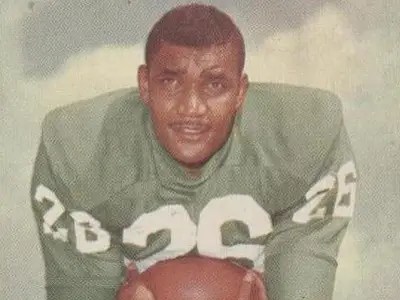
No. 2) Clarence Peaks (1957-63): Pedigree? Peaks was drafted 7th overall in 1957 out the Michigan State, one pick after Jim Brown and in the same draft where the Eagles also plucked Tommy McDonald and Sonny Jurgensen.
The 218-pounder immediately established himself as a power runner, gaining 405 yards as a rookie and 386 and 451 the next two years.
In 1960, Peaks was having a career year before going down with a broken leg. In 7 games, he gained 465 yards (5.4 average) and scored 3 touchdowns.
While he lost some burst after the injury, Peaks ran for 471 and 447 yards the following two seasons before seeing his numbers dip in 1963 to 212 yards in only 6 starts.
Peaks later became a color commentator for Eagles’ game on WIP.
As an Eagle, in seven seasons, he ran for 19 total touchdowns and caught 2 more on 175 catches.
No. 1) Tom Woodeshick (1963-71): In 2007, a sportswriter poll by the Philadelphia Inquirer placed the Wilkes-Barre native 47th all-time on the list of Greatest Eagles.
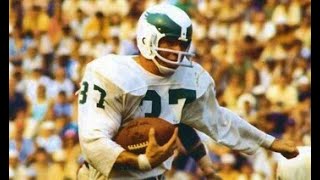
Sports llustrated named Woodeshick, an 8th round pick out of West Virginia in 1963, the best Eagle ever to wear jersey No. 37.
Fast enough to beat teammate Timmy Brown in a foot race but also powerful at 6-feet and 225 pounds, Woodeshick played sparingly for three seasons but became the starting fullback in 1967. He then embarked on an almost apocalyptic journey of being a really good player on some of the worst teams in modern franchise history.
In the next three seasons, 1967-69, Woodeshick ran for 2,448 yards and 13 touchdowns.
His best season was 1968, when he gained 947 yards and had to exit the final game early with a gash that was so harsh that opposing players initially thought he lost an eye.
It was in the same game that exasperated fans threw snowballs at Santa Claus, and then at head coach Joe Kucharich.
Woodeshick was second-team All-Pro in 1968 again in 1969, when he gained 831 yards and ran for 4 TDs despite missing the last two games with a knee injury that proved to be the beginning of the end for him.
After knee surgery, the Eagles released him before the 1972 season.
Woodeshick, whose post-career included column in the Inquirer along with providing commentary for the infamous Philadelphia Bell of the short-lived WFL and did some coaching at Moravian College, was disappointed about how his career ended (despite 3,577 yards and 21 touchdowns as an Eagle).
“I’m extremely bitter,” he was quoted as saying. “There’s no avoiding it. I wanted to go out like a pro. Not so much for myself, but for the fans here. They deserve a winner.”

 ingordonville