Author Archives: gordonglantz

Long Walk Home

MacLeish

By GORDON GLANTZ

Gordonglantz50@gmail.com

@Managing2Edit

GORDONVILLE — Been giving a lot of thought lately to what it means to grow old.

Being on the north side of 50, if only by a year, will do that to a guy.

More or less, I still love – or at least like, or am bemused by – the same music and television shows from my youth (while picking up some strays along the road of life).

I am still given to bouts of unabashed immaturity, often manifested by practical jokes with Sofia serving as my assistant.

And that little girl, sometimes 9 going on 19 and sometimes 9 going on 19 months, keeps me young in so many ways.

Yeah, there are the physical reminders – less hair up top and more girth in the gut.

And I am mastering the art of small talk. I can do the wave and nod thing and the final plunge of discussing the weather and traffic patterns.

But I think we age as we lose drip on our youth.

Listening to Bruce Springsteen 24/7 won’t halt that that inevitability.

No one gets out of here alive.

We lose our grandparents, our parents, our aunts and uncles and we age with each loss.

By the time we lose our friends, well, you don’t need a calendar to tell you how old you are.

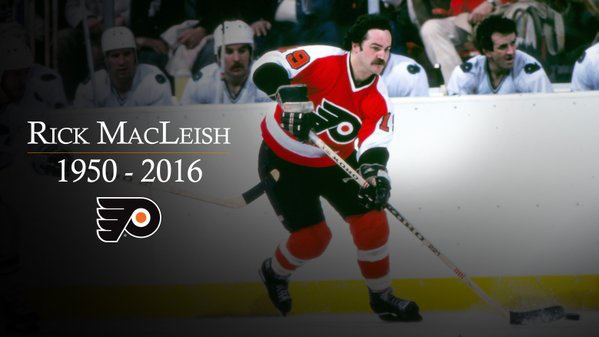
Rick MacLeish was not a personal friend of mine. I met the man twice. Once, as I waited in a long line at a car dealership – Matt Slapp Something or Other (I think Chevrolet, but don’t hold me to that) in the Northeast – but they hustled us all through the line pretty quickly.

My heart pounded as I approached. He quietly asked my name and I stammered with a response. He proceeded to spell it incorrectly – G-O-R-D-E-N – which is actually amazing, considering the number of people named Gordon, like Gordon Lightfoot, from his native Canada.

Because of the length of the line, my impatient stepfather told me he would be back “later” to pick me up. Because of the precision of the movement of the line, he was nowhere to be found when I was done.

So, without a concrete definition of what “later” meant, I did what any stupid 9-year-old would do.

I walked home.

By the time I got there, the late autumn chill had taken its toll and my mother put me in a warm a tub. I didn’t quite understand my stepfather’s panic when he got back to Matt Slapp, but I can only imagine how I would feel – actually I can’t – if the same thing happened with Sofia if she were waiting in line for an autograph from Becky G (her second-favorite teen idol behind Sabrina Carpenter).

When he saw me in the tub, he couldn’t get too mad. I was home. And, really, he should have waited —  and been more concrete about when and where — and he knew it.

But this was 1974. Parents didn’t see child abductors lurking on every corner. We played, out of view, until dark.

My favorite sport to play was street hockey, pretending to be like guys like Rick MacLeish.

All was forgotten and I went to bed happy, despite any panic I caused. I had interfaced with my second-favorite Flyer – Bobby Clarke was like Secretariat pulling away from Sham in the Belmont Stakes – and I had his autograph (I had Clarke’s, too, but it was not from a personal encounter).

The second meeting with MacLeish was a bit different. I was acting in a professional manner as a working member of the press at the Philadelphia Sports Writer’s dinner in Cherry Hill. I walked out of the press room to look for Tommy Lasorda (I worked for the Norristown paper, and we were required to write about Lasorda whenever he passed gas) and almost collided with someone around my own size.

He politely said “excuse me” and timidly stepped aside. His face, like any of the Broad Street Bullies, was unmistakable.

“Rick MacLeish,” I pronounced, much more confident than when I was nine, introducing myself as he shifted his beer to his left hand and shook mine.

We spoke for about five minutes, tops, during which I did most of the talking in a quiet corner where there were so many other Philadelphia sports icons walking around that no one would have even noticed.  I told him he was my second-favorite Flyer, about the Matt Slapp incident and how I spent hours in my garage trying to replicate the quickness and power of his surreal wrist shot.

I also told MacLeish that whenever my father managed to get tickets for a game – no easy task in that time frame –  he always scored a goal, and that I even saw a hat trick or two.

He quipped that he would have gotten me season tickets if he had known.

We also talked about the goal he scored against the Boston Bruins in Game 6 of the Stanley Cup finals, which held up for the duration in a 1-0 win. He said that the deflection was not an accident. He explained that he and Andre “Moose” Dupont tirelessly worked on it in practice. Dupont would shoot it about an inch off the ice and he would deflect it. By the time the situation arose in the game, it was like second nature. For the first time in a game situation, it worked.

He joked that the other power-play point men, Bill Barber and Tom Bladon, shot too hard to spend time on it with them but that “Moose shot it nice and slow, but accurately, and could only get it as high as around the ankles anyway.”

I saw Lasorda – actually, I heard him, too – from the corner of my eye. I was promised five minutes to do a power interview, so I had to excuse myself. MacLeish shook my hand again (hockey players were always gentlemen) and blended back into the crowd from which he came.

I spotted him again, alone in a corner of the VIP area, and thought about resuming the conversation. But I had a story to write, and wanted it out of the way before the dinner, and I didn’t want the man to think I was some sort of a stalker.

So, those are my Rick MacLeish stories. It might be a sign of age, but neither is ever told that often.

From time to time, I would run into someone from overnight camp or somewhere else in my youth, and they would luckily remember me more for my wrist shot than by buck teeth and Jewfro.

My response would be that “I got it from watching MacLeish.”

And I starting watching MacLeish again.

Part of staying young, I suppose, has been some small semblance of computer literacy. The Flyers’ first of two cups is recalled most by the final series, with Clarke winning Game 2 in overtime and MacLeish’s tally in Game 6 that goalie Bernie Parent would preserve, but they got there by edging past a New Rangers team in seven games that was probably better than Boston.

I found Game 7 of the Ranger series on You Tube and what immediately struck me was how dominant MacLeish was in that decisive contest.

And after he passed away this past week at age 66, I watched it again. The whole thing.

It made me feel young.

It made me feel old.

Most of all, it made me feel he was worth that long walk home.


Ring of Fire

Wentz4

By GORDON GLANTZ

Gordonglantz50@gmail.com

@Managing2Edit

GORDONVILLE — I like Carson Wentz.

Maybe not as much as I like Bernie Sanders or Bruce Springsteen, but I like him enough.

And what’s not to the like about the young man the Eagles have christened their quarterback of the future after trading away a treasure trove of prime draft picks to the draft pick-hoarding Cleveland Browns for the right to select the North Dakota State product with the second overall in the 2016 NFL Draft?

Wentz has all the physical attributes – the size, the arm, the athleticism – to go along with enough intangibles, such as polite and down-to-earth manner, to fill open spaces in both of the Dakotas.

He was valedictorian of his senior class in high school, graduated college with a 4.0 grade-point average and scored a near-perfect 40 on the Wonderlic intelligence test at the NFL scouting combine.

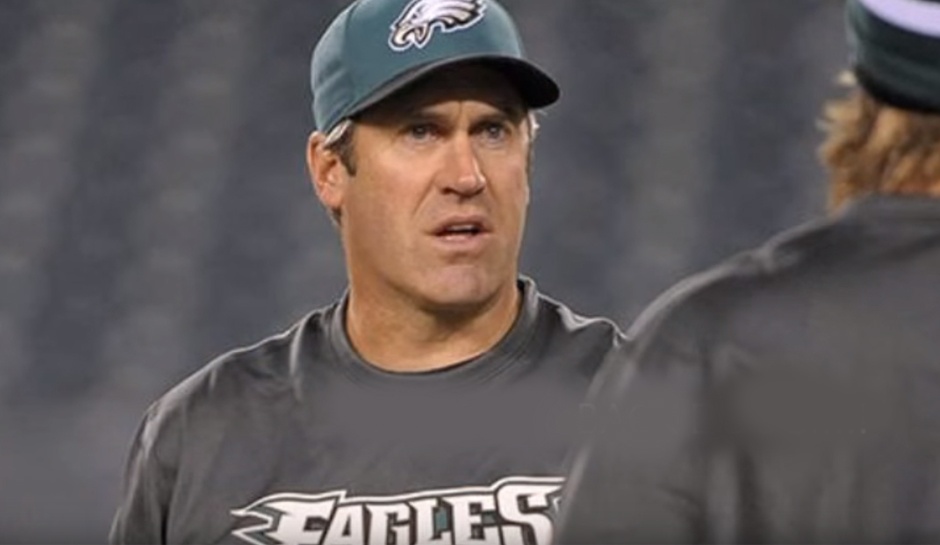
Wentz, who quarterbacked the Bison to a pair of FCS (Division I-AA to us old-heads) titles, endeared himself to coach Doug Pederson and his staff by mastering parts of the team’s intended offensive scheme with a near-photographic memory that may prove to be more of a secret weapon on frosty Linc Sundays in December than a rifle arm that cuts through the wind.

But with all there is to like, let’s not fall in love just yet.

We need to go through a bit of a courtship, maybe even holding off on kissing on the first date. Doing so may give both us and Wentz a bad rep.

And we want this marriage to last.

If all goes according to the best-laid plans – which, in the NFL, often have the lifespan of homes in tornado alley – Wentz will come of age and take the full-time reins sometime in the middle of next season or at the beginning of 2018.

At that point, the rival Cowboys and Giants will be either bathing Tony Romo and Eli Manning in the fountain of youth or bidding them adieu.

With all due respect to Kirk Cousins in Washington, Wentz and his elite skill set – hopefully fine-tuned by coaches like Pederson, offensive coordinator Frank Reich and quarterbacks coach John DeFilippo – should put the Eagles a step ahead of the division.

That should, with the operative word being “should,”  mean free passes to the playoffs, and a path – dare we dream – to not only making the Super Bowl a time or two in his decade-plus under center, but actually winning.

I don’t know about you, but that occurrence would mean I could die – no, not literally – and go to sports-fan heaven.

Anything less, and it is the same purgatory we are in.

Anything less, and the steep bounty paid to Cleveland in draft choices – and you have to attach real names to the players lost in exchange to gain full perspective – was a deal with the devil that set the organization and its tortured fans back for an insurmountable time.

It will likely costly general manager (or whatever he calls himself) Howie Roseman his job, as well as Pederson.

Wentz could be OK, like current place-holder quarterback Sam Bradford (assuming his hissy fit ends before he starts costing himself money), or he could make Pro Bowls and re-write the team’s record books, like another No. 2 overall pick, Donovan McNabb.

It still would not matter.

The NFL graveyard is full of first-round quarterbacks who were either all-out busts (Tim Couch, Akili Smith, Ryan Leaf, David Carr, etc.) who had can’t-miss attributes as well. But there are rare exceptions – Tom Brady (sixth round) and Joe Montana (third) – where a Super Bowl winning quarterback was not of that pedigree.

It was a big step to go there, and it went against the comfort zones of many in the Eagles Nation – myself included – to pull the trigger on Wentz.

By doing so, the stakes were raised to all-or-nothing status.

When you consider the average price of a house in 1960 – the year of the last Eagles championship – was less than $13,000, maybe it was a move that had to be made.

Ironically, Wentz will don uniform No. 11 – forcing Chris Givens to No. 19 after Givens sent Josh Huff to the equipment manager for No. 13 – and there is some symbolism beyond that it is his number of choice.

In 1960, the quarterback, Norm Van Brocklin, wore No. 11. The two titles before that were in 1948 and 1949. The quarterback was Tommy Thompson. Guess what number he wore on his jersey?

So, there it is.

A career that mirrors that of McNabb, who went 1-for-5 in NFC Championship games and 0-for-1 in his one Super Bowl against Brady and the Patriots, is not good enough.

Sorry, but it’s not.

We like Carson Wentz now, and there is no reason not to like him.

In order to fall in love, and get married to his legacy, there needs to be a ring on his finger.

This column originally appeared at http://www.phillyphanatics.com
Philadelphia Freedom

Sanders4

By GORDON GLANTZ

Gordonglantz50@gmail.com

@Managing2Edit

GORDONVILLE — I’m as “Philly” as it gets – right down to an accent so thick that people in out-of-town elevators nail my hometown just from a sliver of small talk.

Even though I call the ‘burbs home these days, not much has changed.

My movie would be called “Straight Outta Cottman Avenue.”

I’m cheese steaks with cheese whiz. I’m soft pretzels with mustard. I eat hoagies, not subs. I’m Temple, not Penn State.

When “Rocky” won best picture in 1976, it felt as if a Philly team had won a championship.

When Live Aid was at old JFK stadium in 1985, my civic pride was so strong that I even endured a four-song set by Duran Duran and remained respectful.

When the Eagles rip my heart out on a Sunday, I go through a 24-hour mourning process with all the stages of grief.

I’ll criticize my brethren for pelting Santa Claus with snow balls, not to mention other such transgressions that perpetuate stereotypes, but I’ll pounce twice as hard on you if you are criticize us from some Ivory Tower (especially with a British accent).

I’ll choose fight over flight. I’m a Broad Street Bully.

And my heart is on my sleeve that barely fits over the chip on my shoulder.

I also always took great pride in Philadelphia’s storied history. When you talk about democracy and freedom and all that theoretically good stuff, this is where was born.

My class trips were short trips — to places like Independence Hall and Valley Forge.

So it was with great consternation that the Democratic Party, my party of choice, chose my beloved City of Brotherly – and sometimes tough – Love, as the place where Democracy would go home to die when the convention comes here in a few months.

How so?

Here is how so.

It is a personal core belief — and should be one with anyone engaged in the process (whether Democrat, Republican, Independent or something else) – that the dysfunctional presidential primary process should never be one where the winners are chosen before the starting gun sounds.

And while the Republican Party seemingly opened up the front door of a funny farm and let the first 14-16 whackos to climb onto a clown car and run for president, it is a better way to go than putting one horse in the starting gate and calling it a day.

But that’s the stunt that the Democrats tried to pull with Hillary Clinton, the former first lady and secretary of state.

And unless you have an incumbent running for re-election, it is completely unacceptable on many levels, particularly for someone like myself who almost always votes.

Was I really going to be faced with the prospect of having no choice by the time Pennsylvania’s primary rolled around?

Was it going to be the same for those in state after us?

How un-Democratic can the Democrats get?

Add in the fact that the media talking heads were trying to brainwash us into believing that we were on a collision course with a Bush-Clinton election, and you had to wonder aloud about how much we ever really cut the umbilical cord from the British Empire – and its concept of royal families — that we broke away from when all that Philadelphia Freedom stuff went down.

While Jeb Bush seemed to be the least zany of his royal clan, it was flanked by too many loudmouths to gain traction and his campaign failed.

How would it go down on the supposed enlightened side of the spectrum?

Instead of letting Clinton waltz, unopposed, some hats were thrown into the ring.

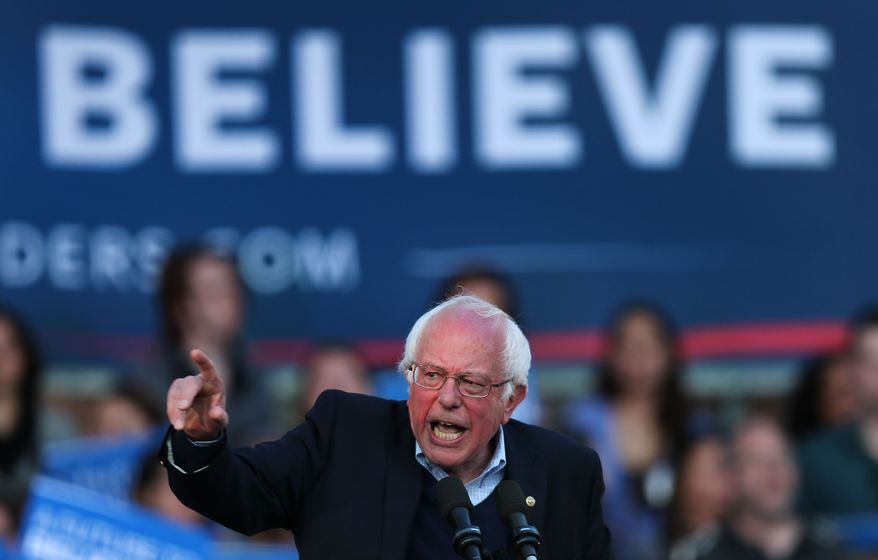
One was from Bernie Sanders, the independent senator from Vermont not afraid to tout the Democratic Socialism that makes other countries, mostly in Europe (i.e. Denmark, Netherlands, Finland, Sweden, and Germany) tick with a healthier pulse rate than that of our own.

I first saw Sanders years ago, when he was a guest on “Real Time With Bill Maher.” I was buying was he was selling, picking up what he was putting down.

It was around the time of the 2007 birth of my daughter, and some of my conservative friends were telling me that this major life event would make see the world more like in their “I-me-mine” way. Nothing could have been further from the truth. The truth, my truth, was that Sanders had a vision of a country – and a world — where I would want Sofia to grow up.

Inside my head, Voice A asked Voice B – in my “Philly accent” – if it were possible if Sanders could ever be president. While they both chuckled, Voice C – the voice of reason – said it would be nice, but highly unlikely.

So when Sanders entered the race, it was more about proving a point. The mainstream media sneered and dismissed it as a lark, but I saw the key role he could play in rectifying a flawed process (and hopefully hang in long enough that there was still democracy, i.e. a choice, when it came time to vote in most states).

I hoped he could push Clinton – in many ways, no different than the type of moderate Republican one has to visit next to dinosaurs on a class trip to the Franklin Institute – out of her middle-of-the-road box. Sanders could get Clinton, who I vigorously supported in print during the 2008 primary process, flustered enough to go on record in debates and interviews.

The fact that it happened doesn’t make me Nostradamus. It just makes me quite satisfied that the system, while badly broken, can be fixed. Not in this election, but down the road. And we have Sanders to thank.

How did it happen?

Knowing he had to real chance of winning as a seventysomething far-left independent without pockets lined with SuperPAC money – and J-J-Jewish, no less – to do what politicians (at least the ones who are not egomaniacal sociopaths appealing to base of voters with an average brain of 2.43 cells) and say what he means and mean what he says.

At the least, as a quirky candidate, he could take advantage of the quirky process and show well in the quirky state of Iowa. That would put him on the map enough to have a good chance of winning in New Hampshire, which borders Vermont, and create a catapult effect.

And that it did, with a strange and unlikely ally for me – Millennials and bright-eyed college students.

The Clinton campaign, in what has become a nauseating sense of entitlement about claiming the nomination, never saw him coming. Seemingly blindsided, her claws came out. Clearly, Hillary had to resent emptying her coffers in the primary process to stave off what we dismissed as a boutique candidacy that wouldn’t last past the first four contests.

The mainstream media tried to do its part by declaring the race – the same horse race they bank on lasting as long possible – as over whenever she won a key race (even if it was a virtual tie) and dismissing any Sanders win as an optical illusion that won’t change anything in the long run.

And, in the end, it won’t – at least in terms of who gets the nomination.

And they will be quick to brand Sanders as the “loser,” but that’s the absolute last thing he will be after chasing her to the finish line after she got such an unfair head start – just with name value, the SuperPAC dough and inherent media bias.

Like Rocky Balboa, who realized just before his bout with heavyweight champion Apollo Creed that winning was going to be next to impossible, Sanders has done the next best thing. He stunned Clinton, knocking her down in the first round. He had her on the ropes in the 15th, cracking her ribs with body blows.

He took a beating in a lot of the rounds in between, but he plodded away – winning over the common folk — and went the distance.

And you don’t get more “Philly” – or Democratic – than that.


Mock and Roll

Alex Collins

By GORDON GLANTZ

Gordonglantz50@gmail.com

@Managing2edit

GORDONIVILLE — So much for the best-laid plans, huh?

A day after I worked out a mock draft for the ages – yes, a roadmap to Utopia for the Philadelphia Eagles – they have done what they have done to me since I got into this Draftnik business.

Made a mock of mockery (even though, through my tears of seasons ended in disappointment, I often have the last laugh).

For the sake of posterity, I want it put into the Kangaroo court record that my original mock went like this: First round (8th overall), Myles Jack, LB, UCLA; Third Round (77th overall) – Vernon Butler, DT, Lousiana Tech; Third Round (79th overall) – Alex Collins, RB, Arkansas; Fourth Round (100th overall) – Tyler Matakevich, LB, Temple; Fifth Round (153rd overall) – Willie Beavers, OT, Western Michigan; Fifth Round (164th overall) – Jordan Payton, WR, UCLA; Sixth Round (188th overall) – Mike Jordan, CB, Missouri Western; Seventh Round (233rd overall) – Daniel Braverman, WR, Western Michigan and Seventh Round (251st overall) – Mike Bercovici, QB, Arizona State.

Quickly, the rationale for my PF (Posterity File).

I saw Jack as a top-five talent, and maybe the best defensive player – if not linebacker – in the draft. A knee injury that sidelined him for most of last season pushed him out of the Top 5 and most reputable mock drafts, much to my surprise, still had him on the board at pick no. 8. With Conner Barwin and Brandon Graham moving to defensive end, the chance was there to line up three young studs – Jack, Jordan Hicks and Mychal Kendricks at linebacker. Because all three have injury histories, I doubled-down on Matakevich, whose exploits at Temple should be well-known to all, in the fourth round.

With the futures of both Fletcher Cox and Bennie Logan in doubt after this year, Butler was a gift from the football gods in the third round. Most years, a player with his size (6-foot-3½, 325 pounds) and raw ability would go earlier, maybe as early as the late first round, but the depth of the defensive line in this draft class would have pushed him into the Eagles’ laps in the middle of the third.

Collins is hard-charging, decisive runner with more than 3,700 career yards – including close to 1,600 last season – to his credit. Coming out after his junior year, there is plenty of fuel still in his tank.

Beavers has the feet to play left tackle but the girth to project to the right side. He would have been a project worth the investment.

Payton was the all-time leading receiver in UCLA history whose only knock is lack of a “wow” factor. Jordan is a Division II standout with good size (6-foot-½-inch, 200 pounds), speed (4.48 in the 40) and production at the Division II level. He would be a special-teams standout from the jump, with upside to help in the secondary down the line.

Braverman is a slot receiver cut from the Edelman-Welker-Amendola cloth and will make somebody’s roster, so why not ours? Only an ACL injury in his past is hurting his stock. And if this is not the year to draft to a quarterback of the future, why not the ideal backup quarterback of the future in the strong-armed but undersized Bercovici?

Then, well, Wednesday happened.

Trade changes everything

Not only did the Flyers avoid a sweep at the hands of the Washington Capitals, the Eagles mortgaged the farm for a farm boy, moving up to the second overall spot held by the Cleveland Browns. The price was steep. The eighth overall pick and the first of two third-rounders – the 77th pick – and the fourth-rounder this year, plus a first next year and a second the following year.

Cleveland was gracious enough to toss in its fourth-round pick next year.

With that, let’s start this thing all over again. While I could mail it in – and deploy my wife’s logic of just keeping all the picks the Eagles still have the same – one with a true football brain knows it is more complicated than that. The dominos, in terms of wants and needs, fall completely differently.

So here, until Howie Roseman busts my groove again before Thursday, is my revised 2016 full mock draft for a Philadelphia Eagles franchise that has been flagless since 1960.

First Round (2nd overall): Carson Wentz, QB, North Dakota State

Listen, it’s not that I don’t like Wentz. To the contrary. I was one of three people watching practices at the Senior Bowl on the NFL Network, and he was throwing darts through the strong winds in that morning session. Watched him some more on You Tube, and there was nothing not to like. I have always maintained that if you are going to draft a franchise quarterback, he needs to have it all – size, arm strength, mobility, smarts (he has a 4.0 GPA at a school where basket-weaving is not an acceptable major) and the ability to win (two FCS titles).

If he fell to the Eagles when they were still at 13, which is more around where he was slotted until the recent league-wide lovefest, I would have pounced. To the No. 8 spot, where the Eagles moved in a deal with Miami? With Jack still on the board? I don’t know. I just don’t know. What I do know, is that it offends my draft-geek sensibilities when any team gives up too much for one player. This it is my team, so it only makes it worse.

There is a small chance that the Los Angeles Rams, who traded up to No. 1, take Wentz. However, the loud whispers in the league winds have it that California’s Jared Goff will be their franchise quarterback of choice. I don’t think the Eagles would have made their move had they not been pretty certain that Wentz would be there at No. 2, as he is reportedly their first choice to build around.

At No. 2, I would take Ohio State defensive end Joey Bosa, but there is no point in going there, right?

Wentz it will be, so Wentz it is.

Third Round (79th overall): Alex Collins, RB, Arkansas

Collins, despite being part of a rotation with the Razorbacks – and only being the “starter” one year – posted the production cited earlier, doing it with more than 1,000 yards in each of his three seasons. In fact, only Herschel Walker and Darren McFadden have more rushing yards in the history of the SEC. At 5-10 and 217 pounds, with 4.59 speed, Collins has the type of physical and instinctive running style that translates well into the NFL. He was not asked to block or catch much in college. While it doesn’t mean he can’t accrue those skills, the lack of tape in those areas will likely hurt his stock enough to leave him on the board toward the end of Day 2. He would be an ideal stunt double for oft-injured starter Ryan Mathews.

It wasn’t easy choosing him over Butler, but the Eagles need another first- and second-down runner in their stable and they may as well make a talented one.

Fifth Round (153rd overall): Hassan Ridgeway, DT, Texas

He lacks the upside of my first choice at this position, Butler, but he is probably more shovel-ready. A two-year starter for the Longhorns, Ridgeway lined up all over the line. At a shade over 6-3 and 303 pounds, he projects more inside in a 4-3 front and has an intense style of play to go along a quick first-step. While breaking up was hard to do with Butler, the Eagles are lucky that the defensive line depth in this draft will have a guy like Ridgeway left on the board.

Fifth Round (164th overall): Joe Haeg, OT, North Dakota State

Hey, if you are going to take Wentz and bring him to the big city, you may as well have a best buddy for company. And it doesn’t hurt that Haeg, a walk-on who played ice hockey in high school, emerged as the dominant offensive lineman – albeit on the FCS level. At 6-6, he will need to add a good 15-20 pounds of bulk to a 304-pound frame that was more than enough, with his advanced footwork, to make him an immovable object in front of Wentz. The four-year starter, who moved from right tackle to left tackle over the course of his highly-decorated career, would be an ideal candidate to develop at right tackle for when Lane Johnson moves to the left side.

Sixth Round (188th overall): Mike Jordan, CB, Missouri Western

Yes, the Eagles could have used a corner earlier – even though I didn’t have one in my original mock – but the reality is that may be able to get by without one as raw-but-exciting as the physical Jordan, who could even be looked at as a safety.

The only knock on Jordan is that he played on the Division II level and easily locked down the top receivers on opposing teams (collecting five interceptions last year, despite not much coming to his side of the field). He wouldn’t be the first late-round corner from a small school to make an impact, and he won’t be the last.

Second-year man Eric Rowe, last year’s second-round pick, will start at one outside spot and Nolan Carroll will likely man the other corner while Leodis McKelvin handles the slot. Another free agent signed out of the Buffalo, Ron Brooks, is likely to press for time. Behind them, likely battling for one or two roster spots, would be several young guys who are roster holdovers. That list includes Jaylen Watkins and Denzel Rice, the only undrafted rookie to make last year’s roster, and 2015 sixth-round selections JacCorey Shepherd and Randall Evans. Add Jordan to the mix and see which one or two – depending on how many safeties are kept – earns it in camp.

Seventh Round (233rd overall): Daniel Braverman, WR, Western Michigan

For the reasons stated above, I can’t quit on this guy. The fact that he is a shade under 5-10 and 175 pounds works to his benefit, as he uses his deceptive 4.52 speed to dart in and out of spaces in the middle of the field. And you can’t knock this production last season: 109 catches for 1,367 yards (12.6 average) and 13 touchdowns. He can also return punts and kicks.

Seventh Round (251st overall): Jatavis Brown, LB, Akron

OK, let’s dispense with the only major negative first. Other than he is not Myles Jack – or Matakevich, for that matter – Brown measures at 5-11½ and 219 pounds. However, he is the type of intense player – with sideline-to-sideline quickness and outstanding read-and-react skills – that will make a roster and help as a situational role player and special-teams ace. On that alone, he is worth the shot. And this is the pick acquired from Arizona for Matt Barkley, so consider it a steal after his first tackle.

Priority Free Agents: Sorry class, we are not dismissed yet. Unless Roseman can weave some hidden magic and come up with some extra picks, the Eagles will be active after the draft. While Chip Kelly rarely gave undrafted players a shot to do much more than make the practice squad, new coach Doug Pederson’s mentor, Andy Reid, almost went too far the other way and put undrafted rookies on a level playing field with later-round draft picks.

Who to look for? Start local, with the only football team playing out of the Linc last year to actually have a winning season: Temple. Matakevich – along with defensive lineman Matt Ioannidis and slot corner Tavon Young – are likely to be drafted. Lanky wide receiver Robby Anderson and center Kyle Friend, who wowed scouts at his pro days with his bench-pressing prowess, would be nice additions. Defensive lineman Hershey Walton won’t be drafted, but he is a high-character guy who would bring intensity to the practice field. Nate D. Smith, the brother of Reid-era tight end L.J. Smith, is an undersized pass-rushing specialist worth a look.

Since we are going all out on North Dakota guys, fullback Nick Bonnet could be brought to battle for that spot. Considering the best option at fullback could be third tight end/special-teams beast Trey Burton, the Eagles should look hard at an undrafted tight end like David Grinnage of North Carolina State or Henry Kreiger-Coble of Iowa.

At linebacker, Don Cherry of Villanova runs a better 40 time (4.71) than most inside linebackers. Nick Kwiatkowski of West Virginia would be another heart-and-soul type to push for a roster and position where depth is a concern.

In the secondary, Kansas State corner Morgan Burns is worth a look just on speed (4.38) alone. A safety job could easily be wrestled away from Ed Reynolds or Jerome Couplin, and someone like Mississippi’s Trae Elston – four interceptions, including two for touchdowns, last season – or Connecticut’s Andrew Adams could be the guy to do it.

So there you have it, long-suffering members of the Eagle Nation. A plan that is too big to fail – at least until the “experts” screw it all up.

This column originally appeared at http://www.phillyphanatics.com

Double Vision and Head Games

Split Screen

By GORDON GLANTZ

Gordonglantz50@gmail.com

@managing2edit

GORDONVILLE – Go ahead, look up at that picture. Study it closely. It will tell you a lot about who you are and which side you are on in this country strewn by an endless and vicious cycle of subdivisions.

The picture has been making the rounds on Facebook a lot lately. What makes it intriguing in Meme World is that is a missile deployed by both supporters of Sen. Bernie Sanders and those diametrically opposed – supporters of Donald Trump.

Sanders is on the left — naturally (wink) — getting arrested during a Civil Rights protest in Chicago, where he attended college. Trump is on the right, donning a military-style uniform that has medals attached to the chest (and it is not from his “college years,” as the labeling suggests).

Sanders people will say that their man was standing up for others, instead of attending a folk hootenanny and calling it a college experience. Trump backers will say that Sander was a malcontent while their man must have been in the military – perhaps serving in Vietnam – while hippies hid behind their fake morals and causes.

Well, every picture tells a story, and these two pictures – melded into one – tell a story as well.

And here it is.

While Democratic rival Hillary Clinton was campaigning for segregationist Barry Goldwater at the time, Sanders was fighting for Civil Rights and rightfully wears that past proudly. The picture is real. And the arrest – for disorderly conduct and a $25 fine — is listed in newspaper clippings.

The picture was snapped during a 1963 rally against segregation in Chicago, which was in line with Sanders leading a rally against draconian segregating campus housing policies. Sanders, a student organizer for the Congress of Racial Equality (CORE), was passionate enough about this cause to be on the front lines on the home front.

Trump, contrary to what a lot of people would like to believe, never came close to a battlefield – whether in Vietnam or on the streets of a nation as divided by black and white as he has helped make it again with his presidential run.

The son of a wealthy Nazi sympathizer and closet Klansman, Trump was so misbehaved that he was shipped off to military school – the New York Military Academy (NYMA) – for eighth grade and kept there in high school.

At NYMA, he played dress up and marched around enough to be called a “captain.” Hence, the above picture – and “punch-me, please” smirk.

While he has arrogantly claimed to have emerged from this glorified reform school for rich kids more prepared for war than “most in the military,” he curiously avoided Vietnam with Houdini-like prowess.

Declared medically eligible in 1966, Trump received four student deferments while attending Fordham. In 1968, when the time came to show off his soldiering skills, he suddenly developed “bone spurs” in one – or both – feet (he can’t seem to remember).

“I actually got lucky because I got a high draft number,” he has since been quoted as saying.

No doubt he did. Money buys a lot in this country. It even buys you the ability to magically “get lucky” – which those who served, or who lost loved ones, should be deeply offended — but then have the gall to turn around and pander to veterans for support with a empty “Make American Great Again” slogan.

The thing is this, though. Who cares?

Our culture tends to judge the man by what war he fought and deduct testosterone points if he didn’t (even if, like Barack Obama, there was no war in which to serve during the “man-up” years).

In case you haven’t guessed, I am supporting Sanders for president. And while his past of being on the right side of history at almost every turn makes for a nice back story, it is more about what he is standing for in the present – with visions of a less dismal future for coming generations — that has made more passionate about a presidential candidate as I ever been in my five decades on the planet.

I believe Trump has appealed to the lowest common denominator among the American populace, ripping some pages out of Adolph Hitler’s shameful playbook, and that’s just unacceptable (Plus, I developed a strong dislike for the guy when he ruined the USFL back in the 1980s.).

I would rather see former Eagles’ coach Rich Kotite elected president over Trump, but it has little to do with what did or didn’t do during the war.

Anyone who served in Vietnam was a pawn in a game, poor kids offering themselves up as sacrificial lambs at the behest of their rich masters. It was not the World War of their fathers and uncles. It was an ugly and needless war.

But in that place and time, in that moment, there was not much choice for some but to go when called. And we have no choice but to thank them for their service and try and comprehend what they endured.

Anyone who didn’t serve was being just as brave, just in a different way. Sanders was a conscientious objector, and does not pull a Fred Astaire – like Trump, with the rotating bone spurs — when asked. He didn’t believe in the war, but does not disrespect those who served. He has a long history in government of standing up for the rights of veterans – often working across the aisle with Republicans – to back that up.

How veterans support Trump but not Sanders amazes me as much as how blacks, especially in the South, can support Clinton over a man like Sanders, who attended the 1963 march on Washington and was inspired by Martin Luther King Jr.’s “I have a dream” speech.

Trump? Well, as outlined above, it’s a little murky what he was all about back then. While it should not change to much in the present, we are in some serious perception and reality terrain and we could use a GPS to find our way out of Meme Hell. It should be cause for pause for anyone looking at the picture above with an objective eye.

I admit I don’t have one, but I will tell you what I see.

I see Sanders as the hero here, not Trump. I will choose wisely.

If Trump went to war, and served admirably, different story. He seemingly hid behind daddy’s checkbook and got deferments. If you think that’s OK, what you are really saying is that Civil Rights – Sanders’ war at home — was not a just cause.

And that is why America was not great then, or now, and won’t be until we face that reality and deal with it.


One For My Baby

People ask why I don’t write a song about Sofia. The answer is that it is complicated. In many ways, I have, but not really. Not directly. Not until now.Bunnypie My lyrics are generally not about one particular person or experience. Additionally, they tend to be from the dark side of my brain – an outlet for my angst and negativity and quest for justice. Sofia represents the polar opposite, a light so blinding that I can’t help but smile in spite of the darkness. That said, long-time readers of my former employer are well-aware that she was a consistent topic in my Sunday columns — so much so that she was probably the most well-known toddler in Central Montgomery County. Sofia just turned 9, going on 19, meaning she is no toddler anymore. They have been the best 9 years of my life and, with me penning lyrics on a nearly daily basis, this is reflected in many songs in an ancillary way. In this song, though, it is more direct. As I patiently wait on the music to be written (hint, partner), let me know what you think.
Song for Sofia (Promise I Will Keep)

I got a bum thumb

From sharpening your pencils

Spend my Father’s Days

At your dance recitals

But what else would I do?

Where else would I be?

No one means more than you

This is what you’ve done to me


We’ll play catch

Till one lands in your glove

Keep getting pets

So you can share all your love

You are my promise

A promise I will keep

A light in the darkness

That is what you are to me


Drive you to school

Send you off to your world

Watching you grow

Still Daddy’s little girl

What else would I do?

What else could I be?

I do it all for you

You are the world to me


You are my promise

A promise I will keep

A light in the darkness

That’s what you are to me

Wanna Fly Like An Eagle

Me at Super Bowl

By GORDON GLANTZ

Gordonglantz50@gmail.com

@Managing2Edit

GORDONVILLE — I was never big believer in the “no news is good news” adage. In my life experience, “no news” means I’m probably in the “pay him no mind” file of “the man.”

In this case, “the man” is Eagles head honcho Jeffery Lurie.

During a press conference a few month backs, Lurie threw out a bit of a hand grenade to keep the Howie Roseman haters from advancing. He did this by stating a third person would be added to the team’s player personnel mix.

The antennae shot out of my head like a pop tart from a toaster.

When you have been on the planet for 50 years, you develop a pretty good sense of self. There are certain things I know was not put on earth to do.

Among them, for example, would be building my own house with my own hands or trying to “sing” the songs I write.

Flip side, though, are the things I was put on earth to do. Among them was to be a doting daddy to a little girl, be a caring pet owner and someone who – when boxed into a corner – can write his way out of a paper bag.

Another would be something in football, preferably as a beat writer or a player personnel person.

You can only take my word for it – and I like to think my word is my calling card – that if the Eagles had followed my advice over the years, whether in the draft or free agency, they would have been considerably better off than they ended up being.

Maybe, just maybe, we’d have a Super Bowl banner hanging at The Linc alongside all those bittersweet NFC East championship flags.

Armed with this knowledge, I had my people talk to Lurie’s people to set up an interview.

Nothing back. Not a word.

Guess it’s not happening.

And at this rate, one has to wonder if the hire – no matter who it is – is going to happen as free agency commences and draft preparation kicks into high gear.

So, instead, I feel free to take my case to you – the few and proud members of my adoring public.

You can decide if you’d rather have me – or some oft-concussed ex-player or some recycled guy with a long record of mediocrity – as part of the brain trust.

We’ll start with the current state of the Birds, as they lead us through yet another period of transition in the wake of Chip Kelly being vetted as a false messiah before the completion of three full seasons, and then to the path I point them toward if Mr. Lurie’s people would just return my people’s phone calls.

First and foremost, if Roseman wasn’t fully vindicated – after being labeled as a “non-football guy” – by Kelly’s public flogging, he should be close to there after the offseason he has had so far.

Roseman, though, seems to be at his best when there is a new coach – like Kelly in his first year coming from the college ranks and now Doug Pederson as a long-time assistant (and head coach at the high school level) – not feeling comfortable enough to impose his “football guy” will upon him.

The hurdle here will be the same. To maintain a cohesive relationship between the personnel people and their staff of scouts and the head coach and his coaches, a voice of reason will be needed.

I know Lurie loves models, and if he had the grace to give me a formal interview, I would point to the old Princeton offense – before the days of the shot clock – of Pete Carril.

If that seemed to get mileage, I would double-down with the “be quick but don’t hurry” approach – proven effective not only to sports, but to business and life in general – of UCLA legend John Wooden.

It would be more than just words, though, as the mistake in the past – and I can point to instances, obvious and otherwise – where “being quick” was working and “hurrying” screwed it up. Related to that would be times when short-term thinking skewed long-term vision.

Hip-checking Roseman out of the way after two seasons when the players he was supplying Kelly won 20 regular-season games and a division title after a rock-bottom ending to the Andy Reid era – when the lack of long-term thinking that it had run its course a few seasons earlier set the organization back – is an example.

Roseman should be allowed to do his thing, and I would make it clear that I would not be looking to interfere.

What is Roseman’s thing? Setting the team well to move forward, with salary cap space, at a critical time like we are now entering.

He already has targeted, and extended, the right players to build around. Quarterback Sam Bradford, on a team-friendly deal, garnered most of the headlines. However, don’t forget tackle Lane Johnson and tight end Zach Ertz or defensive end Vinnie Curry and fellow pass-rusher Brandon Graham, who will likely move to defensive end in the new-look 4-3 scheme of defensive coordinator Jim Schwartz. Roseman also kept safety Malcolm Jenkins, who played in the Pro Bowl as an alternate, in the nest with a new contract.

Now comes the scary part: How to fill out the rest of the roster with an estimate 17 million with which to work?

This is where I would come in, not as an expert, but as a coordinator and courier between all involved.

Don’t get me wrong. I’ll give my opinion, which would pretty much be to move on from the other unsigned free agents and get back the Day 2 draft pick – the one that the “football guy” threw away like an ice cream wrapper on the beach in Ocean City – by trading down from No. 13 in the draft (unless a top-10 talent falls) – to somewhere before pick 20.

But I would understand that my two cents might not even buy lunch.

Roseman’s record here has been more, well, inconsistent. It is where the Princeton-style cohesion between the personnel people and scouts and coaches needs to be tightened up.

If they need a point guard, I could do it.

And it was where they need to be mindful and not getting caught in the trap of hurrying when be quick and decisive will maintain long-term vision over short-term fixes.

If they need someone handy with quotes from the Book of Wooden, I could do it. I can also be the friend in the room that Roseman may have lacked before.

Sure, it’s easy to rip Roseman to shreds for some draft flops – like first-rounders Danny Watkins, an uninspired college tackle turned guard who is now in his native Canada working as a firefighter, and linebacker Marcus Smith, who lingers on the roster after showing some semblance of a pulse last season in the one game after Kelly was gone.

The way I see it, as an outsider trying very hard to read between the lines for my Eagles’-loving lifetime, was that Roseman was less responsible for the pick of Watkins (it was Roseman’s first year in the draft war room and Reid had long-since had final say there, and it was his call to let offensive line coach Howard Mudd hand-pick a player as a gift for coming out of retirement to join the staff), but is more to blame for Smith.

To what degree it was his call, we’ll never know. He has fallen on his sword for both.

And if that is considered fair, then he needs to be lauded for drafting Johnson and Ertz and Jason Kelce in the fifth round and trading a cutting-block rookie free agent running back, David Fluellen, for a rookie kicker who made the Pro Bowl in Cody Parkey.

And the drafts in the Kelly era has so many mediocre players from Oregon, or other PAC-12 schools, that it is hard to keep a straight face and say that it was all Roseman. Maybe he had final say, but his fault was trying to magnanimous and defer more to Kelly and his assistants than to the scouts who study this stuff all year.

I have always had my doubts that Roseman is actually breaking down film of college prospects or currently NFL free agents.

If he is, he needs to stop.

I wouldn’t be doing that, either, if hired.

Let’s target the best scouts we can and let them do their jobs. Take that information and form a plan of attack, whether it is for the draft/free agency or how to do with what remains on the roster.

He has strengths and weaknesses. Perhaps, as another “non-football” guy – unless Friday afternoon rough-touch games against the same group of African-American kids (it was not as horrible, though filled with trash talk, than it sounds) counts as playing experience – we can speak the same language and fill gaps.

I have dealt with coaches, especially football coaches, my whole life. If Howie turns them off, maybe I won’t. I could carry and deliver that mail to the main office.

And I would do it quickly, without hurrying.

This column also appeared at http://www.phillyphanatics.com