Author Archives: gordonglantz

The Ghost of Trayvon Martin

By GORDON GLANTZ

Gordonglantz50@gmail.com

@Managing2Edit

ImageGORDONVILLE – There may not be an American old enough to understand who does not have an opinion on the George Zimmerman verdict in the killing of Trayvon Martin, and now is not the time to mute discourse because we are “tired of it.”

After the verdict, I immediately tried to put myself in the place of a black American who is the parent of a teen, or pre-teen, and wondering what – in the wake of the not guilty verdict – I could possibly say to my child about simple things, like walking down the street to or from the store, that would make sense.

I came up empty.

Instead, Ifollowed a path to try and connect the dots and make sense of it.

I went back to the recent July 4th weekend, when the discussion with my friends for life drifted from each of the four major sports teams in town to the television show “Freaks and Geeks,” the critical acclaim of which could not push it past one season.

It sparked a spirited debate.

Were we more like the class-cutting, music-loving “freaks” or the un-athletic, oft-bullied “geeks?”

We probably weren’t as cool or free-spirited as the “freaks” or as pathetically nerdy and neurotic as the “geeks” (only one friend saw us that way, which may say more about how he sees himself) but it was an interesting drill.

The truth is that we were neither back in the day.

In the early 1980s – the setting of “Freaks and Geeks” — we were just kids.

I am no sociologist (my uncle Oscar was, though, if that counts), but my unscientific analysis views that time period like this: About 5 percent of the kids were too good to be true.  Angels on earth, they rarely got less than an A on their report cards, helped old ladies cross the street and spent their spare time volunteering at the hospital or church.

Another 5 percent were completely incorrigible devils who probably should have been locked up early to avoid the rush.

The rest of us, the other 90 percent, were – to varying degrees – somewhere in the middle.

If we were at-risk, it was for being most likely to fall through the cracks.

Temporarily lost, we usually managed to find ourselves later along life’s crazy path, but high school was a time to be a ghost.

We all had scrapes with disciplinarians in school, earning detentions and suspensions for silly transgressions like having a Sony Walkman in the hall or going up the down staircase, but we had no juvenile records or anything of that magnitude.

Like most, I wore the standard uniform of the time – beat-up jeans and one of my concert shirts (the ones where the sleeves came three-quarters of the way down the arm).

I had wild and crazy hair that, outside of school, often had a bandana buried in it (I couldn’t quite bring myself to try the Steve Van Zandt look).

For a mental picture, try a thinner Juan Epstein with a Led Zeppelin or Rush or Yes concert shirt.

We spent our weekend nights – and some days when attending school didn’t seem to make sense, for a variety of incongruent reasons – on the streets of Northeast Philly. You could find us  in the local record store, debating the merits of vinyl versus cassette (CDs were looming, but not yet in hand). Later at night, when the Roosevelt Mall closed, we would be ducking in and out of the shadows of back alleys and what passed for urban woods.

I don’t mean to over-romanticize it or make it sound like fodder for a Springsteen song. It was, more or less, pathetic.

Mostly, we staked out these concrete havens to drink beer – and other stuff – and then we dispersed, usually at or around whatever curfew was, and made our way home in separate directions.

I’m sure, while walking alone, we each appeared aimless; as if we were up to “no good.” Surely, people peered out of their windows with a suspicious eye. A few times, we each interfaced with police. It seemed like a stroke of bad luck if an officer – likely smelling alcohol (or something) – reminded us of the time of night and took down our names and addresses.

It likely never progressed beyond that because, well, these officers were trained professionals. They had “cop’s eyes,” and could tell if someone was really a menace to society or just another kid on his way home – more or less a ghost — on another Friday night.

There was one thing working in our favor, too. We all had white skin. That surely stopped any wannabe cops – any Charles Bronson types – from taking the law into their hands in what then was an all-white working class ’hood.

It may have saved our lives so that we can reflect, more than 30 years later, about whether we were “freaks” or “geeks” and laugh about it.

By contrast, we didn’t have the experience relayed by President Obama the other day about his teen years 35 years ago.

He, like us, lived to tell the tale.

Trayvon Martin was not so fortunate on the night of Feb. 26, 2012.

For him, there will be no chance for hindsight about a semi-misbegotten youth, a time when it is a natural instinct to challenge authority on some level and to have a fight-or-flight response that is not fully formed.

As we all know, Martin was in a townhouse development as an invited guest of a resident – the fiancé of his father – walking alone.

Like a lot of teens, he probably wanted to be somewhere else. And if he were somewhere else, he probably wouldn’t want to be there, either.

He was wearing the uniform of his generation – a hoodie — and dared to not walk on the sidewalk and cut between houses. And topping it off, he was not affected by the rain.

Consult any Psychology 101 textbook and it will tell how teens feel invincible from greater dangers than some water falling from the sky. A trained professional, not a wannabe cop like George Zimmerman, might have known that.

And let’s say, for the sheer sake of argument, the 17-year-old Martin was “up to no good.”

Is a sudden death sentence, without a trial, the proper punishment – in America or any other civilized nation – for crimes such as vandalism or petty theft?

Zimmerman, playing judge and jury, seemed to think so.

No one really knows exactly what happened right before Zimmerman shot Martin through the heart at close range, but we can deduce that he – thinking he was standing in as an officer of the law – was profiling Martin because of his skin color and perceived menacing appearance. For lack of a better term,  Zimmerman“stalked” him for it.

Martin felt a need to defend himself against a man who did not identify himself as a police officer. He got the better of Zimmerman in the ensuing physical struggle, and it cost him his life.

He was the one who was unarmed in the encounter. He was the one who ended up dead. Zimmerman is the one found not guilty.

Not guilty?

It may not have been second degree murder, but it sure seems like a clear-cut case of manslaughter.

This is a quirk in the system, not only judicial, but in workplaces and schoolyards and taverns.

Someone (Martin) is sufficiently baited by another (Zimmerman) and justifiably responds. They are then vilified, after the fact, because they had the temerity to adequately defend themselves.

Of all that was considered as court fodder – like Martin breaking some oft-bent rules in school and Zimmerman doing the same when he tussled with a cop and had a PFA filed against him by his former fiancé – the fact that Martin was whipping his profiler’s butt seemed, to me, not as relevant as the cause-and-effect of the original interaction between them.

Saying Zimmerman acted in self-defense and calling it a day, well, it just doesn’t fit.

And if it doesn’t fit, you can’t acquit.

But the jury did anyway, pretty much killing Trayvon Martin all over again, and turning him into a ghost who now haunts the nation as it sleeps.

Thanks Dad, For The Love Of The Games

Image

By GORDON GLANTZ

GordonGlantz50@gmail.com

GORDONVILLE — A lot has happened in the last five years.

Good things, bad things and just plain things that happen as we play the unpredictable game of life.

It is enough that it would belie the notion that the time flies by.

But Father’s Day, 2008, seems like yesterday.

It was all about my daughter, Sofia, who just happens to be making me my 2013 Father’s Day card right now – asking how to spell the names of our cats to sign it for them (they’re napping, or else she might be tempted to figure a way to put their paw prints on it).

But there was the phone call with my father, and a subsequent conversation that turned to sports.

A month later, he was in a car accident and never recovered, despite signs of false hope, and he died while in hospice care that August.

He missed the Phillies winning the 2008 World Series by a few months.

Ironically, and despite having three decades of fandom on me, I had witnessed this rare gift from the baseball Gods more times in my life than he did (not counting the technicality of the Philadelphia A’s. of course).

More peculiar, though, is the fact that I find myself thinking in these terms.

My father and I had an odd relationship, and communication – although improved as the years saw me move into adulthood and he into senior citizenship – was often coded.

And that code was sports.

It was our common ground.

Even on serious topics, or ones seemingly unrelated, the analogies would be sports-centric.

While his yearbook shows participation on the track team, my father was not a natural athlete. He biggest claim to fame was returning an interception for a touchdown in a pickup game of touch football while in the military.

He would claim his broken nose and surgically repaired knee were “old football injuries” but we would usually roll our eyes.

That’s because we had eyewitness accounts to the contrary.

My Uncle Oscar, his older brother, was the team captain of Central High’s basketball team. He used to say that “Sammy was a klutz” in a matter-of-fact tone.

Everyone at the table, except my father, would laugh.

Uncle Oscar might have been overstating it a bit. My dad had the basics down. We played catch, and shot baskets in the driveway, and he wasn’t a complete “klutz.”

But the evidence is there.

Because he was left-handed, my dad made the non-athlete’s mistake of buying me a glove for my right hand when I was preschool age. My first street hockey stick was curved the wrong way (a blessing in disguise, as it helped develop my wicked wrist shot).

My first baseball bat was too heavy, so he told me just to put it on my shoulder. I knew better, which probably helped my bat speed at a young age.

But when it came to the art of being a fan, my father knew best.

He showed me how to keep a scorecard, baseball or basketball, a lost art at which I was proficient by Sofia’s age (6 and change).

It is safe to say I knew how to read the standings – usually finding the Phillies and Eagles in last place – in the newspaper before I could even read the articles.

We played sports strategy games – my favorite board games, outside of Monopoly – which enhanced my understanding of Xs and Os when I watched sports on television.

Or in person.

And that happened a lot.

It was not uncommon to attend four or five sporting events in weekend.

This was especially true in the fall. He had season tickets to the Eagles, which are now mine, and to Temple football. He shared a package for the 76ers and, to make me happy, scored Flyers tickets –the toughest in town – when he could.

The winter, as the NBA and NHL continued, Big 5 basketball – the vintage Big 5, before Villanova ruined it with its snobbery – was part of the mix.

The spring brought a Sunday package for Phillies games (my first was actually helmet day at Connie Mack Stadium, and I still remember that palpitation in my heart when we came through the tunnel and saw the diamond).

We would attend the Penn Relays each spring. It was also not uncommon to check out a high school game. In the summer, we would invariably find ourselves at Temple’s McGonigle Hall taking in double- and triple-headers of the Sonny Hill League and Baker League.

I was only with my father on weekends, so not much homework got done. If we weren’t at a game, I was outside acting out what I saw or in my room replaying match-ups via Strat-O-Matic games.

When he started seeing my subpar report cards, he became aware of the monster he created and played the dangling-carrot game, threatening attendance at upcoming games, if he didn’t see improvement.

Invariably, though, it didn’t come to pass. We would be in the car, stopping at Pat’s Steaks and heading to one of the venues.

It was a golden time in Philadelphia sports.

I was born in 1965, so we saw all four teams rise to power. Three of them – the Flyers (1974, 1975), Phillies (1980) and Sixers (1983) –went on to win championships.

The Eagles, well, it’s more complicated.

The greatest memory remains the victory over Dallas in the NFC title game in January of 1981. The worst, and the last time together at Veterans Stadium, was that bitter loss to Tampa Bay.

Disgusted and cold, he left as soon as the game ended. He stayed in my seat for a good 20 minutes, not only replaying the game but reflecting on all the good times I had in that stadium.

And he was the reason.

When my father passed away, there were the invariable things left unsaid.

For the love of sports, Philadelphia-style, I can only say this.

Thank you, dad.

Follow Gordon Glantz on Twitter @Managing2Edit

Pretzel Logic

foul-ball-injury_5

By GORDON GLANTZ

Gordonglantz50@gmail.com

@Managing2Edit

GORDONVILLE – While clicking around the television dial the other night, I must have been really bored because I stopped to watch a baseball game that didn’t even involve the Phillies.

I don’t mean to knock the national pastime, it’s just that sitting through a meaningless May/June contest and analyzing every strategic maneuver is not my ideal idea of fun.

So there I was, at least for one pitch, watching — and mostly waiting — while the batter stepped out of the batter’s box and back in while the pitcher shook off the catcher 54 times.

As per usual, that one pitch led to a foul ball into empty seats down the left-field line. And a mob of spectators ran towards the batted ball, as if miners in pursuit of a chunk of gold during the California gold rush of yore.

This oddity – this fascination with a baseball that you can buy for a nominal price in any sporting goods store – is one of many listed on my I-don’t-get-it list.

Also on the list is the fascination with vampire tales, English royalty, Hollywood sequels and golf (this thing at Merion can’t be over soon enough).

Shifting gears to more serious matters, I don’t quite get why any president of the United StatesBarack Obama, at present — is automatically considered “the leader of the free world” upon election.

No, he is the president of the United States. That’s his job, 24/7. No moonlighting needed, or required, at least for this gig. Not until we get our own act together.

It is rather arrogant – a trait as American as baseball, apple pie and institutional racism – to assume we set the tone for anything on the world stage.

By definition, to be a leader, you have to lead in something. And according to “Ranking America,” we hold the top spot in:

-Anxiety and mood disorders

-Plastic surgeons -Breast Augmentation

-Spending on clothes and shoes

-Registered vehicles

-Criminal prosecutions and prisoners

-Nuclear reactors

-Military spending and exports of arms and ammunition

-Health spending.

By contrast to these dubious distinctions, we rank:

-14th in college graduation

-23rd (out of 45 “more developed countries”) on the women’s index

-70th in women in government

-37th in upholding the rule of law (i.e. human rights) -18th (out of 40) in reading

-61st in monetary freedom

-17th in medical school graduates

-35th in math

-15th in literacy

-64th in human security

-21st in happiness

-22nd in freedom from corruption

-58th in commitment to change in energy consumption

-50th in erection length (explaining a lot about resistance to gun control)

And lastly, and most incongruous to the “leader of the free world” jazz (the real leader would likely hail from somewhere in Scandinavia, judging by the indexes), come these cold and hard factoids:

-22nd in freedom of the press

-17th in democracy.

 Ouch.

Talk about being kicked in a sensitive area, huh?

Since the president being the leader of the free world is mere myth – more indulgent perception than star-spangled reality – then the president being the world’s chief of police can certainly be dismissed offhand.

We do what we can, when we can, but let’s be real.

The events of last Sept. 11 in Benghazi were tragic, but president Obama could not have prevented them anymore than he could have prevented Hurricane Sandy or the recent spate of tornadoes (we also lead the world in those).

Radical Muslims will do what they do – commit violence in the name of religion – as much as the present-day force of nature known as climate-change-induced superstorms.

That’s a reality we have to live with, but instead some are sullying the victims’ memories by playing the blame game for political reasons. This is especially true – if not ironic – when you consider from where the venom is being spewed. When you look at the key areas where we don’t rank, and not even in the top 10, most of the shared blame can go the same Republicans who don’t let Obama come up for air.

For example, in the area of education – math, science and literacy – the states that bring us down are always red come election day.

Ditto on many of the quality of life rankings listed above.

And they have too much blood – American blood – on their paws to claw at Obama.

On the tragedy meter, not much ranks higher than mass shootings like the one in Newtown, Conn., which happened three months after Benghazi but has been swept under the rug because of the touchy dialogue it spawned on gun control.

In the wake of Newtown – and with knowledge that more than 30,000 Americans die by the gun each year (we also rank first in death by violence) – Republican leaders ignored public opinion in favor of self-interest and conspired to shoot down even baby steps toward sane gun control.

This makes them accessories, albeit after the fact, to the accepted madness. They have other fish to fry. Problem is, it’s not edible. Don’t be tempted to consume it. Four people, four people who understood the risks when they accepted their assignments, died in Benghazi.

That’s not to say it wasn’t a tragedy, or that it wasn’t something to learn from going forward, but you can only brace for it the way you can brace for a tornado or hurricane the next time one hits. You can’t stop them from happening again.

Right-wing pretzel logic to twist and turn it into something it isn’t – comparing it to Richard Nixon’s follies, that ended when finally caught with his hand in a cookie jar labeled Watergate — would be funny if it weren’t so sad.

When George “Wingnut” Bush was president, he enacted The Patriot Act in the wake of 9/11 (which happened when his team was asleep at the wheel, despite warnings of terroristic attacks within the country). The Republicans were quick to defend him, calling it necessary.

And yet, when Osama bin Laden, the mastermind of 9/11 was killed on Obama’s watch, they were short on praise and long on rolling their eyes when the president “spiked the ball” and dared do a touchdown dance (unlike the premature adulation of Bush and his “mission accomplished” ceremony to declare the Iraqi War over when that national heartbreak had just begun).

Now, in the wake of the Boston marathon bombings – which have quickly, and nefariously, joined Benghazi and co-replaced Newtown in the public’s psyche because it removes the gun issue and replaces it with bad guys with funny names who pray to Allah – they are critical of Obama for enacting similar, though more sophisticated, measures of keeping us safe from domestic terrorism.

The wrong-minded on the right will go to any lengths – suppressing the vote, calling the man-made human condition “God’s will” – to prove a point when they have none that are salient.

 They say nope to hope.

They resist change.

They call themselves the “real” Americans – implying anyone not seen by their tunnel vision isn’t — and get away with it.

Their motives are as transparent as the painted smile on the face of a beauty pageant contestant, and yet many follow their lead.

And I don’t get it.

Chasing after a foul ball, or watching Queen Elizabeth christen a ship, makes more sense.

On The Carousel Of Time

Sofia67

By GORDON GLANTZ
Gordonglantz50@gmail.com
@Managing2Edit

GORDONVILLE – While doing preliminary research on one of my 62 book ideas – the 100 greatest story songs of all-time (already have about 80 and haven’t even gotten to Springsteen, Dylan, Woody Guthrie or many other brilliant writers yet) – I naturally crossed paths with the Joni Mitchell classic “The Circle Game.”
The song’s theme of childhood innocence lost, simply stated with powerful imagery, turned my thoughts to a familiar place.
To Sofia.
I began to ask myself where, in this song, she – six years in – is at.
She is, for the most part, still in the first verse; still coming out to wonder, catching dragonflies inside jars (she prefers butterflies and fireflies, but let us not quibble over minor details).
She still doesn’t mind being called “Bunny” (shortened from “Honey Bunny”) and/or snuggled at night and/or carried when she is tired, and scoffs at the notion that she won’t want those things one day.
But Sofia is also an old soul.
She gains more from watching “The Waltons” or “The Brady Bunch” than from rather silly cartoons without much in the way of redeeming qualities, other than to serve as a boot camp for our most young and impressionable to march in the army of the culturally challenged.
Recently, while making cards for her wonderful Kindergarten teachers – the lead teacher, the assistant teacher and the student teacher – my wife asked Sofia what she wanted to write.
And Sofia started to sob, realizing that she will not interface with her teachers – at least not in the same way – anymore.
When we drive by her old preschool, her beloved St. John’s on Skippack Pike, she is so prone to bursting into tears that she now looks away.
We asked what she will do when she passes her current school – which she loves just as much – she explained that she will do the same thing.
She already seems to understand the “Circle Game” in its entirety, which is both encouraging and heartbreaking at the same time.
This type of depth of feeling by Sofia – the author of two books, one about rainbows and the other about our cats, on an iPad program — is not uncommon.
Good thing? Bad thing?
Not sureLife is tougher for an overly sensitive person – I know this, because it’s in the genes (just paused for a healthy cry when Ryan Bingham’s brilliant “The Weary Kind” came up on Pandora) – but I’d prefer her to feel on a deeper level than to grow callus and put armor around her soul.
Parts of us, as parents, want our kids to stay in the first verse of “The Circle Game” forever.
But we know that our role is to guide them toward independence — and enduring their declarations of it, knowing it is for the best in the long run.
We look back on each of Sofia’s stages fondly.
We are a bit wistful at times looking through old pictures and videos, but we try to cherish the moments as they come at a fast and furious pace.
Sofia is a busy little girl – with many interests that we indulge beyond what may not have been possible if she were not an only child.
Although she made a spirited first try at coach-pitch “baseball” this spring, her first love remains the arts.
Dancing is her primary passion, and she has been in two recitals so far, with a third pending in a few weeks.
She begins piano lessons this week, and that is a continuation of what she has learned – since a toddler — at Milestones In Music in Lansdale.
You might think, since I’m a music-lover, that she is being pushed too fast.
Truth be told, she would have it no other way.
Her musical taste features a nice mixture of being age-appropriate – all the Disney princess songs she knows by heart – but she also digs a lot of the songs of her parents.
This was evident when it came time for her annual picture at J.C. Penney.
Starting at 6 months – when the sub-title to the picture was “Child Of Mine – 6 Months Old” – we relished in selecting the song title to be the theme of the picture.
Typically, but not always, I would pick out the song title and mommy would put together an outfit – or outfits – to match it.
We had “She’s The One” at one, “Tiny Dancer” at two, “Sunshine On My Shoulders” at three, “Pretty In Pink” at four and “Daydream Believer” at five.
There was a nice list for this year – “Freebird” and “American Girl” and “California Dreamin’” were among the finalists – but she had her own ideas.
And what Sofia wants, Sofia usually gets.
Especially, when it shows us that – for better or worse – she is progressing through “The Circle Game.”
Her choice: “Rocky Mountain High” (mommy is more the John Denver fan than daddy, but a guy has to pick his battles).
Since I fancy myself a bit of a dime-store musicologist – a title that might get more validity when that CD of co-written original songs is burned and when this book on story songs, which I thought would write itself but gets more complicated by the day, hits the shelves (at least our shelf at home) – I took a closer look at this Denver anthem in an attempt to understand why it appeals to Sofia.
It is about the natural beauty of the state of Colorado, about nature (another one of Sofia’s interests, clearly from her mother, as daddy is a city boy).
The best I can do is that, at its core, “Rocky Mountain High” — co-written by Denver and Mike Taylor – is simply stated with powerful energy.
Much like “The Circle Game.” Much like the ongoing story of Sofia.

A Day To Remember

Memorial Day

By GORDON GLANTZ
Gordonglantz50@gmail.com
@Managing2Edit

GORDONVILLE – The other night I was doing what it is I do, pecking away at something or other on my laptop when Sofia came over, looked at the screen and asked what I was writing about.
I told her – honestly, I can’t remember now what it was (I believe lyrics to a Mellencampesque new song “Every Character Has An Arc,” but don’t quote me on that) – and she filed a request.
She wanted me to write about her this week.
As my longtime readers know, I always honor Sofia’s request.
And writing about her has never been a problem.
She is the best muse this “writer” could ask for.
And what’s the point of being a father to a little princess if she can’t be a daddy’s girl, right?
I promised her I would.
After all, it had been a while, and there is as much going on in Sofia Land as there is in Gordonville worthy of reporting. But the best I can do is issue a rain check to Sofia and her fans out there.
I will honor her request, and keep my promise, but I can’t do it this week.
Not in good conscience.
And I say it as a father – a father grateful to be in the enviable situation of kissing her goodnight every night.
This week, I want to speak for all the fathers — and mothers — who were deprived of the chance to live my charmed life as Sofia’s daddy.
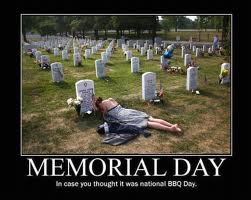
Lest we not, amid the barbecues and holiday sales, forget that the reason we have a long weekend is not the unofficial start of summer and the reason to open pools and begin playing American Legion baseball.
It is because it is Memorial Day.
By definition, it is a day to remember those who gave their lives so that the American dream – unfulfilled as it is for many – can endure.
We, as civilians who never served in the US Armed Forces, cannot pretend to know or understand what it is like to be in battle.
We don’t comprehend the guilt of being alive while your comrades in arms are not.
But that doesn’t mean we can’t try a little harder to be less cavalier about what should be regarded as one of the most solemn of the non-religious holidays on the calendar.
That’s really all we can do, and we should do it because that’s what they – the dead and those who mourn them the most – deserve.
The holiday was born in the wake of the brutal Civil War, with many towns – North (Boalsburg, Pa. has the best claim) and South (Savannah, Ga. is chief among them) – claiming to be the first to decorate graves with flowers.
Known as Decoration Day, it was symptomatic of the lingering ill-will in the country at the time, as it was not uncommon, for example, for people in the South to only adorn the graves of Confederate soldiers while “freedmen” (former slaves) would decorate those of Union soldiers.
As the country evolved into the 20th Century, and through World War I and World War II, Decoration Day became Memorial Day and more civic events, like parades and well-attended ceremonies at cemeteries were common.
As we descended more into our current me-first culture, those events were dwarfed by sales and going to the beach and holding cookouts.
And subject to commercialism.
The other night, we were in the gift shop of the Cracker Barrel in Plymouth Meeting (Sofia, of course, always gets a toy of some sort – usually a doll — after whatever meal it is).
I spotted something curious in a whole over-the-top, proud-to-be-an-American section. It was a book, I believe, stating that there are no agnostics – or maybe it was atheists — in foxholes.
Being an agnostic/borderline deist, and an American who takes the whole freedom of religion deal seriously, I could have taken offense.
But I didn’t.
I get the point, over-simplified – and agenda-driven — as it may be.
In foxholes, or places like them, a lot of pettiness is gone with the wind.
The things that divide us on the home front – politics, geography, race, religion – surely seem ridiculous to those facing death.
And if someone who survives believes some divine intervention was involved, so be it.
Who am I to argue?
I wasn’t there, they were.
If it makes those who survive better people – better Americans – then we are all better off.
And it is our responsibility – one day a year – to help them remember those who didn’t make it out of the foxholes of Europe and jungles of Asia and mountains of Afghanistan.
Sofia and I have a springtime ritual of adorning the yard with our trinkets that spend the winter in the garage, near the door, waiting to sing in the sunshine.
Because this happened to take place Saturday, we also used the occasion to put out the American flag (yes, Democrats do that, too) and decorate the yard with smaller ones.
It seems a bit banal, and only scratches the surface of understanding, but I feel like I’m doing my part in helping a  6-year-old understand that there is more to the holiday than catching a sale at Kohl’s or Macy’s.
I hope she also understands why I couldn’t immediately honor her request to write about her.
I will. I promise.
But not this week.

Giving Voices To The Choices

Fiedler2

By GORDON GLANTZ

gordonglantz50@gmail.com

@Managing2Edit

“We are our choices.”
Jean Paul Sartre

GORDONVILLE — So there we were, my mother and I, driving to the Jersey shore to take care of some business (no, we are not hit men, although it’s probably not bad work if you can get it).
She was behaving herself by not incessantly asking lame questions to illicit small talk that interferes with my holy communion with Sirius radio, which seems to have personal service contracts with Billy Joel and Loggins and Messina.
And a series of events got me about the choices we make, why we make them and the ramifications.
Among the them were:
Which bridge to take?
A) Walt Whitman
B-Ben Franklin
C-Tacony Palmrya
D- Betsy Ross  

Answer: My preferred bridge, presuming KYW’s latest report is accurate, is always the Walt Whitman. It dumps you on the right road that puts you on the right road that puts you on the AC Expressway. That said, we took the long way home, opting for Tacony Palmyra because … I like to torture myself. Actually, it was so we could eat at the Cracker Barrel in Marlton. When I missed that jug-handle thing, the target became the Country Club Diner in my native Northeast Philly. It was such a good suggestion by my mother, so I allowed her talk during the meal.
Side Note: We had a booth by the window, where we were able to watch the students leave Northeast High School, my alma mater, for the day. They were wearing school uniforms. My mother asked if I would have preferred that (a rare good question), and it occurred to me that I did have a uniform – worn-out jeans and a concert shirt with three-quarter sleeves.
How best to dry my hands after washing them – and there should be no choice of about that, especially considering that this dawned on me while at the rest stop (where you don’t really get much rest) on the AC Expressway – in the rest room (where you really don’t get much rest when wondering about choices)?
A-That high-powered, ineffective dryer thing
B-Paper Towels
C-My pant leg
D-Do nothing

Answer: I always go for the paper towels, but I had no choice this time but to use the dryer thing, as there were no paper towels (a sign on the wall had some psychobabble about going green). But I really loathe the drier thing for one simple reason – it doesn’t get my hands dry. It ranks up there with our cultural vampire obsession with things I don’t get. If I weren’t wearing a jogging suit, making me look like a hit man for Tony Soprano, I just would have gone with the pant leg and called it a day.

How about: Preferred Montgomery County shopping mall?
A- Plymouth Meeting
B-Montgomery
C- King of Prussia
D- Does another one even exist?

Answer: Used to be Plymouth Meeting, and it’s still OK, but the food court sucks almost as bad as the parking. Plus, Sofia wants to ride the carousel 153 times in a row. Pretty good place to mall walk on winter mornings, but I started to like Montgomery better when I had to return something there one winter morn (sounds like a Gordon Lightfoot song, does it not?). Aside from irksome hucksters every three feet down the middle of the first floor, I give it the slight nod. I really dig the humungous Dick’s Sporting Goods at the far end (there is a joke there, about size mattering when it comes to Dick’s, but I’m leaving it alone). The store almost makes me want to buy more exercise equipment to collect dust in the basement.
Side Note: I wouldn’t go to King of Prussia, battling that traffic across the Dannehower (or is Dan Howard) Bridge, if you told me the stuff was free. Honest.
Moving on from the realistic, albeit mundane, to theoretical:

The quarterback I would choose to start one game, assuming my life was on the line?
A- Johnny Unitas
B-Joe Montana
C- John Elway
D- Jay Fiedler

Answer: Not Jay Fiedler, but in lieu of going to Temple (the house of worship, not my beloved alma mater) on Yom Kippur (Sins? What sins?) I thought I would list a run-of-the-mill quarterback among the icons because he was Jewish. Obviously, Payton or Eli Manning would be solid options to list, but I would not pick them in the end, so why bother. My choice? Montana. Close, over Elway, but my life is still pretty precious. That’s why I check my blood pressure 64 times per week (103/72, despite being on the road with my mother, on Thursday).

Brass tacks (whatever the heck that means). The Eagles quarterback I would choose to start, assuming my life was on the line?
A- Donovan McNabb
B-Randall Cunningham
C- Norm Van Brocklin
D- Jay Fiedler

Answer: Fiedler? See above. Actually, he has more playoffs wins (one, with the Miami Dolphins, than Cunningham did with the Eagles). And I just wanted to remind the 0.8 of you who care that he began his career with the Eagles (no regular-season snaps, but he was a pre-season legend, leading a few comebacks). McNabb? Actually, I would have him start if … Rush Limbaugh’s life were on the line. Randall, buddy, loved ya – even named my beloved pooch after you – but clutch games were not your thing. That leaves Van Brocklin, which is pretty sad considering he was only in Philadelphia for two seasons (winning a championship).
Side Note: Tommy Thompson actually quarterbacked the Eagles to three title games (1947, 1948 and 1949) and won the last two. And, he did it with vision in only one eye. Then again, partial vision is probably all one needed to hand the ball off to Steve Van Buren.

Shifting gears back from sports to my other passion, music:
Favorite singer/songwriter … from Canada?
A- Joni Mitchell
B-Neil Young
C- Gordon Lightfoot
D- Does it really matter when you have to choose between those three amazing talents?

Answer: I’ll eliminate Joni Mitchell because her body of work, though oft-brilliant, doesn’t stack up. As a gentleman, let me open the exit door for the lady. The other guys? Can I flip a coin? Nope, this is about choices. Hard ones – which bridge to cross, how to dry your hands, leaving your life in the passing arm of a Notre Dame graduate or a guy whose last name begins with Van (not good for a Jewish kid, even if he is from Northeast Philly and wore concert shirts and jeans to school instead of khakis and golf shirts). OK … overall, Neil Young is better – he is a superior guitarist and crosses genres as easily as I slip on jogging suits to look like a hit man – but I have to go with any guy named Gordon. “If You Could Read My Mind” is one of the greatest songs ever written – then again, so is “Like A Hurricane” – and this was for “singer/songwriter.” As a singer, he seals the deal.
Favorite way to listen to music?
A- Casette tape
B-Vinyl
C- CD
D- iPod/iTunes

Answer: This has changed over the years, mostly based on what I could do best while cruising (with chicks other than my mother), although listening to vinyl in the car would have been quite a trick. I grew up with records, so they will always have a soft spot in my heart. Nothing beats being in a record store, being lured in by the artwork and enjoying the lyrics in print a normal person can actually read. But it was a pain in the ass repeatedly getting up to change sides every five songs. Casettes were OK, and good in the car, but they would start to squeak — sounding like cuddly kittens in pain – and that was no fun (especially if you like cuddly kittens). CDs were cool, because they would play all the way through – without switching sides — and allowed for more songs per release (imagine Fleetwood Mac’s “Rumours” with “Silver Springs” or Elton John’s “Captain Fantastic and the Brown Dirt Cowboy” with “Philadelphia Freedom” or Bruce Springsteen’s “Born In The USA” with “Janey, Don’t You Lose Heart”), but they could also scratch and skip – like vinyl – after a while. So, until the next craze, let’s go with the iPod. It’s all your music, making you the programming director of your own station.
And this brings us back to where we started:
Favorite existentialist?
A- Kiekegaard
B-Dostoyevksy
C- Nietzche
D- Sartre

Answer: Really? Who hooked me up with the quote to get this rolling? My mother wouldn’t even have asked that one.

If I Had A Rocket Launcher

By GORDON GLANTZ
GordonGlantz50@gmail.com

GORDONVILLE — We like to talk about days that will live in infamy.
Days like Dec. 7, 1941.
Days like Sept. 11, 2001.
Days like the mass shootings, from Columbine to Newtown.
Well, we topped that, America.
And it should give us cause for pause.
We have just lived through a week that will live in infamy.
We had the horror of the bombings at the Boston Marathon, ricin letters sent to the president and a Mississippi senator and the explosion at a Texas fertilizer plant.
In the midst of these tragedies, we were reminded that law enforcement and first responders – public servants not always appreciated, in terms of pay and benefits – are the real heroes.
Thousands tracked down the Boston bombers that rocked the marathon, an American institution that will never be the same.
Authorities intercepted the ricin-laced letters and promptly tracked down an Elvis impersonator with a suspicious mind.
Ten of the confirmed dead in west Texas were first responders.
And underneath the rubble of it all — an afterthought for all-news networks — was perhaps the most troubling story that will endure in infamy.
Your elected leaders in Washington, D.C. went against the grain of public opinion and voted against what was billed as a bipartisan compromise to expand background checks for gun buyers, a ban on assault weapons and a ban on high-capacity gun magazines.
At the very least, the background checks would have been a small step for mankind, but no.

To the disgust of President Obama – and the heartbreak of the survivors of Newtown and other massacres – each measure failed to get the 60 votes needed (someone explain the filibuster to me like I’m  a 4-year-old, but I thought a majority was a majority).
It is expected that Republicans would vote it down. They are, after all, Republicans. They can’t help themselves.
It’s Democrats who turned traitor, and likely because the NRA shadow looms large in their political careers, that we need to look at here
Brand these names in your memory: Max Baucus of Montana, Mark Pryor of Arkansas, Mark Begich of Alaska and Heidi Heitkamp of North Dakota.
The jury is out on how to judge Harry Reid, the Senate majority leader, because he may have switched from yes to no so that the issue is not DOA – like victims yet unnamed of gun violence coming to a town near you.
The president called it a “shameful day” for Washington.
And it really was, as polls – no matter who is taking them — show that we the people, in order to form a more perfect union, want some peace in the streets – but the NRA lobby, like other special interests, trumps all that inside the beltway.
The president also said the Boston Marathon bombers failed to “divide” America.
Right again.
We are already divided.
And until we get straight on the second amendment, which is a license to kill, that’s how it is going to stay.
The same day gun control was shot down in cold blood, there were stories on the local news about weapons being confiscated at two Philadelphia schools and an elderly woman in Chester being shot through the window of her home while she waited for a ride.

When we search for root causes, and there are many in this world gone mad, lack of elected leadership tops the list.
We allow this to happen by electing people to represent our wants and needs, but they go to wherever they go – county seats, state capitals and Washington – as free agents serving their own needs.
And ineptitude breeds ineptitude.
They refuse to budge on gun control and have the temerity to grandstand after our week of infamy.
Example: To show they can pretend to have the courage of first responders, they started barking about immigration reform because the bombers were from a family of semi-recent immigrants from Eastern Europe.
Sorry, fellas, time to turn the mirror on yourselves here.
In a story from Reuters, the Russian-installed leader of Chechnya, Ramzan Kadyrov pointed the finger of blame at the United States.
While this guy does not grade out well on the human rights scale – you know, kind of like how we don’t grade out well on the health care scale – he has a point.
“The root of evil should be looked for in the United States,” Kadyrov said in comments posted online after the police shot dead Tamerlan Tsarnaev and were still hunting for his brother Dzhokhar, his suspected accomplice, according to the Reuters report.
“They (the brothers) grew up and studied in the United States and their attitudes and beliefs were formed there. Any attempt to make a connection between Chechnya and the Tsarnaevs is in vain.”
Exactly.
Even if they got looped into anti-American ideology, it doesn’t absolve us from the fact that it is our permissible culture of violence – one to which our elected leaders give a wink and a nod – that helped them on that path.

And lest we forget reports that the older of these two monsters was investigated a few years ago, and promptly cleared, by American authorities after a “foreign” request to do so.
We are not absolved because it was labeled terrorism.

We can’t pass the buck because we can’t pronounce their names.
They are no different than Adam Lanza or Jared Loughner or Timothy McVeigh (and let us not forget that the Tsarnev brothers turned to firearms, killing a campus police officer at M.I.T., after the marathon bombing).
We need to look at this violence head-on.

We are so hung up on this misguided right to bear arms malarkey that silly jazz like life, liberty and the pursuit of happiness – all of which all of which were shelved this week this by the Senate –is less important.
If they want to be technical, let’s be technical.
The second amendment talks about “arms,” not guns.
Does that mean I can have a rocket launcher in my back yard?
Does it mean you can terrorize marathons with bombs?
Does it mean we can put a little bit of ricin in our holiday cards this year?
Where does it end?
And without solutions, and with more than 1,300 militias/patriot groups thinking the second amendment is a credit line to chaos, where it will it lead?

More moments, days and weeks of infamy.

And it should give us cause for pause.
Follow Gordon Glantz on Twitter @Managing2Edit.

Rock On, Gold Dust Woman

Stevie Nicks

Stevie Nicks

By GORDON GLANTZ

GordonGlantz50@gmail.com

@Managing2Edit

GORDONVILLE — There is a line in the Bruce Springsteen song “Badlands” that goes: “You spend your whole life waiting for a moment that just don’t come.”

The Boss then advices the listener not to waste his or her time waiting, before launching into the chorus.

Good advice.

And like usual, when Springsteen preaches from his pulpit, I’m a sycophant in the choir.

“Badlands” had to be ringing in my ear when, a few months back,  my wife called from work to inform me that Fleetwood Mac was coming to town on April 6.

There was no hesitation.

I had to be there.

Having been to hundreds of shows, and seeing many bands I could take or leave (Loverboy? Duran Duran?), it was astonishing that I missed one that had been among my absolute favorites since, like, sixth grade.

How was it that our paths never crossed?

In the mid-1970s, when I was wearing the grooves out of “Rumours,” I was not old enough to go to concerts.

Once I was, I suppose the timing was off.

Either they came in the summer, when I was away at overnight camp, or in the winter when I was busy with hockey.

Whatever the reason, the comedy of errors needed correcting.

Reaching age 48, and with the sands running through the hourglass, it would be fair to place seeing Fleetwood Mac on my bucket list.

And I didn’t want to spend my life waiting for that moment that wouldn’t come.

The reality is that these bands are not going to be touring forever, so we have to be prepared to live in the moment.

My wife had her moments of doubt and pain, considering letting me go with a friend when the odds getting a baby sitter who could work post-midnight seemed dim, but I was able to corral one.

I was more than a little perturbed to learn the Phillies had a game at 7, which would be sure to cause traffic headaches when trying to reach the Wells Fargo Center for a scheduled 8 p.m. concert.

We left the house earlier — and wove through a little bit of traffic congestion, made worse by that stupid Xfinity thing — but landed in a parking spot well before the doors to the arena were even opened (despite the fact that the Phillies fans were taking up their share of Wells Fargo spots).

Still, despite my anxieties, this was a night when everything was going to continue to fall in place — from the shirt to the sandwich to not having Mr. and Mrs. Abdul-Jabbar sitting in front of us.

Not a lot of sitting around and waiting, either. There was no warm-up band, and the concert started right around 8:15.

And seeing this band I had loyally followed for decades, while loving and leaving many others along the way, hit the stage sent a surge of teen-aged adrenaline through my middle-aged body.

It was cool to see Mick Fleetwood sit behind his vintage drum kit, John McVie on bass and Lindsay Buckingham on guitar.

But nothing matched the vibe of taking in the sight of the one and only Stevie Nicks, dressed in vintage attire, prancing onto the stage — tambourine in hand — and approaching the microphone.

As legendary female singer/songwriters go, she is unmatched in my book — and it is a thick book that also includes since-retired Fleetwood Mac songbird Christine McVie (John’s ex-wife).

What is amazing about Nicks, beyond the collection of lasting songs — both with Fleetwood Mac and solo — is that men and women both have a love affairs with her.

Best explanation, beyond the obvious-but-superficial fact that she is hauntingly beautiful, is that it is because she is true to herself.

Not perfect, as her trials and tribulations reveal, but a real person with a real message that resonates.

I enjoyed every chord of every song last Saturday night. I was particularly enthralled by Buckingham’s chops on guitar. I always knew the guy was good, as evidenced by his appearance on those oft-silly top 100 guitarist lists, but he was amazing.

It was one of the best non-Springsteen concerts I have seen, living up to every expectation.

With all due respect to Buckingham as a songwriter, the Stevie Nicks-penned songs – from “Dreams” to “Rhiannon” to “Landslide” to “Gold Dust Woman” – had me as entranced as I was when I was hearing them for the first time.

They all had newness to them, and yet the nostalgia could not be lost.

There was not a Stevie Nicks song — poetry set in motion — where tears didn’t well up in my eyes.

I must admit that it seemed surreal, almost like a dream sequence, and that I was going to wake up at a Barry Manilow concert.

But, it was the real deal. I was in the same building with Stevie Nicks, Gordonville’s High Priestess of Rock and Roll.

When I was able to take my eyes from stage, I glanced around the building.

I watched the people naturally moving with her songs, with their arms seemingly taking flight on a magical and mystical journey that brings you back home again, feeling more in touch with your soul, when you return.

It’s not far removed from the theory of loving and letting go of someone — or something — you love, and if it returns, it means it loves you back.

Stevie Nicks, though her music, love us back.

There is no formula for doing this to an audience.

Some artists try and try, and just can’t create this reaction.

For others, a precious few, it is a gift.

A gift that keeps on giving.

We should all be thankful for receiving it.

Contact Gordon Glantz at GordonGlantz50@gmail.com