Category Archives: Slice of Life
Wake Up, Smell The Gravy
By GORDON GLANTZ
Gordonglantz50@gmail.com
@Managing2Edit
GORDONVILLE — To know me is to know that I have been known to be a sore loser.
And having Blood Type G-negative – as in green, with a glass-half-empty view – I don’t take losses by the Philadelphia Eagles well.
Never have, never will.
The only salve in a gaping wound that began with a small-but-decisive cut in 1970, when I went to my first game at Franklin Field (a 34-20 loss to the then-St. Louis Cardinals), would be bearing witness to a Super Bowl title before my eyes develop cataracts and my ears go completely deaf.
Therefore, it should go without saying that I have been taking Sunday’s figurative failure to disembark from the team plane in Minnesota – and the subsequent 48-30 setback – pretty tough.
But I still slept tight Sunday night.
And awoke Monday morning to smell the gravy.
Because the rest of the season, as I see it, is just that.
Gravy.
While taking the post-game temperature of the Eagle Nation, I found myself at peace. My usual subjectivity on the Eagles was wrestled to the ground and forced to tap out by overwhelming objectivity.
Falling to Minnesota was, in a vacuum, a bad loss.
But as a bad losses go, I’m kind of enjoying it.
Some of it has to do with the Dallas Cowboys doing their December Dane and choking against Green Bay – falling, 37-36, to remain a game behind the Eagles in the NFC East.
The end of the game was more humorous than an old episode of “All In The Family.”
Quarterback Tony Romo remained a Santa figure for opposing defenses each holiday season, with his smirk transformed into a dazed gaze. Head coach Jason Garrett looked like he lost his best friend. Owner/emperor Jerry Jones was mortified. Diva/receiver Dez Bryant left the sideline and walked up the tunnel – to cry, he claims, in the locker room – something that would have made Eagles’ fans go ape-sugar had DeSean Jackson done the same thing.
The reality is that the one-game edge on the Cowboys is just window dressing because it can be erased in the season finale, with the tie-breaker for the division going to Dallas.
Of the four scenarios, only one – a Dallas loss to Washington and an Eagles’ win over Chicago – would end the division battle a week earlier than expected.
That means there is a 75 percent chance it will come down to the finale.
Me? Nervous?
I am the good humor man for reasons beyond Dallas’ possible implosion that may make the Eagles the team to beat, even on the road, in that showdown.
It is because the Eagles, in head coach Chip Kelly’s first season, are even in this position.
My perception – forming my reality – is that the season is already a success. Anything that happens now is gravy.
Other than my ultra-optimistic older cousin Alan, who was more of an aware follower than a fan when the franchise plummeted off the radar after the 1960 title and didn’t reappear until Dick Vermeil turned it around nearly two decades later, no one thought a record of above .500 – and a division title – was realistic.
Most of us were braced for a transitional season.
In my season preview for PhillyPhanatics.com, I was Captain Hedge. I said that if everything went wrong, like in 2012, expect 4-12. I conceded that with some bounces and breaks, maybe a ceiling of 8-8. I added that if one or more NFC East rivals completely fell apart – like the Washington Redskins and the New York Giants ended up doing – maybe 9-7. But, given the Eagles’ nightmarish schedule – first three games under a new regime in 11 days and no bye until Week 11 – the most we could hope for was 6-10.
And 6-10, with a sense of direction, was going to feel a whole lot better than the 4-12 while wandering aimlessly through the desert like the previous season.
If and when the Eagles hoist the Lombardi Trophy, I can cross off the top item on my bucket list. Temple beating Penn State in football and the Flyers winning another cup after six straight losses in the finals can then move up.
I’ll think of my late father, who took me to my first game – and countless others – and excuse myself from the room and shed more than a tear.
And then I’ll take out a second mortgage and buy myself a replica Super Bowl ring and wear it every day on my right ring finger, just as I wear my wedding band every day on my left.
The Eagles are two good seasons away from being a serious contender. That’s when I will take losses like last Sunday a little more to heart again.
If the Minnesota game taught us anything, it is that the defense is not where it needs to be. The ongoing struggles on special teams show a lack of overall talent and depth.
And that’s fine. Rome wasn’t built in a day, but there was the confidence that it would be.
This season was more about a change of culture than wins and losses.
And the culture has changed, and beyond expectations.
Listen to sports-talk radio. It’s about all of this – the present – not who they might sign in free agency in February or draft in April.
Turn on the TV, to ESPN or the NFL Network. On a national level, the Eagles are intriguing. They are relevant. Back from the dead.
The Eagles are in the discussion again, and on the screen with their little playoff graphics.
Speaking of which, if the season ended now, the Eagles would host the San Francisco 49ers. That’s the same 49ers that were in the Super Bowl last season.
That doesn’t sound like a favorable matchup. It sounds like a loss.
It might be tough to swallow, at least for a night, but it’s all good.
They were somewhere no one – except my cousin Alan – thought they would be.
We were lamenting Sunday’s loss – as we should be, to a certain extent – but look at the calendar. It’s mid-December, and the Eagles were playing a meaningful game.
A year ago, we were either shrugging off late-season losses or hoping for more to get a higher pick in the first round. That’s a long way to come in a short period of time.
Change of culture might be a tame way to put it.
This has been a stone cold culture shock.
And I’m enjoying every minute of it, even after the losses.
Originally appeared at http://www.phillyphanatics.com
JFK Assassination: Looking Back In Anger
By GORDON GLANTZ
@Managing2Edit
GORDONVILLE – With the coming of the 50th anniversary of the assassination of John Fitzgerald Kennedy, the 35th president of the United States, it is a natural time to look back.
To look back in sorrow –sorrow about a bright light, even if more a figment of pop culture imagination than reality, being burned out before its time.
To look back with nostalgia – nostalgia loaded down with all that self-absorbed, I-remember-where-I-was stuff.
Me? I’m just looking back in anger.
A lot of it.
There are too many questions than answers to have a more mellow reaction and mourn for Camelot and all that jazz designed to take our eye of the ball.
It has been 50 years, and I am among the large percentage of “we the people” who don’t believe the fairy tale that Lee Harvey Oswald acted alone in gunning down JFK from the sixth floor of the Texas School Book Depository in Dallas on Nov. 22, 1963.
The fourth estate – my chosen profession of journalism — became
the first to be duped.
Fifty years later, it is an entity not even worthy of tackling this one. The best they can do is stay in the wheelhouse of discrediting anyone who beats them to the punch.
Since I am not really in the business anymore, I can say that it’s now personal.
When I walked into a movie theatre to see Oliver Stone’s “JFK” in 1991, I was already well-versed on the topic. I had read books, and seen documentaries and feature films, namely the 1973 movie “Executive Action,” starring Burt Lancaster.
I was already convinced that one of the more vile works of modern fiction ever injected into the bloodstream of our culture – like heroin in the veins of a junkie — was the Warren Report that hastily ignored any evidence pointing to a conspiracy and followed a predestined path to lay the guilt solely with Oswald.
Prior to the release of “JFK,” the average person was passé on the topic. They accepted the “official” story about Oswald but post-Watergate cynicism made them say they wouldn’t be surprised if there was an alternate theory that was swept under the rug.
Sitting in the theatre that night, I almost got chills when I could feel an awakening as viewers around me laughed aloud at that utter silliness of the incongruent Warren Report.
There were some liberties taken by Stone in “JFK,” lest a three-hour movie last three days without composite characters and supposition about meetings that took place, but the hatchet job done on him by the supposed left-leaning press told us all we need to know about the ability to tell a story in the light of day in America.
Stone’s legacy, in lieu of breaking the case, is putting the question marks back into public consciousness, which he now says was his primary objective.
Pretty much every network – from NBC, ABC, CBS and PBS to CNN, FOX and all the others – has run its own specials, using tantalizing advertising, only to lead viewers down the same dead end street and conclude that Oswald acted alone.
Like climate change naysayers, they ignore an abundance of evidence and pass it off as saying there is “no real proof” of a conspiracy.
Back at you.
There is “no real proof” that Oswald acted alone – or at all (ballistic tests showed he likely did not even fire a rifle that day).
There is more concrete evidence that he killed a Dallas cop, J.D. Tippit, than that he killed the president, and even that case is circumstantial (witness descriptions of Tippit’s killer vary).
The American public never knew his side of the story – and there are always two sides to every story – because there was no trial.
Jack Ruby was somehow able to enter the armed fortress that was the police station where Oswald was being held and shoot him while being transported to a high-security jail where he would have been an untouchable for anyone to silence before he spilled whatever beans he had to spill.
Perhaps the ante was ratcheted up when he blurted out that he was a “patsy.” There was a panic that he needed to be shut up, and Ruby had the connections to get close.
This tells me Oswald was not without some guilt, at some level, in the assassination.
Ruby was not just some random goofball. He had ties to the mob, the FBI, the Dallas Police Department (his strip club was a popular hangout for cops, possibly even Tippit) and with the district attorney.
The argument that he was never a hit man does not hurt the theory that he was silencing Oswald on someone’s order. It actually furthers it, as the killing of Oswald by a known hit man would have created obvious questions about a conspiracy.
There are many fantastical scenarios, a lot more ridiculous than the one of Oswald acting alone – which the American public at the time was conditioned to believe, as lone nuts killing presidents (i.e. Lincoln) are written into history books in indelible ink.
It would be A-OK with me if Oswald’s guilt could be proven beyond a reasonable doubt, but too many loose ends remain.
In “JFK,” Stone really didn’t lay out one alternate scenario, but rather a litany of “what-ifs,” some of which are easier to dismiss than others.
Because of this, he was discredited – most vociferously by some media icons that made their names on the day of Kennedy’s assassination – instead of lauded for systematically dismantling the ludicrous Warren Report (ordered to be wrapped up quickly by JFK’s successor, Lyndon B. Johnson, for his own political gain).
LBJ wanted to sell the American people a cover story they could almost be comforted by – one that assured them that the Cubans or the Russians were not behind the JFK murder – and move forward with the escalation of the war in Vietnam while appeasing the Kennedy people to his left with civil rights reform.
Kennedy, on the other hand, was never sold on Vietnam and it likely had the establishment of the Military Industrial Complex more than a little rattled that this president, still in his 40s, was not down with sticking with the script of rich old men who
were anxious to profit on more war.
Did that get him killed? Makes as much sense as Oswald acting alone, maybe more.
I was 26 years old in 1991. The movie sparked more research, to the point where it became an obsession.
Life experience in the intervening 22 years has taught me a lot, including the fact that the truth – which is really a stew made up of all of our perceptions of our realities and
realities of our perceptions – is a moving part.
The truth here, as in most cases, is that what really happened 50 years ago is likely somewhere between the Warren Report and Oliver Stone’s version.
Oswald was likely involved, at some level, but was a link in a chain. My gut feeling is that those on the ground had no idea who was pulling their strings and passing along envelopes of cash.
I try to let it go and move on, but then I go against my better judgment and watch a “special” like the one on CNN the other night that left out more facts than it put in
just to disprove conspiracy theories.
Just when I thought I was out, they pulled me back in.
To me, the mechanics of how it went down that day are not hard to recreate.
Just like Oswald’s transfer time from the police station to the jail was mysteriously changed from night to day, so was Kennedy’s parade route. It put him, in an open car, in an area – Dealy Plaza – where the open vehicle would have to slow down to a speed that made him an easy target.
Shots came from three directions – the Texas School Book Depository from JFK right rear, the Dal-Tex Building from the left rear and from behind the fence from the grassy knoll to his right front.
Each location likely had a team that included an advance person to set up the sniper’s nest and have a weapon waiting there. The lead man would assist the shooter and spotter as they moved into place.
There were also some operatives on the street – like the man who had a seizure to create a distraction around the time the shooters set up shot – that never turned up at any local hospital.
And we have the man who curiously pumped an umbrella as Kennedy’s car came into prime position.
This could have been a signal to the shooters that car was in position. It could have been an ominous dig at Kennedy, letting him know that he was being killed for the lack of the “umbrella” of air protection during the botched Bay of Pigs invasion. It has even been suggested that the CIA had developed a device where a small projectile could be fired from an umbrella, which could explain the wound in Kennedy’s neck that doctors at Parkland Hospital recorded as an entrance wound (the Warren Report later changed it to an exit wound to fit the story of a single shooter).
One thing for sure is that it was not raining, and there was no need to open an umbrella at such a suspicious time.
While panic ensued in the aftermath of the shooting, the man with the umbrella was seen calmly sitting on the curb with another man, possibly the same one who had the “seizure.”
There were also pictures of Jack Ruby on the street, suggesting he was part of the operation.
Witnesses reported a man matching Ruby’s description running with a sense of purpose, while everyone else was on the ground, seconds after the shooting.
Oswald’s role?
He was probably the advance person inside the Texas School Book Depository, where the planners expected the kill shot would come from (even though it likely ended up being the grassy knoll). He set up the nest, left the rifle (not the same feeble one attributed to him) and waited inside the building before helping the shooters leave.
At some point, he probably deduced that he was being set up. This led to panic, and the possible shooting of Tippit, who could have been involved the plot – at least to the extent that he was told when and where to arrest the predetermined patsy or to shoot him dead and make it look like self-defense.
Who were these other shooters and operatives? Probably just hired hands, maybe ex-military marksmen for hire, who went through layers of middle men.
Those involved in the killing likely had little to zero knowledge of the breadth of the plan.
Who was behind it?
We can make logical guesses, based on who had the most to gain, but the trail goes cold after 50 years of treating us like we’re children.
We will probably never know the truth.
For all my research, your guess – 50 years later — is as good as mine.
And that is what leaves me angry.
That secret died, not only with Lee Harvey Oswald but with a lot of other people.
Lee Bowers. David Ferrie. Guy Bannister. Dorothy Kilgallen. George de Mohrenschildt.
And that’s to name just a few, whose coincidental deaths are also peculiar.
All of them are – or were — vital pieces to the puzzle.
None of them – and their mysterious deaths – received a passing mention in the CNN mockery of a farce of a sham. Instead, the special spent more time on discrediting former New Orleans District Attorney Jim Garrison than the ludicrous magic bullet theory concocted by Arlen Specter or the litany of witness who were positive the kill shot came from the grassy knoll (consistent with the way Kennedy’s head violently snapped, according to the famed Zapruder film, where frames were deliberately flipped to deceive the public).
The Dal-Tex Building, much like the grassy knoll, is the location where nearby witnesses claimed to have heard gunfire. It was actually locked down before the Texas School Book Depository.
A man in a leather jacket and gloves was taken into custody, questioned and released. His name was stricken from officials records. Also in the building at the time of the lockdown was career criminal from California, Eugene Hale Brading (aka James Braden and James Lee), who just happened to be passing through Dallas.
The day before the assassination, he and another man – Morgan Brown – checked into the Cabana Motel. He then visited with oil man Haroldson L. Hunt.
After the shooting, he was questioned for “acting suspiciously” but released after he said he was inside the building – while everyone else was outside to watch the motorcade – to make a phone call.
Ruby, who was believed to have met with Hunt the same time as Brading/Braden/Lee, reportedly visited the Cabana Motel near midnight.
When Tippit was killed by Oswald, instead of the opposite, they had a problem to discuss that night at the motel.
Were all these men, including the dude in the leather jacket on a warm day, were part of the team on the ground that included those taken into custody – and promptly released – from behind the fence beyond the grassy knoll?
We don’t, and won’t, ever know.
We do have the best living example of more than three shots being fired, a man named James Tague. He was struck in the face with a bullet fragment, which is proof that there had to be at least a fourth shot.
Did CNN mention Tague, whose position in Dealey Plaza, would have been directly in the line of fire from the Dal-Tex Building?
Was he interviewed?
No.
There needed to be the conclusion to the two-hour waste of time.
The brilliant deduction was that we, as a culture, don’t embrace the truth about Oswald because we can’t handle the truth.
What we can’t handle is being deceived by lies and half-truths.
If it makes you nostalgic and/or sad, fine.
It makes me angry.
Related articles
- JFK conspiracy theories still abound 50 years later (star-telegram.com)
- Half a century later, JFK conspiracies still thrive (fresnobee.com)
- The One JFK Conspiracy Theory That Could Be True (ktla.com)
- Half a century later, JFK conspiracies still thrive (mcclatchydc.com)
- Fox Politicizes The Kennedy Assassination: JFK Was A Conservative Murdered By A Liberal (newshounds.us)
- Most still believe in JFK assassination conspiracy (usatoday.com)
- Video: JFK assassination: Cronkite informs a shocked nation (cbsnews.com)
- Warren Commission Report: High Level Coverup Of JFK Assassination? (rinf.com)
- Who killed JFK? Fifty years on, slew of new books add fuel to conspiracy fire (theguardian.com)
‘The Answer’ Needed A Question
By GORDON GLANTZ
Gordonglantz50@gmail.com
@Managing2Edit
GORDONVILLE – Independent filmmakers and recording artists will tell you they are content where they are, but most are in violation of the commandment about bearing false witness (lying).
They’d rather be recognized at the Academy Awards than the Sundance Film Festival, or be on a major label playing big venues than singing for their supper.
The same could be said about the vast majority of sports writers who claim inner peace without ever covering big-time collegiate or professional sports.
I should know, because I was one – for 13 of my 25 years in newspapers.
My first assignments were Little League, followed by high school events in all sorts of weather conditions or in packed gymnasiums with little to no elbow room to think or breathe.
If you want accurate statistics, you have to keep them yourself. If you want quotes from both teams, when a school bus already has the motor running for the visiting team, you best get to stepping.
The fuel that keeps your half-empty tank going is that it will all lead to something more allegedly glamorous one day. For me, that day came in 1997, when I was assigned to cover the Philadelphia 76ers.
Truth be told, it would have been a distant third on my list of pro beats, but I wasn’t about to complain.
I expect a major culture shock, going from scholastic sports to the pros, but the real shock is that I was still dealing with a lot of immature athletes who lacked the power of consequential thinking.
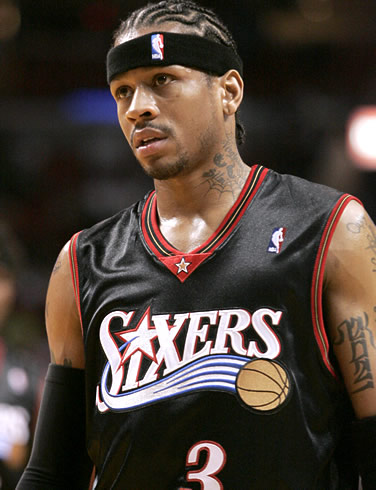
No one epitomized this more than Allen Iverson, who officially retired on Wednesday – and then watched from a box as the Sixers stunned the world champion Miami Heat – a few years after his playing career was prematurely put on life support.
Iverson was contrite and tearful when he made his announcement, and I don’t doubt his veracity.
He always wore his heart on his sleeve, and no naysayer can take that away.
On the court, a small player among giants, it worked to his advantage. Off the court, where he was as hard to handle as an errant pass against a full-court press, the opposite was often true.
The Allen Iverson I came in contact with in 1997 was an angry young man who blew off interviews and could be heard saying he “(expletive) hated (expletive) reporters” on occasion, while seeking high fives from whichever teammate was willing to play the role of temporary sycophant.
After his junior year of high school, he had been incarcerated – seemingly unjustly – and perhaps blamed the media, more so than the justice system, for that scenario.
The beat writers, though, weren’t trying to get him convicted on appeal. We just wanted a coherent quote after a game or at practice, and we ran with any morsel he grudgingly gifted for us like a pre-epiphany Ebenezer Scrooge.
I remember one guy coming all the way from Japan, for that country’s equivalent of Sports Illustrated, and staying two weeks waiting for an interview that never came.
All the Sixers employees could do was gingerly approach Iverson and ask if they had time for the guy. The answer was always no.
We weren’t asking for inner most thoughts on the meaning of life and death, just something simple from the players who just dropped 30 points in a dramatic win. Quotes from the more approachable teammates – Eric Snow, Aaron McKie, George Lynch, etc. – were nice, but when the three maybe had 12 points between them, it was not ideal.
If Iverson got out of bed on the right side and actually spoke at practice, some of my cohorts would actually go up to him the next day and thank him for talking to them like people with jobs to do.
I wasn’t playing that game. And I wasn’t long for the beat.
After my second season, the strike-shortened 1998 campaign that saw the team turn a corner and reach the second round of the playoffs behind the play of Iverson and coaching of Larry Brown, the landscape – as is apt to happen in the roller-coaster world of journalism – changed.
I was covering college hoops and keeping a keen eye, one now blessed with an insider’s insight, on the Sixers as they climbed Iverson’s shoulders to the summit of his time here. The Sixers reached the finals in 2001, falling to the Lakers in five games.
Even then, I didn’t miss the beat.
There was only one time when I did yearn to be back in that press room with Iverson at the podium, which was during the infamous press conference in April of 2002. That’s when Iverson said “practice, we’re talkin’ about practice” in a confrontational and derisive tone that, as he pointed out recently, made for a nice sound bite.
Another question arose about his conditioning, and he wondered why he needed to get “all swolled up” by lifting weights.
And no one asked the obvious follow-up question – at least not on camera. It was that working out would and should and could extend his career, or at least extend his prime.
No one was saying he had to be Charles Atlas – let alone Vinnie Johnson – but he owed it to himself, if not his employer and adoring fans, to put in the same effort in the gym that he did
playing more than 40 minutes a night for 82 games on the court.
But Iverson, like those high school athletes I covered, thought he was invincible.
He thought wrong.
Give me a vote for the Hall of Fame, and I put all personal feelings aside and put him in there with the other greats of the game.
An 11-time NBA All-Star (a two-time MVP of the all-star game), Iverson was the Rookie of Year (1996-97) and the league MVP (2000-01). Known as “The Answer,” he led the league in scoring four times and in steals three times.
What would keep him out? Beyond not winning a title, there is a legacy sullied by the clumsy way it ended.
Iverson’s lack of dedication off the court came back to haunt him in later years. He turned into a nomad faster than you can say “air ball.”
After averaging 26.4 points per game in 82 games for Denver in 2007-08, his production took a precipitous and permanent dip after being dealt to Detroit the following season. After three games in Memphis, he returned back to the Sixers for 25 games (averaging 13.9 points for an
atrocious team) in 2009-10.
He was never seen in the league again, and only played for pay just 10 more times – during an ignominious 10-game stint in Turkey, hoops hot bed that it isn’t.
There were no offers to play other than, in January of this year, from the Texas Legends of the NBA’s Developmental League.
Look up adding insult to injury in the dictionary, and there it is.
All careers end, and all superstars see their skills erode, but Iverson didn’t help himself with a head that was more “all swolled up” than his body.
And the media he despised didn’t do him any favors by not asking “The Answer” a simple question about the consequences of his actions.
And that’s no lie.
This column can also be found at http://www.phillyphanatics.com
Clearing Another Hurdle: Norristown’s Culbreath to enter MCCHOF
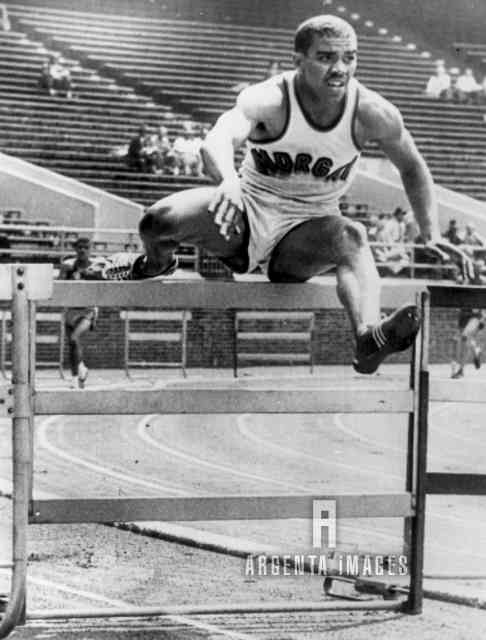
Josh Culbreath, above, clears a hurdle while running for Morgan State at the Penn Relays. The Norristown native will be inducted in the Montgomery County Coaches Hall of Fame Nov. 26. Dinner tickets are $60 (tables of 8 are $440). Mail checks to: Montgomery Coaches Hall of Fame; 803 Northview Blvd., Norristown, Pa., 19401. For more information, call 610-279-9220 or e-mail Gordonglantz50@gmail.com or tleodora@aol.com.
By GORDON GLANTZ
Gordonglantz50@gmail.com
@Managing2Edit
When Josh Culbreath came out for the Norristown High track team as a sophomore, he faced a bit of a conundrum.
The spikes needed to run on the cinder track at Roosevelt Field were property of the school and only handed out to those already on the team.
Any hopeful for legendary coach Pete Lewis’ squad had the challenge of out-pacing an existing letterman while wearing the familiar Converse basketball sneakers that many in the working class community bought at a local pawn shop.
He walked away, in silent protest, vowing to clear the figurative hurdle being laid in his path.
In 11th grade, Culbreath – after already running for track glory in middle school events at the Penn Relays – decided to take matters into his own hands.
Or feet, that is.
He decided to run barefoot on the cinders.
Culbreath – who also played basketball and football at Norristown High — made the team, and the rest is track and field history.
“I knew I was capable,” said the 81-year-young North Wales resident. “I paid the price, but I proved my point.”
The hardware in Culbreath’s trophy case includes a bronze medal from the 1956 Melbourne Olympics and two goal medals from the Pan American games.
On Nov. 26 — at Westover GC in West Norrition, Pa. (ticket information at bottom of article) – Culbreath will be inducted in the Montgomery County Coaches Hall of Fame, just miles from where it all began on the East End of Norristown.
Along the way, he always remaining a fierce but friendly competitor. Well-traveled and interested in other cultures, Culbreath would speak to foreign rivals in their own tongue and then say “I’m gonna whip your butt” in English, while they still smiled and nodded.
And he continued to fight injustice in his own way.
Sometimes he paid the price, but he kept on proving his point.
Such was the case when he was summoned from the campus of Morgan State in Baltimore for the 1955 Pan American Games in Mexico and met up with the team in Houston.
Culbreath and his fellow black teammates were not allowed to stay in a fancy hotel, instead being put up on a local Army base.
When the same hotel arranged for the athletes at the to have steak dinners brought in, Culbreath refused.
“They said, ‘Oh no, you can’t do that,’ … I said, ‘Oh, yes I can, and you don’t what to get me started,’” he recalled, shaking his head from side to side, still displaying a combination of disbelief in the scenario and pride in his stance.
“And they didn’t,” he added. “They knew better.”
When he went on to win gold in Mexico City, pictures of him collapsing after crossing the finish line prompted him to enroll in law school at the University of Colorado so he could train in high altitude.
He paid the price once, this time for not being prepared enough to win with dignity.
He was going to prove his point the next time around.
That chance came in 1959, taking gold again at the Pan American Games in Chicago.
Before scoring a scholarship to Morgan State, Culbreath was hoping against hope to use athletics as a springboard to a college education, but was prepared to follow his older brother into the Navy.
Culbreath did serve in the Marines after college, where he was a three-time national champion, and was the first active-duty Marine duty to both participate – and win a medal – in the Olympics.
He taught and coached in the Norristown School District, getting a Masters’ degree in education from Temple University, often using unconventional methods to get across to students labeled unteachable.
He moved on instruct young people around the world in track and field.
In 1988, Culbreath took the job as head track and field coach — for men and women — at Central State in Ohio.
Winning 10 NAIA titles – men and women, indoor and outdoor – had him and his team at the White House Rose Garden, being honored by President Bill Clinton.
Again, like that high school junior running barefoot on a cinder track, Culbreath was willing to stay true to himself.
Known as “Pop” to his athletes, he was willing to pay the price to prove a point.
When Deon Hemmings, a female runner from Jamaica, said she didn’t want to run anymore at practice, Culbreath offered to help her to pack her bags.
She stayed, and went on to win a gold medal at the 1996 Atlanta Olympics (where three of his other athletes also competed) and two silver medals at the 2000 Sydney Games.
A male runner with Olympic pedigree, Neal de Silva of Trinidad and Tobago, was actually sent home but welcomed back when he “became a man.”
De Silva, who placed seventh at the 1992 Barcelona Olympics, paid the price.
Culbreath, his coach, proved a point.
Yet again.
Dinner tickets are $60 (tables of 8 are $440). Mail checks to: Montgomery Coaches Hall of Fame; 803 Northview Blvd., Norristown, Pa., 19401. For more information, call 610-279-9220 or e-mail Gordonglantz50@gmail.com or tleodora@aol.com.
“Word” On Problems
I know it was an ugly loss in Denver, but Eagles’ coach Chip Kelly gave a brilliant quote:
“Ninety percent of the people don’t care about your problems and the other 10 percent are glad you have them.”
True is football, and in life.
I have actually been in situations where 10 percent of the people around me didn’t care about my problems and 90 percent were glad I had them.
Tough way to live, work and play.
Life is too short to be in those situations.

No Photoshop is being used here. Sofia and her little friend are joined at the hip. They weren’t born that way, but now they are. Perhaps there is a way to rectify it without surgery. We have a call in to an expert at CHOP. Or … we can appreciate that she has such a “close” friend already.
The Heat Of The Moment
Defeating the Kobayashi Maru
By GORDON GLANTZ
@Managing2Edit
GORDONVILLE – As we sat around the dinner table – you know, kind of like “The Waltons” (Sofia even insists we take turns saying grace, which is a challenge when it’s my turn because I feel I need to leave the word God out of it) – we commenced discussing this Syria situation.
It was Saturday, and my head was still spinning from Temple’s 28-6 loss/moral victory against Notre Dame (my young Owls were 30-point underdogs) and the Eagles’ inexplicable roster cuts (no Chris McCoy, really?), but CNN on in the background helped refocus the conversation.
My mother, Sofia’s Nana, seems the most obsessed about it (you know seniors, when they get stuck on something). The wife, Sofia’s Mama, seeks a solution as an intellectual challenge.
Me? I don’t see why the Eagles need six cornerbacks on the active roster when two have broken hands …
Oh wait, Syria.
Yeah, that’s a tough call.
Damned if we do, damned if we don’t (and damn, don’t I enjoy the freedom to use a word like “damned”).
“Kind of reminds me of the Kobayashi Maru,” I said.
“Wait … what?” said a little voice.
Yeah, that was Sofia, already talking like Taylor Swift as an incoming missile of a first-grader.
I know, right? (Yep, she says that, too).
So I had to explain that it was not a new Japanese restaurant, which was important to clarify since her Mama has a Sushi addiction (I’ll have to save that line for a song).
It derives from the alternate universe that is Star Trek. As Trekkies know – I am a hidden Trekkie, as I’ll watch the original series for hours but not be caught dead at a convention – the Kobayaski Maru, while not a bad name for a high-end Japanese food joint, is a Starfleet test.
Cadets, as shown in the opening scene of the fine flick “Star Trek II: The Wrath of Khan,” have to find a way to survive in a simulated no-win scenario.
After the commander in training, a fine Vulcan chick (despite the ears) named Saarek, flunks – and first-time viewers are led to believe everyone is really dead on the ship – Kirk walks through a door in the mock bridge and engages Saarek in constructive criticism.
“I don’t believe in the no-win scenario,” he says.
Kirk, as it turns out, is the only cadet to have avoided losing.
How so?
He cheated, programming the computer ahead of time, for which he received a commendation for “original thinking.”
As much of a glass-half-empty type of a guy as I am – particularly with sports and traffic jams – I am kind of with Kirk, a role model of sorts (although Mr. Spock, with his logic, appeals the most).
Syria might be a lose-lose – as most scenarios in the arcane Arab world are (Spring or no Spring) – but the president, blessed with an IQ double that of his predecessor, will at least join Temple and find a way to beat the spread and record a moral victory.
I think Obama should wait – at least until after the Eagles open the season on Monday Night Football, Sept. 9.
The wife thinks he should put the onus on Congress a little, as it is a political wedge issue at home as much as it is a moral one in Syria.
Nana, she just holds her head, not knowing what to do.
“I would attack now,” says a little voice.
Why? We ask.
“To surprise them,” she responds.
And it’s not like she hasn’t been giving it some deep thought.
As soon as she heard about it, she said: “Another war? Not again. I don’t believe it.”
And then she broke out her map to locate Syria and study the logistics.
While she was more upset Saturday afternoon that Disney Jr. did away with her favorite game on its website, our little Hillary Clinton was refocused on world affairs come dinner time.
The question arose about whether or not Syria bordered Israel. I said it did, but Nana dared to doubt me (I guess that’s fair, considering the grades I brought home). Sofia backed her Daddy up, breaking out her trusty map (after grilling me over where I put it after tidying up the family room that often looks like Hurricane Katrina blew through and George W. Bush sent “Brownie” to deal with it).
After she put it away, the question arose as to whether Syria was also bordered by a body of water. In an instant replay, my affirmative response was not good enough. Sofia went for the map again and pointed it out.
“See, Nana, the Mediterranean Sea,” she replied.
And yes, she rattled off that word – with its 13 letters and six syllables – as if it were “gaga.”
It’s been that kind of summer with Sofia.
For me, she has found a way to help me win the no-win scenario.
And I will be so eternally grateful that I vow to spoil her rotten forever.
I know I was already doing that, but you get the point.
That car at 16 is looking good, even if she isn’t allowed to drive it until she is 30.
Meanwhile, at 6, she continues to do and say amazing things – like the morning she got up first (a true rarity, as she is a night owl like her Daddy) and sat quietly under a hallway light and made a list of all the states and their capitals.
Or like the time she got her dolls ready for a tea party for hours, including writing up invitations (she tried to make the cats sit still for the party but it didn’t work).
Or the time I came home late from the recording studio and she scurried out into the hall to issue a whispered warning: “Mommy’s not happy with you.”
It’s terrific that Sofia is smart, but even better that she has – at least so far – a desire to learn.
She had a summer reading list knocked out by June, and her math workbook nailed by July. She has a first-grade primer she does just for fun. Ditto for drawing and crafts.
She also throws the cutest tantrums when she doesn’t get her way, or when she is misunderstood or rushed, and it’s hard to get her off the computer and/or iPad.
She can be bad.
But it’s all good.
She is better than any mind-numbing tranquilizer. It has been the best, most carefree summer of my “adult” life.
We have gone on multi-night stays in Hershey and the Eastern Shore of Maryland (she was a little bored at Annapolis, but was a good sport for my sake). She also took day trips to Dutch Wonderland and Crystal Cave.
She got a new kitten, Hershey, giving us a feline hat trick (even though Sofia is a little allergic).
In between, I have been her chauffeur for all kinds of stuff – piano lessons, swimming lessons, music camp and gymnastics.
But it’s not just about where she has gone and what she has done. It has been a blessing – there I said it – to be in the here and now with her, without having to worry about rushing off to work all the time and coming home after she is already asleep.
There have been glimpses into the future, too. In tears, she confessed that some of the girls in her dance class this past year could do cartwheels and that the teacher praised them – and one specifically – for being graceful.
You could see the betrayal in her face when Nana let it slip, after pinky-swearing not to tell, which kid from Kindergarten Sofia considered her boyfriend (this happened while Sofia was pretending to be at a café in France and making Nana be the waitress).
I played dumb, telling Sofia I didn’t hear what Nana said because my hearing aid wasn’t in, but I don’t think she bought it.
Being able to share this extended quality time with her – negotiating like union-versus-management to get her to practice the piano and watching “The Family Guy” from 11 to midnight (although she thought it was a good idea to put on Al-Jazeera to get “their point of view” Saturday night) – has taken the losing hand I was dealt by being left jobless and turned it into into a royal flush.
They say that it is he who laughs last, laughs the loudest.
I have had some loud laughs this summer, so I guess I’m laughing last.
And it’s all because of Sofia and her ability to turn my my Kobayashi Maru into a win — without even cheating.
Related articles
- The Career Kobayashi Maru (career.answers.com)
- Is academia a “no-win scenario”? Scholar Hero does the “impossible” (scholarhero.wordpress.com)
- Sustainability lessons from Star Trek (theguardian.com)
- Syria: The Quintessential No-Win Predicament (LiberalBeef.com)
- More than 110,000 dead in Syria conflict: activists (dailystar.com.lb)
The Revolution Starts Now
By GORDON GLANTZ
@Managing2Edit
GORDONVILLE — So I was rapping to this guy the other day, and I was describing some ordinary situation in my day. I added that it annoyed the heck out of me.
His response: “Everything annoys you.”
Well, not everything.
But enough “things” that the point is well-taken and met with little resistance.
Near the top of the AL – Annoyance List, not American League – standings is the propensity on the nightly news, usually on a Sunday, to list the top movies of the week.
The criteria? The box office sales are it, which is really a sad commentary on culture, given the subject matter of the majority of the movies.
Want to raise the bar on Hollywood, challenging it to do better than it does with lame scripts and gratuitous violence? Change the approach. Why not list the “best” movies, according to critics, that week?
Dumb?
Not so, dumb-dumb.
Not an alien concept, really. AP and USA Today release Top 25 rankings for college football and basketball – among other sports – on a weekly basis. Those votes are also based on media observations from those with trained eyes.
Why doesn’t this happen in the movie universe? Well, if you subscribe to the theory that everything is a conspiracy until proven otherwise, Hollywood is in cahoots with the networks that broadcast these lists of high-budget B movies.
It’s not that, say, science fiction cannot have a role in storytelling. At its best, the genre uses an alternate setting to send a strong message. But how often, realistically, does that happen anymore?
I have an idea for the perfect sci-fi thriller, as it eerily hits close to home. It need not be set too far into the future, either. Maybe 50-75 years, tops.
And it is rooted in today’s headlines.
Seems that a day doesn’t go by without hearing of bears infringing upon man’s arrogant eminent domain and attacking and mauling, right? Ditto for coyotes. And we all know about deer daring to get in our way on the roads to the extent that hunting season is cast in a way that is supposed to be for our best interest – and that of the hunted (LOL!). And we are also getting more reports of shark attacks than ever.
Some of it is the 24-hour news cycle and Internet bringing this stuff to light more readily, but it’s hard to buy as the only reason.
Where there is smoke, there is fire.
So here is the plot. The bucks, with their mighty antlers, decide to get angry about the violence perpetrated against their women and children and begin turning aggressive toward human women and children. The bears, the sharks and coyotes – and maybe alligators and snakes — follow suit.
The only way to stem the tide is for the adult male of the future where just about all (49 of 50) are stricken with autism (1 in 50 boys now, in 2013, and the epidemic is getting worse, so it’s not outlandish) to find a way to communicate and work together, to create an environment where we can co-exist with these animals again and reverse the risk factors for Austism Spectrum Disorder – clearly in the polluted air, the food loaded with additives and medication we take in the U.S. at a rate well beyond that of the rest of the planet – to have that Hollywood ending.
We can call the movie “The Revolution Starts Now” after the Steve Earle song (I have Steve Earle on the brain after he rocked my world at the Sellersville Theater Thursday night).
How’s that?
Nah, too close for comfort.
Bring on the vampires and zombies and keep on annoying me.
I’ll be OK. It’s just another example of … drum roll … What Is And What Should Never Be.
Ready for more?
What Is: A study conducted by the University of Michigan – my favorite college football team once each year, when Penn State is the opponent – reveals that making connections, via Facebook, might have us singing the blues.
And What Should Never Be: Letting a positive turn into a negative.
The point of the study was a good one. Facebook time can cause us to compare our lives to that of others and leaving us coming away feeling like we have bought one-way tickets to Loserville.
I have been there, done that. Not gonna lie.
For myself, being home a lot this summer with Sofia has led to time interacting on Facebook, often engaging in political debates and just touching base with people I am better for knowing.
It’s just a phase, though. I have gone – and will go – through others where it’s a secondary activity and not my immediate connection to the outside world.
We just have to take it for it is, and stare the truth in the eye.
Certain people, for whatever reason – who and what they represent in relation to our own life and times, and ensuing trials and tribulations – can put us in a funk by paging through their pictures or status posts about how they are in this place or that enjoying wine and cheese with friends.
But this is an onion that needs peeling, the study cautions. In actuality, it is the people who “socialize the most in real life” that are most prone to these oft-unhealthy comparisons.
According to John Jonides, the research co-author and a University of Michigan cognitive neuroscientist: “It suggests that when you are engaging in social interactions a lot, you’re more aware of what others are doing and, consequently, you might be more sensitized about what’s happening on Facebook and comparing that to your own life.”
I would have to say that more good than bad has come of entering the Facebook universe that allows room to breathe, despite 1.1 billion co-inhabitants.
What Is: Just to prove that man does not live by Facebook alone, a more recent discovery – Netflix – has opened up new horizons.
And What Should Never Be: Having a closed mind.
I had heard how Netflix reinvented itself for years, but figured the likes of HBO had me covered in the quest for inspiring and intriguing entertainment.
Even knowing that Netflix had an original series starring Steven Van Zandt wasn’t enough.
But then I got an iPad for my birthday in March and I took the plunge, figuring seeing the likes of “The Wonder Years” and “Star Trek” – while playing catch-up on “Mad Men” — was worth the price of admission.
Turns out, I went off in a completely different direction. First it was “Sons Of Anarchy.” Then, a friend told me about a show called “Freaks and Geeks” about high school in the early 1980s, which is when we were in high school. The only bad part of the show was that it only lasted one season and left me lamenting what could and should have been.
Next, I turned to the Van Zandt vehicle, “Lillyhammer,” and got a kick out of him pretty much reprising the role of Silvio Dante (“The Sopranos”) in a bizarre setting (a New York mob guy in witness protection in Norway).
The cool thing about Netflix is that, like Facebook, it takes a snapshot of what you like and suggests more ideas.
That led me to another original Netflix series, “Orange Is The New Black,” and I roared through the first season in about two weeks. Ditto for the award-winning “House of Cards.”
HBO cornered the market with the catch-phrase of “it’s not TV, it’s HBO.” Now, one has to consider saying, “it’s not HBO, it’s Netflix.”
Then again, “Boardwalk Empire” returns Sept. 8 on HBO.
How do I know?
Facebook.
What Is: The aforementioned Steve Earle – even though his show ended too late to stay in line for an autograph, which I may live to regret – got me thinking about our place and time in history (including the story line for the movie, as he spoke of his toddler son with autism).
And Should Never Be: Not turning the deep thinking to action.
Earle explained that all songwriters of his generation follow in Bob Dylan’s footsteps, whether they want to admit it or not (don’t the ones who refuse to submit just annoy you?). He continued to explain that Dylan modeled himself after Woody Guthrie, whose legacy was pretty much creating the realistic soundtrack of The Great Depression era. Earle added that Dylan would be the first to admit that he never experienced America going through the hard times as seen through the eyes of his hero, Guthrie.
Earle, who has been touring by bus for a while, said that it has struck him that the America he is now seeing is as horrific as that of Guthrie’s time.
And he’s spot-on accurate.
I blame Bush, you blame Obama.
Others point to Wall Street.
And maybe we should just look in the mirror, blame ourselves and start doing something about it.
After Earle and his band – The Dukes – aptly ended their show with “The Revolution Starts Now,” the lights went up and a recording of Guthrie’s “This Land Is Your Land” (should be the national anthem, but don’t get me started on that) began to play.
It sounded new again.
It sounded great.
Related articles
- Netflix the ‘New HBO’? Get Real (variety.com)
- Steve Earle; The Voice of Reason … (keenemusic.wordpress.com)
- Netflix’s Latest Content Grab: All Weinstein Movies (businessweek.com)
- REVIEW: Steve Earle at Sellersville Theater: Roots rocker plays big show in intimate venue (blogs.mcall.com)
- Netflix Is Still No HBO (dailyfinance.com)
- In Defense Of … Netflix Being the Future of Television (Column) (popmatters.com)
- Netflix Strikes Movie Deal With Weinstein Co. (abcnews.go.com)