Category Archives: Uncategorized

Fullback Fallback

By GORDON GLANTZ

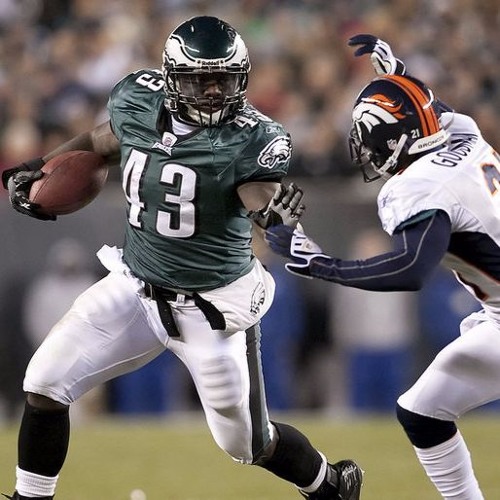
In a move that was approved at the highest level of the organization – that being Eagles’ team owner Jeffrey Lurie – former linebacker/special teamer Ben VanSumeren is now a fulltime fullback.

Just to make it officially official, the third-year man out of Michigan State (by way of Michigan) saw his jersey number switched from 57 to 43 (meaning his doesn’t have to declare himself eligible as a receiver).

VanSumeren (6-2, 231) will surely still be a core special teamer, but he is caucusing with the other running backs.

The move isn’t random. There is some offensive pedigree here, as VanSumeren – aka BVM – was a top-notch receiver in high school.

He was initially recruited to play running back at Michigan, where he gained 20 yards and scored a touchdown on five carries as a true freshman. VanSumeren was then moved to fullback and then linebacker before transferring to Michigan State, where he started 10 games as a senior linebacker and recorded 81 tackles and two sacks before being signed by the Eagles as an undrafted free agent in 2023.

It was last season, before going down a knee injury, that VanSumeren was inserted into the lineup as a fullback and laid down some key lead blocks, primarily for Saquon Barkley (while catching a pass for a gain of one yard).

While VanSumeren will not likely play more than a handful of offensive snaps per game, the commitment to resurrect the fullback in Philly allows us to look back at the top fullbacks in franchise history, which also sadly reveals the sheer brutality of the position.

Honorable Mention (alphabetical order):

Cecil Martin (1999-2002): A 6th round pick out of Wisconsin, Martin – a 6-0, 235 pounder – Martin was the first of many fullbacks in the Andy Reid, starting 38 games in four seasons, running for 103 yards and catching 81 passes with 2 touchdowns. Martin also caught a 13-yard touchdown pass in a 33-19 playoff win at Chicago, where he was born and spent time in homeless shelters.

Jon Ritchie (2002-03): While the Stanford product’s best years were with the Raiders, then of Oakland, Ritchie was the fullback on a 2002 Eagles’ team than gained more than 2,000 yards on the ground. He also caught 3 touchdown passes.

The native of Mechanicsburg, Pa. Ritchie became a broadcaster on TV and radio, and has the ignominious distinction of repeatedly calling for Howie Roseman to be replaced.

Owen Schmitt (2010-11): In two seasons with the Eagles, Schmitt never did a whole lot with the ball in his hands.

While he had 19 catches and a touchdown on a 10-6 team in 2010 and turned three catches on an 8-8 2011 team into two more TDs, his main contribution was as a lead blocker for LeSean McCoy, who ran for 2,367 yards combined in those two seasons.

At 6-2 and 251 pounds, Schmitt fit the part of a vintage fullback, as a surgery for a cleft palate when he was younger left a menacing scar under his nose to his upper lip.

And now, the Top 10 …

No. 10) Thomas Tapeh (2004-07): When Brad Childress went from being the Eagles’ offensive coordinator to the head coach of the Vikings, Tapeh was signed on the first day of free agency. That was a sign of his value.

It was no secret that Tapeh, who had battled hip and knee issues just to get back onto the field, played a key part in Brian Westbrook having his best two statistical seasons (2006 and 2007) with Tapeh as his fullback.

No. 9) Earl Gros: After two years backing up Jim Taylor in Green Bay, the former first-round pick was swapped to the Eagles in the 1963-64 offseason.

The 6-3, 220-pounder led the Eagles in rushing in the year of Beatlemania by gaining 748 yards and scoring twice while catching 29 passes.

Gros ran for less yardage in 1965 and 1966, but had 7 rushing TDs each of those seasons while catching 29 passes again in 1965 and 18, with two scores, in 1966 (the team’s last winning campaign, at 9-5, until 1978).

No. 8) Mike Hogan (1976-78, 1980): In the mid-70s, with guys like Larry Csonka and John Riggins, it was not uncommon for fullbacks to be the primary rusher on their teams.

Even the teams that were not so good, like the Eagles.

Hogan – at 6-2, 213 pounds – was the Eagles’ fullback from 1976-78, starting 32 games in that time frame.

He led the Eagles in rushing in 1976 and 1977, with 561 and 546 yards, respectively. In 1978, when Wilbert Montgomery emerged as the main threat at halfback, Hogan still posted a career-bests in rushing yards (607) and rushing touchdowns (4). He also caught 55 total passes as an Eagle.

No. 7) LeRoy Harris (1979-82): At 5-9 and 226 pounds, Harris made the most out of his low center of gravity when he usurped Hogan as Montgomery’s escort in 1979, and had his best season that first year, gaining 504 yards on 107 carries (4.7) with two touchdowns and 22 receptions.

While his numbers dipped in the 1980 season to 341 yards on 104 carries and 15 receptions, Harris had his shining moment as an Eagle in the NFC championship game against Dallas.

While Montgomery ran for 194 yards and a memorable early touchdown, it was Harris leading the way with some devastating blocking. Harris also added 60 yards and a touchdown on 10 carries in the storied 20-7 win.

In the fourth quarter, when the Eagles were trying to run out the clock and Montgomery exhausted, Harris picked up some key first downs on sheer determination.

The scoreboard at Veterans Stadium flashed “Leroy Wants It” as the crowd roared.

Harris missed the 1981 season with an injury and retired after playing sparingly in the strike-shortened 1982 season.

No. 6) Norm Bulaich (1973-74): Bulaich was a first-round pick of Don Shula and the Baltimore Colts and helped them win Super Bowl V as a rookie in 1970. He then made the Pro Bowl at fullback in 1971.

After an injury-riddled third season, the 218-pounder was traded to the Eagles and was a key part of the potent Roman Gabriel-led offense of 1973 that saw wide receiver and rookie tight end Charle Young join Gabriel in the Pro Bowl while halfback Tom “Silky” Sullivan ran for 968 yards (in 13 games).

Bulaich, played a key supporting role in the “Fire High Gang.” He supplied key blocking and gained 436 yards (4.1 average) on the ground and a caught a career-best 42 passes for another 403 yards (9.6 average) and 3 TDs.

Nicknamed “Paper Head” because he suffered multiple concussions that were called “dings” at the time, Bulaich had bouts with memory loss but still started all 14 games in the 5-8-1 season.

Bulaich was not as effective in 1974, his final year here, before being reunited with Shula in Miami.

Subsequent tests on Bulaich, in terms of CTE effects, were officially inconclusive and he worked as an executive for a waste management company in his native Texas.

No. 5) Anthony Toney (1986-90)/Keith Byars (1986-92): In the mixed-up confusion that was the Eagles offense during the Buddy Ryan era, it was never 100 percent clear whether Toney or Byars was the halfback or the fullback.

What is known that, when Ryan drafted Byars 10th overall in 1986, it was to be “the next Jim Brown.”

Even though he was more than 240 pounds, that would seem to indicate Byars was meant to be the halfback while Toney was nabbed in the second round to be Byars’ running mate at fullback.

Byars struggled to regain his college form because of the same right foot injury that kept him out most of his senior year (he gained a whopping 1,764 yards as a junior). Consequently, Toney (54 starts over 5 seasons) received more of the workload as the primary runner.

Byars, to his credit, became a stellar receiver, using his gigantic mitts to make one-handed grabs out of the backfield. He also became such a strong blocker that he was more or less considered a motion tight end at the end of his stint in Eagleville before moving on to the Miami Dolphins as a true pure fullback, earning him a Pro Bowl nod.

Toney, for his Eagles’ five-year career that was cut short by hamstring issues, gained 2,229 yards to along with 14 touchdowns. He also and had 122 catches.

No. 4) Kevin Turner (1995-99): An Alabama product, Turner came to the Eagles from the New England Patriots and was a traditional fullback in front of the one-two punch of Ricky Watters and Charlie Garner in the Ray Rhodes era.

He missed all but two games of the 1995 season with a knee injury but bounced back in 1996, when Watters and Garner combined for more than 1,700 yards rushing and Watters led the NFL in all-purpose yards.

Turner, who caught 43 passes for 409 yards (9.5 average), received the Ed Block Courage Award at the end of that season.

His courageous battle had only yet begun, however.

Turner had two more solid years with the Eagles in 1997 and 1998 but was limited to 8 games in 1999 by what were called “stingers.”

In 2010, Turner was diagnosed with ALS (Lou Gehrig’s Disease) and died in 2018. Turner donated his brain and spine for further study and it was determined that CTE likely caused the ALS.

No. 3) Leonard Weaver (2009-10): In 2009, after coming over the Seattle Seahawks, Weaver picked up 323 rushing yards (4.6 average) and 2 touchdowns while adding 15 catches for 140 yards and another pair of touchdowns. A strong blocker, Weaver was named to the Pro Bowl and first-team All-Pro at fullback.

This earned him a three-year deal, but it was all short-lived.

After the 2009 season, Weaver went from being considered the best fullback in football to being out of the game entirely when he sustained a gruesome ACL injury on his first carry of the 2010 season.

No. 2) Clarence Peaks (1957-63): Pedigree? Peaks was drafted 7th overall in 1957 out the Michigan State, one pick after Jim Brown and in the same draft where the Eagles also plucked Tommy McDonald and Sonny Jurgensen.

The 218-pounder immediately established himself as a power runner, gaining 405 yards as a rookie and 386 and 451 the next two years.

In 1960, Peaks was having a career year before going down with a broken leg. In 7 games, he gained 465 yards (5.4 average) and scored 3 touchdowns.

While he lost some burst after the injury, Peaks ran for 471 and 447 yards the following two seasons before seeing his numbers dip in 1963 to 212 yards in only 6 starts.

Peaks later became a color commentator for Eagles’ game on WIP.

As an Eagle, in seven seasons, he ran for 19 total touchdowns and caught 2 more on 175 catches.

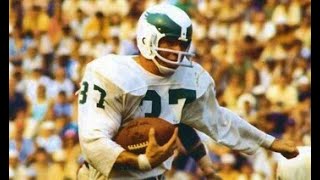
No. 1) Tom Woodeshick (1963-71): In 2007, a sportswriter poll by the Philadelphia Inquirer placed the Wilkes-Barre native 47th all-time on the list of Greatest Eagles.

Sports llustrated named Woodeshick, an 8th round pick out of West Virginia in 1963, the best Eagle ever to wear jersey No. 37.

Fast enough to beat teammate Timmy Brown in a foot race but also powerful at 6-feet and 225 pounds, Woodeshick played sparingly for three seasons but became the starting fullback in 1967. He then embarked on an almost apocalyptic journey of being a really good player on some of the worst teams in modern franchise history.

In the next three seasons, 1967-69, Woodeshick ran for 2,448 yards and 13 touchdowns.

His best season was 1968, when he gained 947 yards and had to exit the final game early with a gash that was so harsh that opposing players initially thought he lost an eye.

It was in the same game that exasperated fans threw snowballs at Santa Claus, and then at head coach Joe Kucharich.

Woodeshick was second-team All-Pro in 1968 again in 1969, when he gained 831 yards and ran for 4 TDs despite missing the last two games with a knee injury that proved to be the beginning of the end for him.

After knee surgery, the Eagles released him before the 1972 season.

Woodeshick, whose post-career included column in the Inquirer along with providing commentary for the infamous Philadelphia Bell of the short-lived WFL and did some coaching at Moravian College, was disappointed about how his career ended (despite 3,577 yards and 21 touchdowns as an Eagle).

“I’m extremely bitter,” he was quoted as saying. “There’s no avoiding it. I wanted to go out like a pro. Not so much for myself, but for the fans here. They deserve a winner.”
Post-Mortem Message: Go Lower

By GORDON GLANTZ

GORDONVILLE – Dearly beloved, we are gathered here today to get through this national nightmare of another Donald Trump presidency.

As I struggle to understand how an individual who never worked a hard day in his life and who ducked out of Vietnam five times with phantom bone spurs can emerge a working class hero, this eulogy is about the Democratic party that is only expert at repeatedly shooting itself in the foot.

It’s the same Democratic Party that absorbed a lopsided loss in the 1972 presidential election, with Tricky Dick Nixon carrying 49 states to George McGovern’s one (Minnesota) but rose from those ashes — exemplified by having to endure the ignominy of a television telethons to raise money for itself — to elect Jimmy Carter in 1976.

Even though the pendulum swung back to the right with Ronald Reagan in 1980 and back to the left again with Bill Clinton in 1992, it shows you can reinvent yourself. Remember, before the scourge of Nixon in 1968, the Democrats owned the 60s with JFK and LBJ and important advancements in social issues like civil rights.

Trump was not only reelected, but is now positioned for complete control with all branches of government (Senate, House and Supreme Court) tucked his obnoxious overcoat designed to hide his beer gut.

There is now a steep hill to climb to again become the party of FDR and Obama, but history has shown that it is possible,

America loves a good comeback story, which is probably why a 34-time felon and serial abuser of women was just absolved in the court of common misconception.

Before Barack Obama burst onto the scene in 2008, there was the disheartening election of 2004. George W. Bush had ignored warnings prior to 9/11 and displaced his aggression by making the response more about Iraq and less about the Taliban in Afghanistan.

Meanwhile, as poor kids were fighting the rich man’s war on two fronts, tax cuts were dulled out to the wealthy, screwing up the economy.

The Democrats seemed to have the ideal cure to this scourge in a Vietnam War hero, John Kerry, but that was turned around fast by a disinformation campaign.

While Bush had a soft military record (although a Red Beret, compared to Trump), Kerry commanded a Swift boat during a tour in Vietnam, a rarity for a Yale graduate. He earned thee Purple Heart Medals, a Sliver Star Medal and the Bronze Star Medal.

Gotcha now, right?

Wrong.

By the GOP Convention of 2004, he was openly mocked about his service and about a few issues he had dared to change his mind about, and we all know that nuanced thinking is viewed as weakness by the right.

The crowd had props as well: Flip-flops with Kerry’s face on them. Whenever he was lambasted by a speaker, they chanted “”Flip Flop” and waived these flip flops in the air.

Sounds juvenile, but in he kangaroo court of common opinion, he was doomed to ultimate defeat (even with Bruce Springsteen and R.E.M. on his side).

Fast forward to the current election, where vice president Kamala Harris had to take over the candidate for aging Joe Biden, I remembered these antics and wondered why Democrats couldn’t rip a page from that playbook of lowdown trick plays.

While there were inspiring speeches from the stage, there was not enough sheer hostility.

I know all about Michelle Obama’s “when they go low, we go high” message, but the messaging needed some updating.

Remember when Trump grudgingly visited Puerto Rico after Hurricane Maria and proceeded to throw paper towels at people as if they were dog fetching a bone?

How about organizing games of Paper Towel Dodge Ball or Basketball, or both, on the Convention floor?

Remember hearing how we thew ketchup against the wall in a temper tantrum after realizing that he couldn’t overturn a free an fair election?

How about ketchup throwing contests.

This image has an empty alt attribute; its file name is 17c2f-kerryjohnsecstate.jpg

We all know about him getting out of Vietnam altogether — five times — with phantom bone spurs.

There are veterans groups out there who are vehemently against Trump, They should have been front and center, perhaps with shirts saying “Look, Ma, No Bone Spurs.”

It sounds silly, especially to come from the more educated left, but we need to take the temperature of the country better and let it know if it is suffering from a fever (you know, like COVID, which he flat-out bungled and destroyed the robust economy he inherited from Obama).

How about telling the truth about immigration, in lieu of echoing the venom in a lesser form)?

The reality is that undocumented workers commit crimes at a lesser rate than citizens. Without them, agriculture is going to suffer.

Say that. You’re allowed.

Trump lied so much in both debates that independent fact checkers could barely keep up. Those lies should have and could have been deployed in commercials and social media almost in real time.

Were they? No, not really.

I really don’t know who was running the Harris campaign, but they should never be in national politics again.

I could go on, but you get the point. The Democratic party, my party, needs what they call a Come to Jesus Moment. And, really, it needs to stop being all things to all people. Define a simple message and stick to it. Find an ideal candidate now, send him to the tailor and make sure he fits the suit. Send him to the barbershop and make sure he looks the part.

Going back to JFK, he looked better than a sweaty Nixon in a 1960 televised debate, the first of its kind. Those listening on radio had it scored evenly, those watching were enthralled by Kennedy’s looks and charisma.

I know a lot of women near and dear to me felt the sting of Hillary Clinton losing in 2016 and then of Harris falling this time.

While neither helped themselves with their choice of running mates. it was clear the country wasn’t ready for a woman when Clinton ran (even though she did win the popular vote, much to Trump’s chagrin) and wasn’t ready for a woman of color his time around.

The Democrats need to be a bit less PC, sorry to say. No female candidate. No gay candidate, no matter how qualified. No extremely progressive candidate talking about issues that really don’t affect the whole.

The top of the ticket needs someone like California governor or Beto O’Rourke of Texas. Although Maryland governor Wes Moore and New Jersey senator Corey Booker are beyond qualified, the Democrats might want to step away from anyone of color, even at the bottom of the ticket. for 2028.

We have dug ourselves a steep hole here, and time to start digging out starts now — and with clear heads and minds.

Disco Duck Revisited

By GORDON GLANTZ

GORDONVILLE — I know it’s hard to believe, given that I’m the handsome-but-aging devil I am today, that there was once a time when I was the the ugly kid at the Junior High — or Bar/Bat Mitzvah or overnight camp — dance (record hops, as they were called).

There was no moment more sad than hearing Donna Summer’s “Last Dance,” signaling the end of the night, and me and the other dorks still standing by the punch bowl.

After scoring big in fifth grade with the ladies, the steady decline began in sixth and only got worse from there with buck and crooked death and Brillo pad hair. By the end of high school, I suppose I was sneaky cute and it was fifth grade all over again by college (girls not being into messed-up older guys helped).

What does this memory of my Disco Duck years have to do with my latest NFL Mock Draft? Everything, actually.

My latest public Eagles-only 7-round mock, unlike others, included trades. The computer offered me some, and I offered it some.

And, like those dances of yore, I met with a lot of rejections in my offers.

Example: In the first round, I offered the Houston Texans — not exactly beauty queens themselves — the 18th overall pick and a third for the 13th overall pick (Cincinnati corner Ahmad “Sauce” Gardner was still on the board) and a sixth. The answer? A flat no.

And so it went.

Here it goes the Mock Draft, with trades, hot off the presses:

Round 1

Pick 15: George Karlaftis, DE, Purdue (6-4, 270)

Notes: A lot was made of Michigan’s David Ojabo not having a ton of football experience and his ultimate upside, even before his injury. Karlaftis was born in Greece and grew up playing water polo before moving to he US and taking up football in high school. Translation: He is already good, and is still going to get better. I really didn’t like him at first, but he has grown on me.

Then came a trade offer from the Detroit Lions, who were asking for the 18th and 101st picks in exchange for No. 32 and 34. I accepted.

Pick 32: Kenyon Green, OG, Texas A&M (6-4, 325)

Notes: Brandon Brooks is gone, and I’m just not sold on Isaac Seumalo right now being the guy, especially at his salary. Green, at worst, could either start by next season or could be ready by midseason if and when Seumalo gets hurt again.

Round 2

Pick 34: Christian Watson, WR, North Dakota State 6-4, 210)

Notes: Passed on the chance to get some wideouts in the first round, instead settling on more sexy picks, and Watson may end up being the best receiver in the draft when it is all said and done. He began the draft process as a Day 3 dark horse and has raised his own stock at every turn. He checks all the boxes for the Birds, in terms of size and his ability to also double as a return man.

Pick 51: Troy Andersen, LB, Montana State (6-4, 240)

Notes: If you like Leighton Vander Esch, despite the uniform he wears, you will love this Swiss Army Knife. Andersen may just be limited to special teams early on while being phased into the defense, but it will be worth the wait. And don’t be shocked, in the interim, if he gets in some snaps on offense on gadget plays.

Round 3

Pick 83: Trey McBride, TE, Colorado State (6-3, 250)

Notes: I have a long list of Day 3 tight ends that I was going to refer to when the time was right, but I was pleasantly surprised to still see my No. 1 tight end still on the board. With all due disrespect to J.J. Arecega-Whiteside, who allegedly converting from receiver to tight end, it was a no-brainer.

Round 4

Pick 134: J.T. Woods, S, Baylor (6-2, 190)

Notes: Like the McBride selection, the value here was too good to pass up, even with some corners on the board. I’m just not sold on the current safeties as anything more than flotation devices. He has improved his stock slightly — from, say, the latter part of Day 3 — by allaying some fears about man coverage in postseason poking and prodding. He is one of the faster safeties in the draft.

Round 5

Pick 154: Dameon Pierce, RB, Florida (5-9, 215)

Notes: I’m still not sure why Jordan Howard was so quickly jettisoned, and I mourn his loss from the roster. Pierce, though, brings some of the same qualities with his compact frame. I’m reminded of the “Weeble Wobble But They Don’t Fall Down” toys of the 1970s.

Pick 166: Tyquan Thornton, WR, Baylor (6-2, 180)

Notes: The kid is 6-2 with 33-inch arms and runs a 4.2 40. He is only 180 pounds and is raw and doesn’t always catch the ball, or double catches it, meaning we could be looking at another John Hightower. Or not. Worth the pick here.

Pick 173: Aqeel Glass, QB, Alabama A&M (6-4, 235)

Notes: Nowhere near ready to play meaningful regular season snaps for a year or two, but the raw tools make him an upgrade at the No. 3 spot on the depth chart.

Round 6

The Eagles currently don’t have a 6th having the swap of picks with the Saints, but I was able to fix that by actually asking a girl to dance and getting a “yes.”

The Patriots accepted a fifth next year for a sixth this year. Seems a steep price, but this draft is deep and the Eagles are awash in picks next year.

Pick 200: Dawson Deaton, C, Texas Tech (6-5, 305)

Notes: He is a former defensive lineman and will bring an attack mentality to Jeff Stoutland’s classroom.

UPDATE: Nate Herbig just resigned with the Eagles, so Deaton is not needed.

NEW PICK 200: Tayland Humphrey, DT, Louisiana (6-5, 350)

Notes: “Big Saucy” will need some refinement, but you can’t teach size, and he has it.

Round 7

Pick 237: Velus Jones, WR, Tennessee (5-11, 200)

Notes: A third receiver seems a bit much, but we just need to trust the board here and go value. Jones lacks some size/speed stuff but plays the right way, grading out as an excellent blocker, and brings needed return skills (as a Plan B for Watson).

Summary: I left the dance with only admiring San Diego State punter Matt Araiza from afar. This means either an undrafted punter (Penn State’s Jordan Stout), or a veteran journeymen fringe guy, to battle it out with incumbent Arryn Siposs,who tailed off horribly last year. I took no corners in a year loaded with them, meaning either a return of someone Steve Nelson (now with Texans) or the younger guys – Zech McPherson, Tay Gowan, Kary Vincent, etc. — battling it out. But fear not, this is not the last dance. I shall return,

The Race To Save America

McGrath Turtle

By GORDON GLANTZ

GORDONVILLE — If Amy McGrath were running for public office in more liberal parts of the country, she would only be able to keep a straight face by a being a right of center Republican.

Sane-minded Republicans, the few that have yet to be tarred and feathered for thinking for themselves, will eat up her unprecedented military service. Free of bone spurs, McGrath flew 89 combat missions during her 20 years in the Marines, breaking the that branch’s gender barrier.

Heavily decorated for her service, Lt. Col McGrath, a Naval Academy graduate, then entered politics – as a Democrat – in 2017 (even though her husband is a Republican).

Her stances on key issues – like supporting the second amendment with some baby steps with background checks — place put her firmly into the center lane, where she is careful not to make a dangerous move, lest she commit career suicide in home state of Kentucky.

Concerning your president (not mine), McGrath has stated: “I want to do what’s best for Kentucky,” adding she will support him when he has good ideas. “To me it’s not about your political party, it’s not about wearing a red jersey or blue jersey.”

In a state where it would be a shock if a referendum on going back to white and colored water fountains would not shock me, she has to walk that tightrope like a Wallenda.

She accepts climate change as fact, but with a keen eye toward what substantial legislation would mean for the coal regions of eastern Kentucky.

Not to be confused with Bernie Sanders, she is firmly behind Obamacare as is and against free college tuition.

And yet, Amy McGrath is my favorite politician right now.

Of her combat missions, what she faces now may be her most important.

With no more need to donate my $27 to the Sanders campaign for mugs and bumper stickers, I may just send some that way.

And, if you want to save the Union, you should feel the same.

She is running for senate in Kentucky against none other than Mitch McConnell, who struggles for a 20 percent approval rating nationally but is around 50 percent in the home state he rarely even graces with his presence (and allows for eastern Kentucky to remain in squalor while overwhelmingly grabbing votes there).

Your president (not mine) can’t help the fact that he is who he is, as we all knew he was who was before too many of you (not me) gave a sociopath his ultimate playroom.

It is his enablers, both in the House (before the 2018 midterms) and still in the Senate, that have collectively failed to give him his rabies vaccine.

Some know better, speaking in hushed tones under condition anonymity about how they’d like to vote for sanity, if they only could, on draconian policies.

But they fear retribution so much that they follow the lead of McConnell, the Senate majority leader, who would probably block aid to starving kittens if his lord and master – not to mention special interest groups – told him so.

I have engaged with many other concerned lefties about other contests — from Arizona and Colorado to Maine and Iowa — that could help tilt the Senate back to a place of sanity and humanity.

McGrath is currently being given a 45 percent chance of winning, suggesting a waste of money and effort, as compared to those. I get it, but the whole landscape could continue to change with what is going on currently with the coronavirus and the economy.

My argument with throwing unmitigated support behind McGrath is that a victory, seen as difficult but not impossible, would kill the proverbial two birds with one stone.

It would knock McConnell off his perch of power, and send his butt bhome.

The fact that she has built a nice war chest already, which is driving McConnell bonkers, shows that I am not alone.

Why is this so important?

Let’s recount the ways, using the book “Un-Trumping America: A Plan to make America a Democracy Again” by Dan Pfeiffer, the cohost of the podcast “Pod Save America.”

Quickly establishing that your president (not mine) is nothing but a petulant child who can’t help himself, he begins getting to root of the matter, with the scourge he calls “McConnellism” by page 13.

It boils down, as he breaks it down, to a cultural Civil War between Yes We Can vs. Because We Can.

In his position of power, he led blockades against President Barack Obama without showing any willingness to compromise, as he lone stated agenda was for him to be a single-term president

As much as the Russians and the poor timing of James Comey, he set the table for your president (not mine) to place our democracy in peril.

McConnell does nothing because it is or is not the right thing to do in his mind. That would mean he has a belief system and a moral compass in the first place.

He will hold up a stop sign simply because he can.

Pfeiffer flat-out dubs McConnell as “the worst person in American politics.”

And that’s saying something, since we have the worst president in modern American history in the Oval Office.

So here we are, with Amy McGrath.  Her bid to unseat McConnell, and turn McConnellism to ash, may be just as important – if not more so – than the presidential race.

She’s all we have, and the best we can hope for in a state like Kentucky, so let’s do all we can to make it happen.


Philadelphia Freedom

Sanders4

By GORDON GLANTZ

Gordonglantz50@gmail.com

@Managing2Edit

GORDONVILLE — I’m as “Philly” as it gets – right down to an accent so thick that people in out-of-town elevators nail my hometown just from a sliver of small talk.

Even though I call the ‘burbs home these days, not much has changed.

My movie would be called “Straight Outta Cottman Avenue.”

I’m cheese steaks with cheese whiz. I’m soft pretzels with mustard. I eat hoagies, not subs. I’m Temple, not Penn State.

When “Rocky” won best picture in 1976, it felt as if a Philly team had won a championship.

When Live Aid was at old JFK stadium in 1985, my civic pride was so strong that I even endured a four-song set by Duran Duran and remained respectful.

When the Eagles rip my heart out on a Sunday, I go through a 24-hour mourning process with all the stages of grief.

I’ll criticize my brethren for pelting Santa Claus with snow balls, not to mention other such transgressions that perpetuate stereotypes, but I’ll pounce twice as hard on you if you are criticize us from some Ivory Tower (especially with a British accent).

I’ll choose fight over flight. I’m a Broad Street Bully.

And my heart is on my sleeve that barely fits over the chip on my shoulder.

I also always took great pride in Philadelphia’s storied history. When you talk about democracy and freedom and all that theoretically good stuff, this is where was born.

My class trips were short trips — to places like Independence Hall and Valley Forge.

So it was with great consternation that the Democratic Party, my party of choice, chose my beloved City of Brotherly – and sometimes tough – Love, as the place where Democracy would go home to die when the convention comes here in a few months.

How so?

Here is how so.

It is a personal core belief — and should be one with anyone engaged in the process (whether Democrat, Republican, Independent or something else) – that the dysfunctional presidential primary process should never be one where the winners are chosen before the starting gun sounds.

And while the Republican Party seemingly opened up the front door of a funny farm and let the first 14-16 whackos to climb onto a clown car and run for president, it is a better way to go than putting one horse in the starting gate and calling it a day.

But that’s the stunt that the Democrats tried to pull with Hillary Clinton, the former first lady and secretary of state.

And unless you have an incumbent running for re-election, it is completely unacceptable on many levels, particularly for someone like myself who almost always votes.

Was I really going to be faced with the prospect of having no choice by the time Pennsylvania’s primary rolled around?

Was it going to be the same for those in state after us?

How un-Democratic can the Democrats get?

Add in the fact that the media talking heads were trying to brainwash us into believing that we were on a collision course with a Bush-Clinton election, and you had to wonder aloud about how much we ever really cut the umbilical cord from the British Empire – and its concept of royal families — that we broke away from when all that Philadelphia Freedom stuff went down.

While Jeb Bush seemed to be the least zany of his royal clan, it was flanked by too many loudmouths to gain traction and his campaign failed.

How would it go down on the supposed enlightened side of the spectrum?

Instead of letting Clinton waltz, unopposed, some hats were thrown into the ring.

One was from Bernie Sanders, the independent senator from Vermont not afraid to tout the Democratic Socialism that makes other countries, mostly in Europe (i.e. Denmark, Netherlands, Finland, Sweden, and Germany) tick with a healthier pulse rate than that of our own.

I first saw Sanders years ago, when he was a guest on “Real Time With Bill Maher.” I was buying was he was selling, picking up what he was putting down.

It was around the time of the 2007 birth of my daughter, and some of my conservative friends were telling me that this major life event would make see the world more like in their “I-me-mine” way. Nothing could have been further from the truth. The truth, my truth, was that Sanders had a vision of a country – and a world — where I would want Sofia to grow up.

Inside my head, Voice A asked Voice B – in my “Philly accent” – if it were possible if Sanders could ever be president. While they both chuckled, Voice C – the voice of reason – said it would be nice, but highly unlikely.

So when Sanders entered the race, it was more about proving a point. The mainstream media sneered and dismissed it as a lark, but I saw the key role he could play in rectifying a flawed process (and hopefully hang in long enough that there was still democracy, i.e. a choice, when it came time to vote in most states).

I hoped he could push Clinton – in many ways, no different than the type of moderate Republican one has to visit next to dinosaurs on a class trip to the Franklin Institute – out of her middle-of-the-road box. Sanders could get Clinton, who I vigorously supported in print during the 2008 primary process, flustered enough to go on record in debates and interviews.

The fact that it happened doesn’t make me Nostradamus. It just makes me quite satisfied that the system, while badly broken, can be fixed. Not in this election, but down the road. And we have Sanders to thank.

How did it happen?

Knowing he had to real chance of winning as a seventysomething far-left independent without pockets lined with SuperPAC money – and J-J-Jewish, no less – to do what politicians (at least the ones who are not egomaniacal sociopaths appealing to base of voters with an average brain of 2.43 cells) and say what he means and mean what he says.

At the least, as a quirky candidate, he could take advantage of the quirky process and show well in the quirky state of Iowa. That would put him on the map enough to have a good chance of winning in New Hampshire, which borders Vermont, and create a catapult effect.

And that it did, with a strange and unlikely ally for me – Millennials and bright-eyed college students.

The Clinton campaign, in what has become a nauseating sense of entitlement about claiming the nomination, never saw him coming. Seemingly blindsided, her claws came out. Clearly, Hillary had to resent emptying her coffers in the primary process to stave off what we dismissed as a boutique candidacy that wouldn’t last past the first four contests.

The mainstream media tried to do its part by declaring the race – the same horse race they bank on lasting as long possible – as over whenever she won a key race (even if it was a virtual tie) and dismissing any Sanders win as an optical illusion that won’t change anything in the long run.

And, in the end, it won’t – at least in terms of who gets the nomination.

And they will be quick to brand Sanders as the “loser,” but that’s the absolute last thing he will be after chasing her to the finish line after she got such an unfair head start – just with name value, the SuperPAC dough and inherent media bias.

Like Rocky Balboa, who realized just before his bout with heavyweight champion Apollo Creed that winning was going to be next to impossible, Sanders has done the next best thing. He stunned Clinton, knocking her down in the first round. He had her on the ropes in the 15th, cracking her ribs with body blows.

He took a beating in a lot of the rounds in between, but he plodded away – winning over the common folk — and went the distance.

And you don’t get more “Philly” – or Democratic – than that.