Category Archives: Pet Peeves

Mock Draft 1.0: Love The GM You’re With

Roseman

By GORDON GLANTZ

GORDONVILLE – Healthier than quitting smoking is quitting Eagles fan pages on Facebook, where vitriol for Howie Roseman for not getting every single superstar on the open market – regardless of who is on the roster and the salary ramifications – runs amok.

While Disneyland is closed due to coronavirus. Dingusland is open for business, as it is clear that as soon as Roseman descended from the podium after the Super Bowl parade in February of 2018 that went right back onto the hot seat in the eyes of too many.

The City of Brotherly Love, at least in some segments of the Eagle Nation, remains the City of Brotherly Howie Hate.

The largest concern among the unwashed masses is at wide receiver, but it is not as if Roseman is wearing blinders.

The situation is this: DeSean Jackson returns as the deep threat with health questions after fans took his jersey out of moth balls only to see him limited to three games (9 catches for a 17.7 average, 2 TDs).

Alshon Jeffery, in addition to not being best buds with franchise quarterback Carson Wentz, finished last season on the shelf with a foot injury after 10 games (43 catches for an underwhelming 11.4 average, 4 TDs) and may not be ready for the start of this season.

If anyone is disliked and mistrusted more than Roseman, it is Jeffery — despite his name being spelled about 22 different ways in Facebook diatribes.

The slot receiver looks to be Greg Ward (28 catches down the stretch), the converted quarterback who broke out of the bondage of the practice squad to be more than productive. For this team, in the short term, he fits. With the double threat of Zach Ertz and Dallas Goedert at tight end (a combined 146 catches, 11 TDs), Ward can be a more cost-effective option than the dearly departed Nelson Agholor (signed with the Raiders for way too much money). Additionally, Ward provides the peace of mind as an emergency quarterback.

The only other receiver the brass will feel obliged to keep on the payroll is J.J. Arcega-Whiteside (10 catches, 16.9 averages, 1 TD, several bad drops at key times), as he cost a second-round pick out of Stanford. The reality is that Arega-Whiteside could surprise as a sophomore. He was not a reach when drafted and had an promising preseason (12 catches, TD) before not being able to adjust to the speed of the game once the regular season began. While he wouldn’t be the first bust at receiver in team history (Kenny Jackson, Mike Bellamy), he wouldn’t be the first to blossom after a tough initial transition to the NFL (Harold Carmichael, Mike Quick).

Nonetheless, I’ve heard the cries of the Iggles Idiots on the Facebook pages. As such, I’ve gone into overkill with the following mock draft. You want receivers? You got them here. There have been no projected trades, although we all know there will be. I also did something you know the Eagles won’t do, and drafted two players out of Temple.

OK, here we go:

Round 1 (pick 21) – Justin Jefferson, WR, LSU, 6-3, 192

Rationale: As tempting as it is to think about trading up for one of the top three receivers – Jerry Jeudy and Henry Ruggs III, both of Alabama, or Oklahoma’s CeDee Lamb – in a loaded class, the wildly productive Jefferson (111 catches, 1,540 yards, 18 TDs just last season) could be the most shovel-ready of the crop. Not a burner, he uses every bit of his 4.53 speed without wasting motion and can line up anywhere — outside, inside and in motion. He is compared by scouts to Michael Thomas of the Saints. We’d take that, right? What’s more, I’ll put forward another theory. Jefferson was productive at LSU before projected No. 1 overall pick Joe Burrow “came out of nowhere.” Perhaps, it was a case of the receiver – Jefferson – making the quarterback look better than he was, as opposed to the other way around.
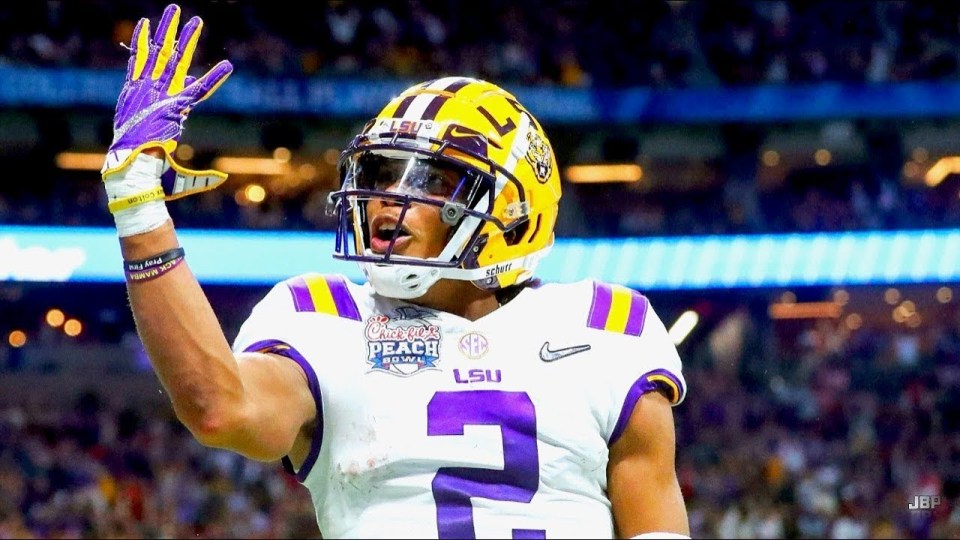
Justin Jefferson

Round 2 (pick 53) – K.J. Hamler, WR, Penn State, 5-9, 176

Rationale: The Nittany Lion with 4.37 speed and electrifying athletic ability will immediately add juice to w moribund return game. Talent-wise, he would go in the late first or early second round if not for his stature. Will size matter in the NFL? If used properly, perhaps as a Desean Jackson protégé, it shouldn’t. High end? Think Tyreek Hill of the Chiefs.

Round 3 (pick 103) – Collin Johnson, WR, Texas, 6-6, 220

Rationale: If the draft  were not a virtual event this year, the Eagles would run this card to the podium (and may not have taken Hamler in the second round if they had known he’d be there). Johnson’s family tree is made out of pigskin. His father (Johnnie) and uncle (Ron) played in the NFL, while his brother played college football. His speed (4.55) won’t wow anyone, but he brings precise in his routes and has good hands – especially on contested catches. Johnson doesn’t just have impressive size and an insane wingspan,  as he knows how to use it. Some scouts see, with time, another Kenny Golladay in the making.

Round 4 (pick 127): Matt Hennessey, C, Temple, 6-3, 295

Rationale: While we are not rushing Jason Kelce out the door, he has hinted at retirement the last few years. Eventually, he will say what he said at the Super Bowl parade and retire with his body intact. A replacement needs to be groomed. Hennessey has all the tools as a natural scheme fit, as he has the light feet (4.95 speed) – like Kelce – to get to the second level. Only issue is that the Eagles seem to have a strict policy against drafting Temple players (the last was safety Jaiquawn Jarrett in the second round in 2011). The last undrafted Owl they had in camp was Adam DiMechele, a fourth quarterback, in … 2009. This is of note because ratings on Hennessey, largely because of medical issues, are all over the map. Another team without an allergy to Owls might jump on him as early as the second round.

Round 4 (pick 145): Joe Bachie, Michigan State, MLB, 6-1, 238

Rationale: Eagles fans will love this guy, if only because his last name is pronounced “Bocce,” like the sport. A tackling machine in college, he would likely have been drafted higher if not for a failed PED test, which may give him a chip on his shoulder entering the league. Although a two-down linebacker at the NFL level,  the Birds rotate linebackers, based on situaton, anyway. At the least, he will also add much-needed grit to a special teams unit that hasn’t been special for a while. Pro comparison? How about a guy the Eagles should have drafted in 2016 — Temple’s Tyler Matakevich  (instead of Joe Walker, who is out of football).

Round 4 (Pick 146): Harrison Hand, Temple, 6-0, 192

Rationale: Two Temple guys? The NovaCare Comlex might have to be fumigated. The brass can at least cajole themselves with Hand, since he transferred to Temple for his final year after following Matt Rhule to Baylor (after being recruited to Temple originally). The Cherry Hill West alum is considered by some the best tackling corner in the draft, which may be attributed to him having some safety experience (and he could end up there in the NFL). Hand also has been timed at 4.40. With recent acquisitions on the back end, he can be eased into the secondary while joining Bachie in immediately bolstering the coverage units.
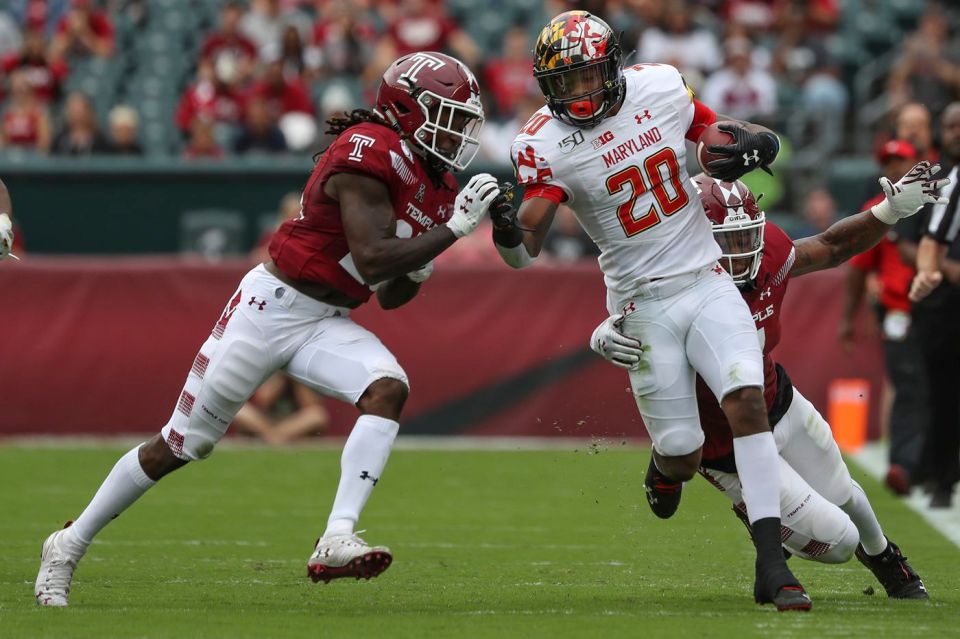
Harrison Hand

Round 5 (pick 168) – Ben Bartch, G, St. John’s, 6-6, 308

Rationale: The Eagles will likely be looking for interior line help – while likely opting for a street veteran that shakes loose from another pro roster to be the third tackle – and this class is seen as slightly above average. With that being the case, why not cast their line in a small pond to pull out a big fish with raw potential. A converted tight end, Bartch lined up in a two-point stance at left tackle in a spread offense at the Division III level. He projects to guard in the big leagues, but that is not assured (he won’t be on the active roster as a rookie anyway, so there would be time to figure it out).

Ben Bartch

Round 6 (pick 190): Kalija Lipscomb, WR, Vanderbilt, 6-1, 201

Rationale: His average size is not helped by average speed, but he was productive – particularly as a junior (87 catches, 9 TDs). As a senior, in a difficult situation with the 3-9 Commodores his production dipped (47 catches, 3 TDs). Why would the Eagles draft a fourth receiver who may slip out of the draft entirely? Because new wide receivers coach Aaron Moorhead coached him at Vanderbilt, and he likely vouched for his ability to pick up the playbook quickly, which is considered his greatest asset.

Summary: This is somewhat fantasy, I admit. While multiple receivers are likely, two may be the actual limit. There would be no way they take four, but this was an exercise to show it could be done and the corps would be well-fortified for the future. There were no trades here. At No. 21, the Eagles are in a bit of a No Man’s Land at receiver. The brass could easily opt to go back, maybe to Miami at 26 or Green By 30, but they would likely lose Jefferson to New Orleans at No. 24. That would still leave tempting options like Denzel Mims (Baylor), Laviska Shenault, Jr. (Colorado) or Jealon Reagor (TCU) and an extra second round pick with which to work. I didn’t take an edge rusher, which is an annual rite of passage – usually with middling results – for the Birds. I also didn’t take a running back, although the third spot behind Miles Sanders and Boston Scott is likely to go to a familiar face (LeSean McCoy or Corey Clement), with an undrafted guy or two – i.e. Antonio Gibson (Memphis), JaMychal Hasty (Baylor), Tony Jones, Jr. (Notre Dame, picture below), Rodney Smith (Minnesota) — brought in to battle it out for the fourth spot. And, of course, there is no way they would draft two Temple guys.
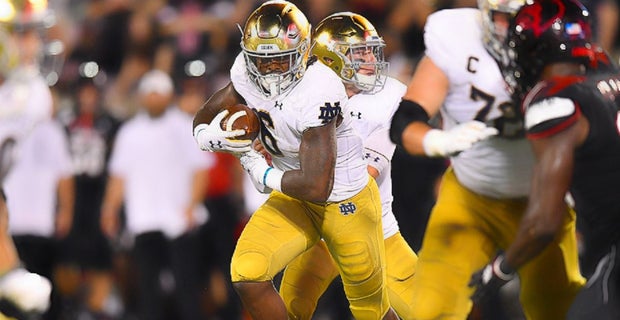
Tony Jones


It’s About Time (to end DST)

driving-with-headlights

The following column ran in The Times Herald on March 8, before coronavirus put us on all lockdown and matter that now seem more trivial were more in the mainstream:

By GORDON GLANTZ

GORDONVILLE — It doesn’t take much to move me to tears, and I’m not ashamed to admit it.

Tears of sadness. Tears of joy. Tears from a harsh March wind blowing so fierce in my face that they can’t be avoided.

Since getting a new used car last January, I have been able to cry tears of relief when we fall back and spring forward on the clock.

My new used car, which is a 2018 Ford Edge, came equipped with all the computerized bells and whistles. It’s so easy to change the time that, yeah, it makes me want to cry. I almost want to reset it and do it all over again.

While that makes today’s spring back drill easier to take, I’m not off the hook.

While the time automatically changes on our computers and phones, I still have to go from clock to clock around the house and reset them all.

Then there’s my wife’s near-antique car, a Honda that historians believe was used to transport troops to the front in the War of 1812. It requires a degree in nuclear physics to figure out.

Then, when we visit my mother at her assisted living place, it gets to the point that the best option for trying to figure out changing the time on a cheap clock radio is to just go get a new one.

Turns out, that this source of tears and frustration is needless.

I’m talking on the A-List scale of needlessness – with the likes of the Iowa caucuses, hockey shootouts, chop sticks, the running of the bulls, overusing the word “very” and playing games at carnivals that are impossible to win.

When we fall back, we gain an hour of sleep but lose an hour of daylight for months. We lose the hour of sleep by springing forward, but the days are longer.

You really need to be in another part of the country, in another time zone, to completely understand the extremes of it all.

A few summers back, we were in South Dakota, enjoying the indoor pool of a hotel with the worst excuse for a continental breakfast ever (Fig Newtons instead of donuts and no decaf coffee). The sun was still up at 10 p.m. Sounds cool, but the only view was of a trailer park across the street in a town where the hot place to eat was a Dairy Queen.

Really no need, in that time zone, for the sun to catch you crying.

It is more than some annoyance that costs me my beauty sleep in the spring and makes me take out the trash and walk Rex in the dark in the fall and winter.

This raises the deeper question: Why do we do this drill, Daylight Saving/Savings Time (DST) as if we were marching around like zombies at a military academy?

Turns out, falling back and springing forward are acts – like the creation of the electoral college – that have far outlived their usefulness.

While the concept dates back eons, and Benjamin Franklin pontificated about it as a way to preserve candle light, DST first became a “thing” in America during World War I to conserve coal.

That made sense at the time, but my history books seem to indicate that World War I ended more than a century ago.

While your president (not mine) lies to the faces of coal miners to get their votes, we know that industry is pretty much a shadow of its former self.

Repealed after World War I, Franklin Delano Roosevelt put the action back into play during World War II.

Following the war, it was more of a state by state thing until Lyndon B. Johnson, in 1966, set into law that DST should begin the last Sunday in April and end the last Sunday in October.

And so we sit, hearing some vague arguments for the status quo (mostly economic) but others against it (mostly health-related, such at workplace injuries).

According to those who have studied it, it would mean a lot to make a change – certainly a lot more than we think, beyond anguish over remembering how to change clocks and watches that do it on their own, to stop the needless madness of springing back and forward.

They suggest it would reduce headaches – fatal car crashes — especially to pedestrians — and heart attacks.

Consider two studies by the University of Colorado. One found a spike in car accidents the first week after the DST change (with the apparent cause being drivers less sharp with one hour less of sleep).

The other found the heart attack risk spiking 25 percent the following Monday after the “spring forward” but fell to almost normal when the clocks fell back in the Fall.

In this era of partisan politics, this surely sounds like one issue we can all get behind.

And it’s about time.

Turn and Face the Strange

Change

By GORDON GLANTZ

GORDONVILLE  — It was the fall of 2000. I had become engaged to my now-wife (and Sofia’s “mama”) over the summer, and I could feel the winds of change in the air.

I had been a sports writer since 1988 and, other than not getting to be next Johnny Bravo (Greg Brady still should have gone for it, and then done college), I was content.

I liked to write, and I liked sports, so it fit (at least better than the glove on O.J.’s hand).

The problem was that sports are played on nights and weekends, a time when most of the spectating world is doing the opposite.

But if you’re a sports writer, it means you are working nights and weekends.

It was fine for 13 years, but I looked into the future and saw an abyss.

If I wanted to be a family man, I needed to make a change.

Some would call it a “Come to Jesus” moment. Lapsed Jew/atheist that I am, we will just call it a moment of truth.

While others in my situation had to either leave the business or go elsewhere, a chance to turn the beat around – quite literally — was right there at The Times Herald.

Newsroom turnover always had a mind of its own. We would have a set staff for long stretches and then, for whatever reason, everyone would seem to leave at once.

At this particular time, while we were full in sports, the newsroom had turned into a ghost town.

Skirting the tumbleweeds, I walked into the office of then-editor Mike Morsch – a straight shooter from the Midwest with whom I had a good rapport and still call friend – and, in the words of Tony Montana from Scarface, “proposed a proposition.”

I offered to fill one of the many empty chairs in the newsroom, but only under the condition that I would be the police reporter and nothing else. I wanted no parts of covering municipal or school board meetings.

Ever.

To my surprise, he was good with it.

For a while, I did both – helping out sports on busy nights, like when there were Friday night football games to be covered – while also learning the ropes of the police beat.

Within a few months, though, I really wasn’t even homesick for sports anymore.

News was growing on me.

But that’s easy for me to say.

I wasn’t going to meetings, like other reporters, and coming back to the office to write about complex issues – ones that truly affected people’s lives — while on the deadline crunch.

When I became managing editor in 2003, a large part of the job was scheduling reporters based on their meetings. If they had a conflict – there were more municipalities and school districts than reporters – we had to prioritize.

It was an odd thing, not having any personal experience with what was or was not important.

Until now.

The times they are a changin’ (nod to Sir Bob of Dylan).

As a concerned citizen, I have been to a handful of Whitpain Township meetings – and have gotten up to voice my opinion with more passion than I thought possible – about an ongoing issue in my neighborhood.

I won’t bore you with the gory details. Let’s just say that someone is looking to rewrite the zoning code to maximize his profit margin. Some of my concerned neighbors are primarily focused on the environment — water flow, trees being chopped down, the view from their back windows and water basins.

I’m with them on all that (even though my eyes glaze over with the water basin stuff), but my main thing – and that of a few others in our core group – is what even more cars will do to an already tenuous morning traffic logjam.

The other night, while we were waiting for our issue on the docket, the room was packed beyond capacity about the issue of what will become of the Mermaid Lake property.

As concerned citizens from that end of the township grilled the developers about many of the same concerns we have – only on a larger scale (school overcrowding chief among them) – it hit me just how much these meetings matter.

If citizens don’t turn out and speak up, a lot of these permanent changes – changes for the worse – will be made in their name.

During all of this heated debate, I noticed a few young ladies who appeared to be reporters furiously taking down notes (one had a small laptop and the other big yellow legal pad).

I don’t know where they were from, but I’m glad they were there.

It was another moment of truth.

While I remain eternally grateful that I never had to be in their shoes and cover a meeting, I am eternally grateful they exist.

Because these meetings matter.

Always did, and always will.

This column appeared on February 16, 2020


Breaking News, Broken Heart

Bryants

By GORDON GLANTZ

GORDONVILLE — Weird thing with me, and I’m sure a lot of you, is that I can recall happenings from decades ago while needing to be repeatedly reminded to take out the trash every Monday night.

A certain song, as much as anything, can provide a ride in a time machine to other events.

This brings me to the song “Dirty Laundry,” released by Don Henley in a solo effort back in 1982.

It was a sharp condemnation of the media, particularly on the television side, as it came at a time when CNN was still a toddler learning to walk as a round-the-clock entity.

Because I listen to retro radio whenever Sofia isn’t in the car to dictate otherwise, I still hear “Dirty Laundry” from time to time.

Just the other day, I realized that as on-point as the song – written by Henley and Danny Kortchmar – was in 1982, when I had decided to major in journalism (primarily to avoid taking more than one math and one science class at Temple), it has proven only more ominous over the decades.

It was this verse that got the few marbles I have left to rattle around:

“We got the bubble-headed-bleach-blond

Who comes on at five

She can tell you ’bout the plane crash with a gleam in her eye

It’s interesting when people die

Give us dirty laundry”

There is a later reference to the boys in the newsroom having a running bet about when someone will die.

It sounds unreal and callous, but it rings true. Sadly. The only real way to stay sane behind the curtain in the business is to become insensitive.

It took only events the magnitude of a 9/11 or a Sandy Hook — or a horrific local murder, like that of Lisa Manderach and her 19-month-old daughter, Devon — to cast a pall over the newsroom.

Not being a full-time newspaper guy in recent years, coupled with the birth of Sofia, has greatly softened my veneer.

When news affects me personally, it not only hits me, but I’m not afraid to show it.

When I cry at the end of the movie, which happens a lot, I’m that guy who has to watch all the credits roll in case someone sees me when I leave.

And when breaking news breaks my heart, it’s increasingly difficult to get up off the canvas.

Such was the case when Tom Petty died last year and, more recently, when the death of Neil Peart was followed closely by that of dear friend Hank Cisco.

These days, news just hits you in an instant.

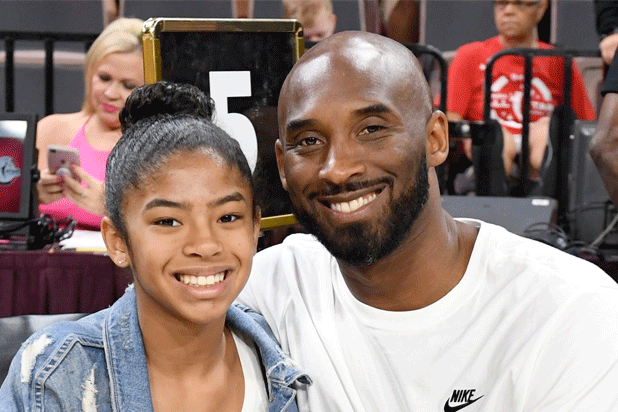
On Sunday, for example, I was sitting where I am right now – at my laptop – when my cellphone flashed: “Kobe Bryant dead at 41.”

There was no other information, as it was one of the first initial reports.

“Oh, my God,” bellowed this atheist. “Kobe Bryant just died.”

“Oh, my God,” my wife, a practicing Catholic, replied.

When MSNBC was unable to provide much in the way of detail, we turned to CNN.

The news trickled in slow, and with a lot of the misinformation we didn’t run with back in the day, when we needed confirming sources and getting 2-3 people of authority on the record, and I took Sofia to her indoor softball practice not knowing for sure who else was on the private helicopter and how many people were on board.

Reports ranged from Bryant and daughter, Gianna, to the whole family to another teammate of Gianna and her parent.

We since learned the heartbreaking details, and the identities of all the nine victims beyond Bryant and his daughter.

The fact that Gianna was 13 (the age Sofia will be in two months, almost to the day) is enough to give me chills. Sports icon or not, I try not to think about what must have been going through Kobe’s mind knowing he couldn’t protect his daughter as the crash happened.

It was also personal on other levels.

Like an old song on the radio, the tragedy brought back a flood of memories.

Weaned on the Philadelphia Big 5, I remember his dad — Joe “Jelly Bean” Bryant — starring for La Salle before playing for the hometown 76ers (and later the then-San Diego Clippers) before moving on Europe (Kobe was born in Italy).

Back when I was a sports writer (1988-2001, with some comebacks after), the Bryant family had moved back to the area.

By the time Bryant was in high school, you only needed to say “Kobe” to know who was being spoken about. He starred at nearby Lower Merion High School, and was the area’s greatest scholastic player – in an area of many great ones – since the days of Wilt Chamberlain.

I saw him play in the Donofrio tournament at the Fellowship House of Conshohocken, at Norristown High, on his home court at Lower Merion and on the same hallowed Palestra hardwood where I saw his father.

Later on, as fate would have it, I had the opportunity to cover the NBA when Bryant was cutting his teeth with the same Los Angeles Lakers team that he stayed with his entire Hall of Fame career after coming straight to the NBA out of Lower Merion and being drafted 13th overall by Charlotte and traded to Los Angeles for Vlade Divac (after he made it clear he didn’t want to play in Charlotte).

Through this relatively short time interval, I rarely found myself alone – or even in a small group – of reporters around Bryant (including at The Fellowship House).

I know I asked a pre-game question, when he was playing for the Lakers, but I’d be lying if I said I remember what it was (it was possibly about getting booed in his hometown, but don’t quote me).

I just remember that patented smile of his as he looked back over his shoulder and answered.

For now, as the shock waves subside and morph into the dirty laundry of impeachment hearings, it will have to be enough.

This column ran in The Times Herald on January 29, 2020.

Legal Evils Eat Away At Our Souls

Prevagen-1200x900

By GORDON GLANTZ

GORDONVILLE — Appalling.

There is no other way to describe what happened to a 90-year-old woman at Shannondell. She was scammed out of $8,500 dollars by someone pretending to be from law enforcement.

She was asked for bail money for her grandson, who she was led to believe had been in a DUI-related accident.

Unable to drive, the woman gave the envelope of cash to someone impersonating a police officer.

This is an example of a scam – one that has been used elsewhere around the area recently – that has several slight variations and is not uncommon.

It is illegal, on many levels, and we can all hope the guilty party – or parties – eventually get the old book thrown at them.

There are, however, legal scams – or shams – that go on every day.

We are all victims, but we just don’t call timeout long enough to catch our collective breath from the daily grind to realize it.

Here are four examples – a Mt. Everest, if you will – of the most egregious:

1) Printer Ink – So, you just bought a printer and some sales kid with gigantic earrings and a nose ring (ehat happens when they sneeze?) had you temporarily insane enough to believe you got a great deal.

Not quite.

Whatever you plunked down for the printer was merely a down payment on the tree-killing process that is print-o-mania.

The payments on it come in the form of continual, and seriously marked up, purchases on ink cartridges that always seem to run out all too quick (a good portion of the ink in them is used up before it even reaches the paper).

And, as we become increasingly reliant on computer printouts, as opposed to pen and paper, running out is inevitable. There is no such thing as universal ink that works in any type of printer, and no generic brands.

In order to function in modern society, the companies – like Arab sheiks setting the price on oil based on their whims – set the price to make a humongous profit off the dire need to replenish our ink.

Some say to join clubs where you get a slight markdown, or buying laser printers that are significantly more expensive.

These amount to ways to treat the symptoms without finding a cure.

After posting on Facebook that this might be one of the biggest rackets going, a friend who works behind the curtain in the computer business was quick to affirm my accusation.

He said: “I’m going to say that detention and separation of immigrant children at the border is the biggest racket, but this one is basically brazen theft. It’s akin to (drug) pushers giving you your first hit for free.”

2) Dog Licenses – This one is a bit like acid reflux, the way it keeps coming up.

Once a year, in November or December, I get a reminder that Rex needs to have his dog license renewed.

Man, what a stone-cold racket.

It’s not like I don’t already have my bases covered. Updated shots? Check.

Rabies shot? Check.

Microchipped? Rex is too lazy to run off, so no check mark needed.

What do I need this annual piece of paper for? Anyone? Anyone?

Into whose pockets does the fee go? Anyone? Anyone?

They need to have a record of my rescue dog’s existence because … why, exactly?

Thing is, I cannot take him to doggy daycare, let alone board him when we go away, so I have no choice but to submit.

I recently mailed in my annual fee, and I’m still waiting for e-mail confirmation. Certainly not coming as fast as the e-mail reminding me to pay it.

Perhaps Montgomery County Treasurer Jason Salus can provide some answers.

3) Prevagen – When they first created the term Snake Oil, I think they had this stuff in mind.

The makers of this supplement claim it comes from … jellyfish oils, and “may improve memory” (note the qualifier of “may” in there).

The ads say it is “pharmacist recommended.” By what pharmacist? Give me a name.

This one is personal. My mother won’t relent about this stuff. She resides in an assisted living facility, and I’ve gotten more calls about replenishing her supply from the staff (surely do to her nagging them) than when she has been seriously ill. Only time I ever heard from her doctor, other than when she was in the hospital, was when she had him call me (he couldn’t prescribe it because it wasn’t … a real medicine).

His basic point was that it is harmless so, if she wants it, get it.

Thanks, Doc.

Problem is this: At $2 per pill, with no hard proof it does anything, it is quite harmful – especially to those on fixed incomes.

And then there is this, the FTC and New York Attorney General’s office filed suit against the makers of Prevagen, Quincy Bioscience, LLC. The suit claims the company “made false statements about their purported clinical evidence in their advertising.”

Because it targets older people, claiming to help with “mild” memory loss due to aging, are they any worse than those who bilked the grandmother at Shannondell out of her money?

The only difference is that this is a slow bleed, as opposed to a one-shot deal.

4) Bottled Water – Surely you have gone into a restaurant and they ask you if want bottled water (at a price) or tap water?

Choose the tap water, please. If the waiter or waitress — with gigantic earrings and/or a nose ring (still want to know what happens when they sneeze) — sneers at you like you have no class, it’s their problem.

With the exception of a mere few cases, bottled water has proven to be a total sham. It’s just tap water dressed up in a labeled bottle.

Considering that blind taste tests show that participants cannot tell the difference between bottled and tap water, it is like paying for a bottle of air to breathe — as opposed to just breathing it.

According to a 2017 article in Business Insider, we spend roughly $100 billion per year on bottled water (more than milk, beer and now soda).

Meanwhile, it is estimated than 90 percent of the plastic bottles are not recycled, adding to the environmental nightmare.

A 2009 documentary film “Tapped” – made to expose pollution in sea water — laid out the damning case against the scam of bottled water.

Said actor Ed Begley, Jr.: “The film ‘Tapped’ illustrates quite clearly how we’ve been getting ‘soaked’ for years by the bottled water industry.”

Appalling.

This column appeared in The Times Herald on January 26, 2020.

News Turns To A Snooze

joe-scarborough-trump-journey-groupie-resistance

By GORDON GLANTZ

GORDONVILLE — As I attempt to age as gracefully as possible for an otherwise graceless person, I have increasingly become a creature of habit.

One of those habits to turn on the TV every morning – sometime after the weekday alarms screeches at 6:30 — to watch “Morning Joe” on MSNBC. I don’t even really like the show, or the hosts and regulars (other than brilliant Washington Post columnist Eugene Robinson), but I watch anyway.

Much to my disgust, Joe and the crew tend to belabor two issues ad nauseam: The Democratic race for the nomination and the ongoing ineptitude of your president (not mine).

The psychobabble seems like a colossal waste of breath, considering the primary season is in its infancy and your president (not mine) is never ever going to be impeached.

If I hear the words “Mayor Pete,” followed by a long and drawn out discussion by a panel of “experts” about his electability – all while they skirt the obvious issue, unfair or not – I may hurl the remote at Joe Scarborough’s smug mug.

Why, then, do they spend so much time cherry-picking a poll that shows Bernie Sanders up a point and Elizabeth Warren down two – all while doing a poor job of suppressing a clear pro-Joe Biden agenda – or giving too much attention to some late-night Twitter post that would make a middle school grammar teacher wince in pain?

Easy answer. It’s easy. It’s right there, with low hurdles to scale.

Better than anything else on, all things considered, but far from good enough.

The thing is, I’m a news junkie. It’s why I majored in journalism (along with not having to take many math or science classes).

I’m naturally curious, and some would say I’m really just a total gossip. I plead partially guilty, but with an explanation. I’m really just in search of information – even if I’ll do little to nothing with it, like a fisherman tossing his catch back into the water, once I reel it in.

Which brings us back to the facts, or lack thereof.

These days, the whole earth can shake itself out of existence while I’m sleeping. Excuse me if I like to know what happened overnight.

CNN? No better than MSNBC (especially at night). It tries to get both sides of the story so perfunctorily that neither side is satisfied. I know I don’t want to hear another discussion on climate change as if it is open for debate, especially as it ignites forest fires in Australia and California with the verve of a serial arsonist.

The few remaining friends I have on the right don’t want any human interest story, like the border camps, told with any bit of sensitivity.

And don’t even mention Fox News. I’m OK with trying to stomach a little bit of the opposing viewpoint before wanting to vomit, but independent fact checkers have issued reports on the network’s accuracy that make the ones I used to bring home look like those of a Rhodes Scholar.

The sad truth is that I can find out more about what it is really going on with the local news from 6-6:30, followed by the national news from 6:30-7, than all day on any supposedly superior all-news network.

Newspapers have morphed into digital entities, but a second mortgage is needed to get around the pay walls needed to get what you need.

That leaves fly-by-night sights that may or not follow the ye olde rules of actually putting people on the record, as opposed to being anonymous, and having at least two sources.

All the conjecture leaves us, in this advanced day and age, prone to be less informed than we’ve been in the industrial age.

The only option is television, and the flaws are obvious.

Yes, the wall-to-wall coverage of our recent near flirtation with igniting World War III was relatively well-done, but so much more has been going on – locally, nationally and internationally – that much of it falls through the cracks.

And it happens at our own peril.

The more the masses are numbed up with dumbed-down messaging, the easier it is to go on electing sociopaths with the hellish belief they are heaven sent.

While we were looking at polls that really don’t matter until a week or two before voters in Iowa leave the wheat fields and reading too much into unreadable tweets, the wheel in the sky keeps on turning for a frightening tomorrow.

Example: Did you know that, since late December, more than 500 earthquakes have hit Puerto Rico. That’s the same Puerto Rico still waiting on $18 billion in aid from hurricane damage incurred two years ago?

Did you know that, just on New Year’s Day, there were 45 non-suicide gun violence deaths across America? Including suicides by gun, there were 177 deaths.

Speaking of suicides, did you know that there were 228 suicides by police officers in 2019 in what has become a silent epidemic?

Veterans? Try a suicide rate of 17 per day.

Did you know that Philadelphia had 356 homicides last year, just nine short of one per day? You can say you are safe here in the suburbs, but this is the city you border and crime knows no boundaries.

Did you know that hate crimes have increased dramatically since a certain someone who calls himself your president began campaigning in 2015 with divisive rhetoric?

I shouldn’t just dwell on the negative, as there are positive stories every day – from simple acts of human kindness to medical advances to big bad athletes going out of their way for a sick child — that get buried under the if-it-bleeds-it-leads approach that goes a notch underneath the analysis of paralysis of politics and of an orange nitwit that the lack of real journalism left us with.

Rant over.

This column ran in The Times Herald on Jan. 12, 2020

Hillary, Please, Go Away

Hillary-Clinton-Just-Crept-Back-Into-Politics-And-Scored-A-Big-Win

By GORDON GLANTZ

GORDONVILLE — Some people, I’ll tell ya, they just don’t know when to go away.

Kanye West. The cast of the rebooted “Ghostbusters.” Anyone with the last name of Kardashian or Jenner.

But, today, I’m talking about Hillary Clinton.

The future of the nation depends on a more graceful exit, as opposed to her ongoing stumble that sets off the fire alarm.

She might think her two cents – sounding more to the masses like the teacher in the Charlie Brown cartoons – remains vital to the national discourse, but nothing is further from the truth.

It just adds to the noise.

Clinton, who pretty much handed your president (not mine) the presidency by running one of the worst campaigns possible while presuming victory (kind of like the Eagles two Sundays hence in Miami against the lowly Dolphins with a 92-year-old quarterback).

She recently put some more cheese with her whine in an interview with Howard Stern, blaming her costly and embarrassing loss on the usual suspects – James Comey, the Russians – and, of course, Bernie Sanders.

Bernie Sanders? You mean the same Bernie Sanders who is very much alive and well – without the SuperPAC donations that were the lifeblood of Clinton’s otherwise comatose campaign – in the 2020 bid to unseat the albatross that Clinton, and Clinton alone, left us to deal with while she fires spitballs at the free-thinking Vermont senator from her detached Manhattan perch.

Clinton’s stated resentment of Sanders has less to do with him not vociferously backing her after being literally jobbed out of the nomination by the DNC establishment and more to do with that he dared to enter the race at all.

The sad thing is that what I’m going to write now is nothing I haven’t already written before in past columns and blog posts, but – like a bad rash – Clinton makes me keep on itching at it.

The original plan, as sickening as it sounds, was for Clinton to run unopposed by anyone after a few marginal candidates – Sanders, included – dropped out after the first four primaries/caucuses.

But Sanders had a groundswell of support, mostly from the younger voters that Clinton couldn’t connect with, and he used donations averaging $27 (I made several) to chase her almost to the finish line.

Once she “won,” after only some rather strange vote counts in the Western primaries/caucuses where Sanders was polling even or ahead, plenty of Sanders supporters – myself included – moved into her camp.

Truth be told, her resume made her beyond qualified to be president. I had no issue whatsoever with voting for her when the time came.

But then it went.

And she lost.

She lost by not going to places where Sanders either beat her (Wisconsin, Michigan) and or made a surprisingly strong showing. She lost by picking a saccharine running made that added zero, and actually hindered, her chances.

She was qualified but uninspiring, a trait that shouldn’t disqualify someone from being elected but, sadly, does in this day and age.

Your president (not mine) can do and say – and tweet — anything about anyone and get away with it. She can accurately call some – not all, but some – of his supporters “deplorable” and have it held against for time in memoriam.

Clinton should have stood up for herself on the debate stage better. When your president (not mine) kept interrupting her at the pace of every other word – saying “wrong,” like the pestilent ADHD child he is – she should have stopped cold and told him that she was going to interrupt him and he needs to stop interrupting her.

If he continued, she should have asked the moderators to do their jobs.

At another point, in another debate, he literally stalked her, physically, to make her look smaller in stature. She should have, and could have, told him to go stand where he is supposed and not invade her space.

Some said she couldn’t do that because women are judged differently, and there may be some truth to it. However, I think it could be more nuanced. I can’t see Elizabeth Warren putting up with those antics.

Personally, I think she figured he was making so much of a jackass out of himself that she didn’t need to intervene. That is, unfortunately, the way of the wimpy Democrat.

And it can’t be anymore.

Full disclosure, of course, is that I join fellow celebrities (wink) and intellectuals (wink again) – documentarian/activist Michael Moore, rapper/activist Killer Mike, philosopher/activist Dr. Cornel West and singer-songwriter Brandi Carlile – as a noted Sanders supporter.

But I’m also realistic enough to read the writing on the walls the White House – particularly in the environment of hate that your president (not mine) created – that reads both “No Jews Allowed” and “No Socialists Allowed.”

Sanders – like myself – is barely a practicing Jew and is a Democratic Socialist (go check the economy, and quality of life index, in Finland), not a Socialist.

So, when Clinton stuck in a dig during her interview, saying that she hopes Sanders is quicker to support the nominee this time around, she is unfortunately accurate that he probably won’t get the nod.

However, in the process, she admitted that he still carries a lot of sway with a lot of voters – particularly the younger voters – the ones that she so miserably failed to captivate on her own accord.

That’s why she is pleading her case with Howard Stern, still lamenting not being president, instead of sitting in the Oval Office.

This column originally ran in The Times Herald on Dec. 15, 2019.

Common Enemies to Bond Us

Robocall

By GORDON GLANTZ

GORDONVILLE — So I’m sitting here thinking – a scary thought, pardon the pun – about ways we can become more unified in these times that are so divisive that we all may as well meet at Gettsyburg and get it over with already.

Before we go there, though, let’s go here.

Let’s think of the late Rodney King, who implored us all to get along in the midst of the Los Angeles riots of 1991.

We have some common enemies, true leeches on our collective hide.

Not matter our heritage or religion, let alone political leaning, they don’t play favorites.

I talk, of course, of scam artists.

I could let my mind wander over to the ultimate such being in the White House, but I won’t go there (even though I just did).

I’ll keep to those who are even worse, as they can ruin your life in a more direct and insidious way, hacking their way into your personal information.

These are some of the most inventive beings out there, lurking in the shadows, and it makes one wonder what would happen if they focused on helping society.

This time of year, especially in an era of Internet shopping, cyber-scamming is ratcheted up several scary notches.

It is not uncommon for “spoofing” sites to be set up set up to capture innocent shoppers looking for a bargain.

Also prevalent this time of year are charity scams, where the money you donate – along with your personal information – goes to the scammer.

While organizations like AARP warn seniors, no one is immune.

All day, and I mean all day, my phone rings with numbers I don’t recognize.

There is no way, and I mean none, that anyone at the other end is out to do you and your family any favors.

At best, it might be someone conducting a political survey.

Yeah, it’s harmless enough to vent to them for a few minutes, but they have your number in their database for life.

If I tell you I’m a Bernie Sanders guy until further notice, no reason to call again – until further notice.

Got it? Get it. Apparently not.

They will call again – multiple times – and it will never ever be at a good time.

Eagles in the middle of eating my heart out? They’ll call.

Re-watching Paulie and Christopher get lost in the Pine Barrens for the 194th time? They’ll call.

Dinner? You can bet tomorrow’s lunch on it.

Get Caller ID, they said.

It helps, but it doesn’t stop the calls.

And if the ID says “No Name” or “Anonymous,” you won’t be talking to me (until I’m in a mood to fight with someone).

Buy a magical thingamajig to stop them?

A) Why should we buy something extra to stop what the phone company should police better?

B) We all know it’s a matter of time before these PITAs find a workaround. It’s like an electronic fence. If Fido is determined, you are going to find him in your neighbor’s yard (if you’re lucky).

C) How do I know the sellers of the thingamajig are not scammers?

Do away with my home phone? I get just many unwanted calls on my cell phone as I do the land line, which I have admittedly unplugged (not a good idea with a kid at school) just to catch an afternoon nap with Rex.

Yeah, there is a mechanism to block that number. A day later, I just get another call from a number with one digit changed – and at the same time of day.

What do these people want? They rarely, if ever, talk anyway.

Before they got busted in 2016, after four years of playing their trade, there were these creeps who would call and say they were from the IRS.

I once decided to answer and play along.

The callers had very thick accents – from India or Sri Lanka – but were using names like John Smith and Tim Jones.

One time, I told the guy I was going to give him some advice on how to be a better scammer and not use those anglicized aliases, as no one will believe them.

But, sadly, people – particularly seniors on fixed incomes – panicked at the prospect of being in trouble with the IRS and turned over personal information.

The rules here are simple.

If anyone – in a phone call or e-mail – asks you to update credit card information, give them your social security numbers or anything else (bank account information for an alleged forthcoming deposit from an African prince), don’t do it.

It happened to me just this week, with an e-mail from Netflix, saying there was trouble with my account and to update my credit card information.

They even coopted the Netflix logo, so it looked semi-legit.

Plus, it was the third or fourth such e-mail in the last few weeks. From past experience of writing up zillions of scams in police reports, I called the Netflix customer service number.

Things are so bad these days, that I was a bit worried that the woman in the other end was not legit. However, it became crystal clear I was the target of a scam in the e-mails that she was the one helping me keep my account secure (while on the phone, I received several e-mails from Netlfix about re-setting my account, etc.).

This is an example of what it has come to, as we are even wary of people doing their jobs because others have nothing better to do with their ingenuity than to use it for malevolent purposes.

If we can all agree on that, maybe Rodney King’s question – “Can we all get along?” – is still a beckon of hope.

This column originally ran in The Times Herald on Dec. 8, 2019.

Searching for the Reconnection

Sonny

By GORDON GLANTZ

GORDONVILLE — The year was 1911 – you know, when America was supposedly “great.”

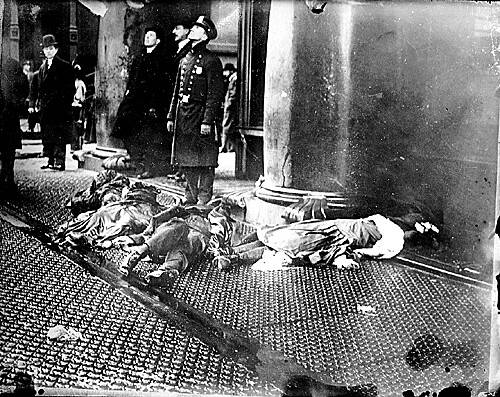
A fire inside the Triangle Shirtwaist factory in the Greenwich Village section of New York City left 146 garment workers dead in a what remains not only Gotham’s worst industrial disaster but one of the worst in our nation’s not-so-great history.

Eyewitness accounts to this horrific event detail how dozens of the victims leaped to their deaths from the building’s eighth floor (it became increasingly obvious that the fire ladders of the time period couldn’t get to them).

The victims sometimes reportedly landed so hard that they left indentations on the sidewalk below.

There were a lot of commonalities between the workers. Most were young woman between the ages of 14 and 23. And almost all were Italian or Jewish, having recently arrived as first-generation immigrants during the height of immigration for both ethnic groups.

tff-sidewalk

The joint tragedy was not an aberration, as the American experience for Italian and Jewish citizens has always been connected, through good times and bad.

Scholars have even speculated that at least some of the crewmen traveling with Christopher Columbus were Conversos (Jews who converted to Christianity) escaping the persecution of the Spanish Inquisition.

But the true parallel American experience for both groups began when they immigrated here by the millions – through Ellis Island and other ports of entry – between the end of the Civil War and the start of World War I.

Both faced prejudices, based on fear and superstition, not unlike those now aimed at Hispanics and Muslims.

Italians and Jews debunked those myths by fighting, and dying, in the wars that made this country an international power and by achieving success in all professional fields of endeavor.

From living in neighboring city ghettos — and other cultural similarities — both groups had been allies since banding together for changes in working conditions in the wake of the tragedy of 1911.

From physical appearance to wearing our hearts on our sleeves to talking with our hands, we have been kindred ethnic spirits – not only on a large scale but more interpersonal ones.

For me, it was an ideal fit when coming to work in Norristown many moons ago.

I grew up with an Italian stepfather and, by extension, had a third wing of relatives – and cousins to play with – who were Italian. At school, a large number of my non-Jewish classmates were full or half-Italian.

I always said that if one room had all Jewish people in it and the other all Italians, I’d be at ease in either – although I’d probably have a better time, truth be told, in the Italian room.

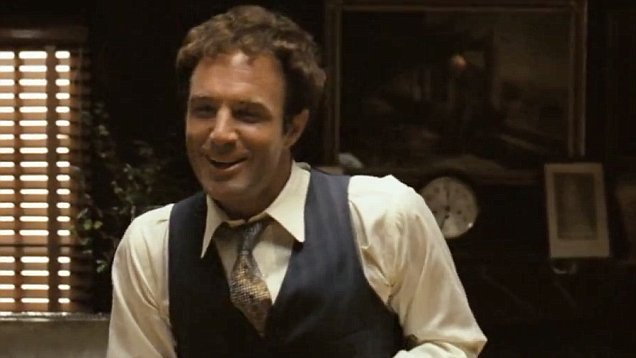
After all, as Tony Soprano once put it, in his own “Tony” way, Italians are “Jews with better food.”

So why not opt for the room with the better food?

But something has going terribly wrong on my return trip to the buffet table.

ItalianStarofDavid

I would have to watch what I say, lest I not get a return invite – or worse.

We may have been born in America as conjoined twins, but politics have separated us.

The other day, while adding yet another person wanting to settle a political debate with a duel in the town square to my expanding Facebook blocked list, it struck me how many former paisans I have lost since the commencement of what I consider a cold Civil War in America.

And I’m really trying to find out why Jews generally go to the left and Italians to the right when in the political arena.

Ethnicity plays a vital role in elections, all the way up the ladder from local to state to national, almost as much as factors such as economic status and geography.

Yet, the correlation between ethnicity and political leanings is just not talked about – or seriously studied — as much as, say, skin color or blue-collar vs. white-collar.

With Jews, the 70-30 Democratic tendency has not wavered much for decades.

For Italian-Americans – once about 50-50 — it now sits at about 70-30 in the other direction.

And it leaves me perplexed.

The same people jumping from that burning building in 1911 have seen their ghosts land in different places almost 11 decades later.

Example: Even though your president (not mine) is from New York City, he got destroyed there in the 2016 election. The only borough he won was Staten Island, which has a large Italian-American voting contingent.

I just don’t get the disconnect.

The common explanation – “because we love our country” – is a nice try, but it doesn’t fly, sorry.

We love our country, too, but our hearts are broken right now.

And love is a prerequisite of a broken heart.

I honestly can’t say why more Italian-American hearts aren’t broken as well.

Some are, don’t get me wrong. I have close Italian friends who are even more liberal than I am (Bruce Springsteen is half-Italian, and has lost fans because of his liberal stances).

Nonetheless, a curiously high number remain staunchly loyal to your president (not mine).

I’d love to discuss it — without a threat of a shootout at high noon — over a dish of “better food.”

Maybe, one day, it will be possible again.