Category Archives: Sports

Training Wheels Off For Training Camp

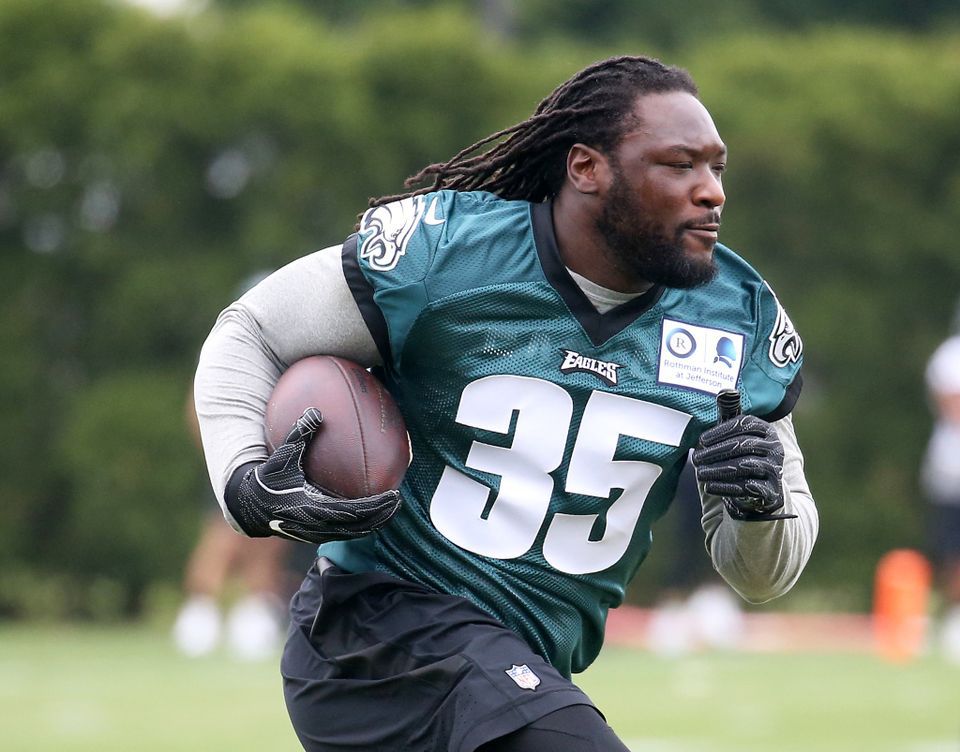
blount-3

By GORDON GLANTZ

@Managing2Edit

Just stop already, will ya?

No more lamenting every pitch of this long-lost Phillies season. How many times can you watch the same paint dry?

And who cares if Costa Rica beats Belgium in soccer?

Golf? Please.

Tennis? No comment.

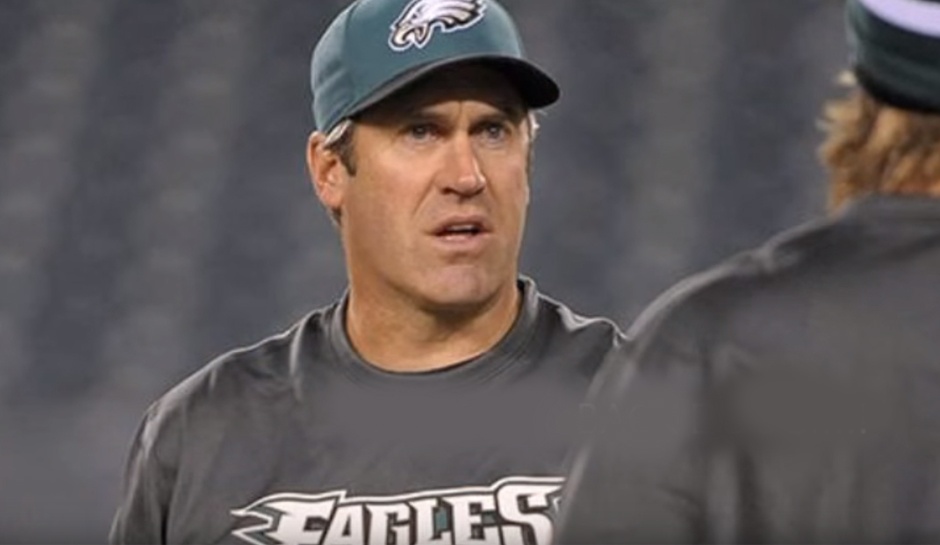
This week we will be counting down the days until the 2017 version of the Philadelphia Eagles begin training camp under second-year head coach Doug Pederson.

To get you primed for prime time, here is a positional primer to get you more up to speed than if you were watching perpetual left turns in a NASCAR race (only to interrupted by a fiery crash and debris soaring into the crowd).

OFFENSE

QUARTERBACK

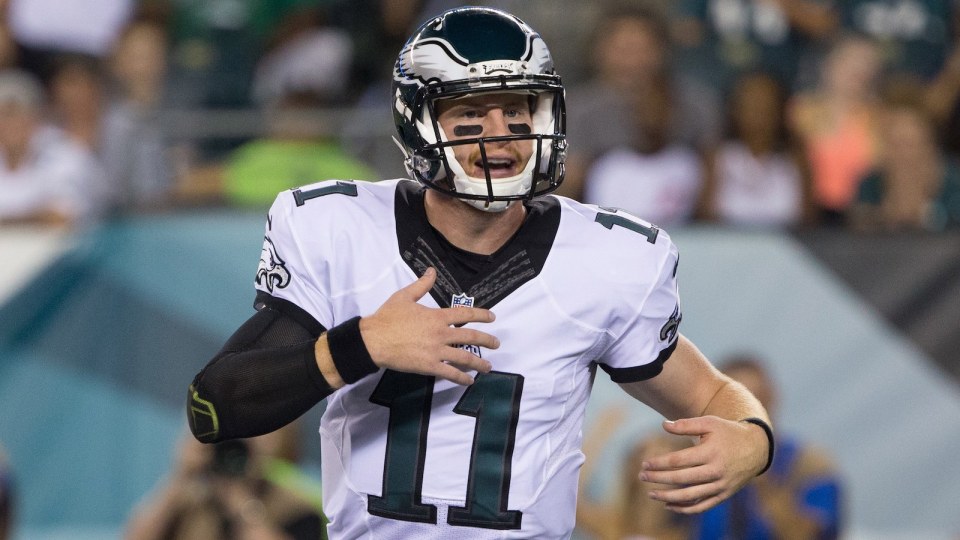
Eagles-Foles1The Play Call: Easy peasy. Carson Wentz returns – hopefully wiser and more settled, in terms of mechanics – after his baptism by fire a year ago. Nick Foles (left), whose biggest crime was achieving near-perfection in 2013 (a league-best 119.2 QB rating, largely on the strength of 27 touchdown passes against two interceptions in 13 starts), comes back to town as the backup. It is doubtful the brass wants to keep more than these two on the active roster, meaning third QB Matt McGloin – who has somehow managed to parlay a middling career at Penn State into seven career starts (six as a rookie) in four years in the NFL with the Raiders – is here to take preseason snaps and have good enough tape on himself that he would get a call from another team, or the Eagles, if catastrophe would strike. Fourth quarterback Dane Evans will forever be associated with Dorial Green-Beckham because he was officially added to the roster when the plug was pulled on Project DGB. Evans, a Tulsa product, could play himself onto the practice squad with a solid camp and showing in preseason games.

Audible: Only needed if Wentz, or even Foles, goes down. Would the Eagles feel comfortable with McGloin as a backup? Also, it remains to be seen how much leash the restless fan base will give Wentz in his second year when many still have Foles jerseys hanging in their closets.

RUNNING BACK

The Play Call: With Ryan Mathews’ career in limbo after a neck injury last year, the Eagles went out got themselves a similar two-down option in 250-pound bulldozer LaGarette Blount, who has a pair of 1,000-yard seasons under his belt, as well as a career average of 4.4 yards-per-carry average. Last year, while earning a ring with the Patriots, he ran for 18 touchdowns. However, while Mathews was also a decent receiver out the backfield, Blount is more one-dimensional (season-high for catches was 15 in 2011, his second in the league). The Eagles have the ideal complement in Darren Sproles, the quintessential third-down back/return man-type whose all-purpose numbers (8th all-time) have put him at the precipice of Hall of Fame consideration when his career concludes, possibly as soon as the end of this season. Planning ahead, the Eagles aggressively pursued San Diego State’s Donnel Pumphrey to be Sproles’ successor by moving up in the fourth round to grab him. Despite both being diminutive, they are not apples-to-apples in body build (Sproles is 5-6 and around 190, while Pumphrey is generously listed at 5-9 and 170). And while Pumphrey put up record-setting all-purpose numbers in college, he was rarely used as a return man. The Eagles’ are reportedly giving him a crash course on bringing back kickoffs (punts are more a risky proposition for the uninitiated), but expect some growing pains in terms of decision-making.

Audible: Blount, Sproles and Pumphrey – barring injury to any of the three – are the only locks to make the squad. And with two active quarterbacks, that leaves open a job for a fifth running back or a sixth receiver. Wendell Smallwood, last year’s fifth-round pick from the Eagles’ new minor-league affiliate, West Virginia, had a 100-yard game early in the season and also returned a kick for a touchdown, but he faded while being dogged by injuries and didn’t finish the year on the active roster. Smallwood would still have the inside track on the No. 4 spot, but nothing is guaranteed. That means any touches – carries, catches or return chances – for high-end UDFA (undrafted free agent) Corey Clement (from Wisconsin by way of Glassboro, N.J.) and versatile Byron Marshall could prove meaningful. Clement, who gained 1,375 yards and scored 15 touchdowns against Big 10 competition last year, could unseat Smallwood with a good camp, while Marshall, like Pumphrey, could make keeping a sixth receiver a luxury if they can each double as decent slot receivers.

WIDE RECEIVER

The Play Call: On the surface, the Eagles created a more stable situation for Wentz at the much-maligned receiver spot. But free-agent signee Alshon Jeffrey was only inked to a one-year, make-good deal. Torrey Smith’s alleged five-year contract is really just a series of five one-year deals. Jordan Matthews, who moves back to his more comfortable slot position, goes into the season as a pending free agent. Best-case scenario, all three are retained for the long haul Worst-case, none are – meaning the Eagles will start all over the following year. Hopes still hinge on 2015 first-round pick Nelson Agholor answering his wake-up call from the front desk. The impromptu release of DGB suggests Agholor at least earned another chance for himself. The Eagles also drafted two receivers, albeit in the fourth and fifth rounds. Mack Hollins out of North Carolina brings shovel-ready special teams skills but might be a work in progress as a receiver. Shelton Gibson, the fifth-round pick out of West Virginia, is reportedly not catching on – literally and figuratively – to the speed of the pro game, but his college credentials are solid.

Audible: Last year’s training camp head-turner, Paul Turner, got time at the end of the season and showed some ability as a slot receiver who could at least handle return-game responsibilities in a pinch. Converted quarterback David Watford was kept around last year on the practice squad and could make a push for a roster spot if someone ahead of him on the depth chart isn’t careful – or remains careless. And then there is Bryce Treggs, now a rightful afterthought. All he needs to do is get behind a fourth-string UDFA in a preseason game for a long touchdown and he will come back from the dead to be a folk hero.

Eagles-ErtzTIGHT END

The Play Call: Easy peasy here, too. Zach Ertz (left), Brent Celek and Trey Burton. All that remains to be seen is if Ertz finally makes the leap to being an elite tight end or continues to be a tease in that regard. Celek and Burton form the ideal supporting cast for a star. That’s all on Ertz and how he is used. Celek, like Sproles, is likely in his last season, but is a solid No. 2 tight end as a blocker, underneath receiver and respected team leader. Wentz and Burton developed a nice rapport last year – connecting 37 times – and Burton’s versatility may also be deployed a bit as a fullback in certain sets.

Audible: The Eagles have two other tight ends in camp – A.D. Denham and UDFA Billy Brown – and a good preseason could set one or the other on a path to go from the 2017 practice squad to the roster in 2018.

OFFENSIVE LINE

The Play Call: The unofficial depth shows the starters – from left to right – as venerable Jason Peters, Allen Barbre, Jason Kelce, Brandon Brooks and Lane Johnson. Some have gone so far as to suggest this is best unit in the NFC and maybe the whole NFL. A closer look reveals some lingering questions. Barbre was allowed to shop himself around the league and had no takers. Kelce seems to be on an early downslide for an NFL pivot, with his physique (6-3, 282) being a likely culprit. Brooks struggled with some mental issues last year while Johnson was suspended for 10 games for PED violations. Depth, though, seems sound. Isaac Seumalo, the third-round pick in 2016, can play anywhere on the line and could be the heir apparent for either Barbre or Kelce, although veteran Stefen Wisniewski would be better suited to start at either spot in the short term. After struggling in his first career start as a fifth-round rookie, Hal Vatai played decently in Johnson’s stead. The Eagles are also trying to revive the career of guard Chance Warmack, who played at Alabama under offensive line coach Jeff Stoutland (and was probably overdrafted as result). And then there is Josh Andrews, who always manages to hang on to a low-end roster spot through coaching and regime changes.

Audible: The team is likely to keep 10 offensive linemen on the active roster, which will make camp battles interesting. Second-year man Dillon Gordon was an undrafted free agent who was kept on the roster last year because it was believed he would be a hot commodity for some other team if put on the practice squad. Hard to believe he did anything to make them lose faith in Peters’ hand-picked protégé. Then there is guard/tackle Matt Tobin, who has plenty of playing time under his belt, although much of it is forgettable. Wasted 2014 fifth-round pick Taylor Hart, who was waived last year as a defensive lineman, is back trying to cut it as an offensive tackle. Also keep an eye peeled on both Tyler Orlosky and Darrell Greene. Orlosky, a center, was this year’s highest-paid UDFA and Greene was last year’s highest-paid UDFA (only to set a world’s record for being released and brought back on the practice squad). Interesting to note that Greene blocked for Pumphrey at San Diego State and Orlosky for Smallwood at West Virginia.

DEFENSE

Eagles-Cox with footballDEFENSIVE LINE

The Play Call: The locks are Fletcher Cox (left) and newcomer Timmy Jernigan inside and Brandon Graham, Vinny Curry and first-round pick Derek Barnett likely rotating outside. With third tackle Beau Allen injured for possibly the first 4-6 games of the season, meaning he could land on short-term injured reserve, sixth-round pick Elijah Qualls would seem to have a job locked up.

Audible: Nothing else is guaranteed, and how well the rest of the group of aspiring Eagles plays will determine if eight, nine or even 10 linemen are kept. Hence, these roster battles will be worth watching. Chris Long, the song of Howie Long, was signed off the champion Patriots’ scrap heap and he could provide professional and depth at end, but he will fend off challenges from the likes of 2014 first-round bust-in-the making Marcus Smith and 2017 seventh-rounder Alex McAlister, who spent last year on IR and added bulk to his 6-6 frame. A summer ago, journeyman Steven Means came out of nowhere to earn a roster spot. If he has another strong camp, it could send someone – Long, Smith, McAlister (or two of three) – to the street. Destiny Vaeao made it as a UDFA last year and played decently early in the season before seeing his playing time diminish, but he could easily play himself onto the squad again as an extra tackle.

LINEBACKER

The Play Call: Assuming mercurial middle linebacker Jordan Hicks didn’t injure his hand too badly on his honeymoon and outside linebacker Nigel Bradham will have his legal woes in the rear-view mirror, this group should be OK. Mychal Kendricks, talented but underutilized last year by defensive coordinator Jim Schwartz, returns to man the other outside spot. Depth is bolstered by the return of Joe Walker, last year’s seventh-round pick who looked like a major draft steal until tearing his knee before the season. Versatile veteran and special teams’ standout Najee Goode also returns.

Audible: The Eagles can go with nine or 10 defensive lineman and/or nine or 10 defensive backs by keeping just six linebackers. That would leave one job open and it would likely come down to a battle between two hybrid outside linebacker/safety types in Kamu Grugier-Hill (6-2, 220) and recent fifth-round pick Nathan Gerry (6-2, 209). How they look on special teams and passing-down packages will go a long way toward securing a job (although Gerry could land on the practice squad). Also in the mix is Villanova product Don Cherry, a middle linebacker who was solid enough a year to be kept around on the practice squad.

CORNERBACK

The Play Call: Still remains to be seen how it will all shake out. Veteran Patrick Robinson is the next in a succession of first-round stones from elsewhere that the Eagles are hoping to get some blood from, while Jalen Mills – who gave it the old college try against pros as a seventh-round pick getting a lot of work last year – will either man the other outside spot or shuffle between outside and the slot. Much of that depends on a series of unknowns and what remains the team’s weakest link. Will Ron Brooks, an experienced slot corner, return from injury or will he be waived once he is medically cleared? Will second-round pick Sidney Jones, who slid on draft boards out of the top half of the first round because of a ruptured Achilles, be miraculously healed or will he go on the extended or full-season IR? Will third-round pick Rasul Douglas – from, you guessed it, West Virginia – be ready for prime time?

Audible: A savior could still be found. There has been talk of Darrelle Revis, but there is the same buzz around about a dozen other teams. A more realistic answer could be unearthed in house by the likes of Aaron Grymes, who played in the CFL before getting a chance last summer. Grymes was making a name for himself before getting injured. He was waived with a settlement, quietly brought back to the practice squad and was reportedly one of the stars of the recent team workouts. There is also C.J. Smith, who was a teammate of Wentz at North Dakota State and played a bit on special teams last year. Others who will get longer looks then perhaps anywhere else in the league include Dwayne Gratz, Mitchell White and Jomal Wiltz.

SAFETY

The Play Call: All good here with starters Malcolm Jenkins and Rodney McLeod. Chris Maragos would be a lock to make the team because he is a Pro Bowl-level special teams’ player, but a viable third safety to play ahead of him on defense needs to be found at this point.

Audible: It’s all right there for Jaylen Watkins, but that’s an old song. The former fourth-round pick, who was cut and then brought back, has had opportunities at every spot in the secondary and has been good enough to not quite be good enough. Versatility and special teams’ acumen could keep him employed, but not if Terrence Brooks, probably a better pure safety, makes him expendable. Randall Goforth, an UDFA from UCLA, is undersized (5-10, 190), but could turn some heads after a productive college career.

SPECIALISTS

The Play Call: Donnie Jones punts and holds the snaps from Jon Dorenbos while Caleb Sturgis does the kicking. Easy peasy, right? Well, maybe.

Audible: Rookie UDFA punter Cameron Johnston has a strong leg. Dorenbos isn’t getting any younger, is coming off an injury and has a legit challenge to fend off from the guy who finished the season in his stead last season, Rick Lovato.

This column/analysis originally appeared at phillyphanatics.com

Reality Bites for We Democrats

Hillary

By GORDON GLANTZ

@Managing2Edit

GORDONVILLE – Put away your wallets.

No need for an annual triple crown here in my Soul Town of Gordonville.

It’s always the same coming down the homestretch. Sports and music are neck-and-neck in a photo finish.

Third? Politics.

For the purposes of this drill, we will go with a sports analogy to put a political issue to rest.

If you have watched as many football games as I have – high school, college and pro – you come to learn that a loss can’t be laid on the doorstep of any one player.

Sure, the kicker may shank the chip-shot field goal at games end or the receiver who is “paid millions to catch the ball” drops the go-ahead pass in the end zone, but the hard facts remain. If team X (usually a Philadelphia team) was at the point where it came down to a missed field goal by a soccer player dressed up in football gear for Halloween or a receiver who caught everything else thrown his way all game, there is a laundry list of reasons why they were trailing in the first place.

Cut and paste this analogy, and apply to politics.

And let’s use it to put one falsehood to bed, if only for the sake of breathing life back into a moribund Democratic party.

Hillary Clinton did not lose the 2016 election because of Russia.

And I’m not saying Putin’s long reach didn’t allow his fingers to dip into our Fourth of July apple pies, because he clearly did.

It didn’t help, and it probably hurt.

A fatal blow?

Nyet (“no” in Russian).

Russia was guilty the same way our nation committed nefarious acts to influence elections elsewhere, particularly since two World Wars left us as a world power.

But Clinton didn’t lose because of Russia.

Clinton lost because of Clinton.

And the sooner we cross that bridge into the land of reality, however bitter the taste, the better.

Why? Because we have issues that affect all of us that are simply more important.

And if you make yourself sick over this, you may wake up to learn you do not have the health care to get well.

Catch my drift?

We have critical mid-term elections coming up, and taking back the House and Senate will be the first step in rendering President Twitter-thumbs as powerless as possible.

Yes, I understand that Clinton had a tough task, trying to extend a run of one party in the White House beyond two terms.

Beginning with Dwight D. Eisenhower, it has only happened once – when George H.W. Bush went from Ronald Reagan’s second banana to first for a four-year stint (before falling after one term to Hillary’s husband, Bill) – and not at all with a non-VP (let alone someone daring to be the first female president).

But her path to the Promised Land was strewn with penalty flags (see what I did there, sneaking in another sports reference?).

Many, myself included, resented the RFS (Royal Family Syndrome) that was being quietly perpetrated. We had two Bushes, and now the Democratic leadership was trying to prematurely send a queen to the throne while pushing all challengers to the fringes.

And here comes Bernie Sanders – for the record, my candidate – blowing up their early touchdown dance (Why stop with the analogies now?).

He was supposed to go away – with the likes of Jim Webb, Lincoln Chaffee and Martin O’Malley – after being humored for one debate and a few primaries.

But if it were not for O’Malley, and his phony-baloney grin, Sanders would have won Iowa instead of finishing a close second. Come New Hampshire, Sanders crushed Hillary – and her team seemed curiously stunned, even though it was a neighboring state to Sanders’ own Vermont.

Sanders’ progressive message appealed to the under-30 crowd and he was filling college arenas (not that you would ever see it on CNN) while cameras had to pan it tight to make crowds at Clinton’s appearances seems larger than they were.

She was being out-flanked on the left, and badly, so she played her Obama card in debates and on the stump for the swath of Southern (i.e. Red State) primaries for the sole purpose of drumming up the black vote.

It was a smart short-term strategy that hurt her in the long-term. Attaching herself to Obama’s hip, and with Obamacare, was a Scarlett letter she then had to wear as she needed PAC money and party backing to barely edge Sanders’ campaign of $27 dollar donations (I gave several) at the finish line.

Sanders exposed her weaknesses, especially in states like Wisconsin and Michigan, but her campaign arrogantly felt they need not campaign hard there – or in Pennsylvania, since the coronation was held in Philadelphia.

Did Russia seize the weaknesses in these swing states? Yes, more than likely.

Could and should she have still won them? Uh, yes.

Just pick Bernie Sanders as the running mate.

Too much eating crow, with a side dish of bad blood?

Fine.

How about Cory Booker, the standout star of the convention?

How about Elizabeth Warren?

How about anyone but Tim Caine, who not only added nothing to the campaign but detracted from it?

When I say anyone, I mean anyone.

Or anything — up to and including a Cigar Store Native American.

I see Cain now and I immediately think of Mike Michel, the Eagles’ emergency “kicker” who missed not only game-winning field goal in a 14-13 playoff loss to the Falcons in 1978, but also an extra point (hence, 13 points instead of 14) and a field goal that would have made it 16-0 before Atlanta scored two fourth-quarter touchdowns.

I don’t know how to say that all in Spanish – the way Caine would – but you get the point.

Michel was not qualified to be a NFL kicker. He was, by trade, a marginal punter. Coach Dick Vermeil figured he was “good enough” but he wasn’t.

Maybe someone should have read this parable from the Philadelphia Fan Book of Horrors to Clinton before tabbing Caine.

And yet, while a key reason for the loss, he was not the only.

There was Hillary herself. While her opponent gained steam all summer – in the full glare of the cameras from the networks he now loathes for not giving unconditional adoration due only Greek Gods and rock stars – leading “lock her up” chants, Hillary locked herself up by not finding a way to counter punch.

Personally, I don’t believe one needs to be inspiring — or likeable — to be qualified for most jobs, including president. In a prior life, I interviewed people for jobs and often went with the most qualified person, even if they were neither likeable nor inspiring.

But the reality is that, in today’s political world, you need to be both. And she was neither.

Maybe a fiery running mate would have helped to offset that issue, but she went the milquetoast route with Caine.

Maybe it was her campaign more than Clinton. Whatever it was, she went into the general election sounding a little disingenuous by touting more of Sanders’ issues than the disjointed talking points she started off with out of the gate.

And this well-oiled Clinton political machine, the one Sanders himself seemed to blame his noble second-place finish on, was a bit of a mirage.

At the least, it was overdue for an oil and lube change and never got one.

Deferring to the better half, a Clinton backer who punched me in the arm a lot during the primary season, we went to the closest office for a lawn sign 2-3 weeks before the election. The overwhelmed twentysomethings there couldn’t help us.

We eventually got one from a few towns over by calling in a favor from a politically connected friend.

Meanwhile, the opponent had phallic symbol messages all over. And yes, considering she lost the crucial swing state of Pennsylvania, it seems that signs matter. They matter so much that we still see them – erections lasting more than four months – often next to Confederate flags (just from finished a 10-day Pennsylvania road trip, and I know what my eyes saw).

And then there were the debates. While SNL had a grand time mocking the other guy, the satire only skirted the deeper concern that had me screaming at the television as much as when my beloved Eagles or Flyers or Sixers are locked in mortal combat.

She missed chance after chance after chance to land the knockout punches he was leaving himself open to receiving, perhaps figuring she didn’t want to come across as a bully.

Instead, the guy on the bully pulpit bullied her out of making history and shattering the glass ceiling.

He may have had some help, and the thought of being a foreign government is abhorent, but she likely had some tools up her sleeve, too. It is how the game is played.

And she still lost.

Some say she should come back and try again.

I say stay away. Please.

You don’t move ahead by looking back.

The next time Hillary Clinton smiles and waves, let’s hope it is goodbye.


An Open Letter To Flyers’ Brass


Nico

Dear Flyers,

Hello orange and black, my old friend. I’ve come to talk with you again.

And don’t play dumb with the Simon and Garfunkel reference. We go back almost that far, back to the 1972-73 season, when I discovered hockey amid the vast wasteland of the Philadelphia sports landscape of the time.

As such, the Broad Street Bullies are the predominant sports team of my youth.

To this day, if I call for a takeout pizza, and they tell me I’m No. 6, I remember by saying “I’m Andre Dupont.” Heck, I’ll reveal some declassified information. Past passwords have included the likes of “MacLeish19” and “Leach27.”

I wanted to be like my heroes so badly that I became such a hockey legend on the backstreets of Northeast Philly that I was seen as a Charles Manson with a hockey stick at summer camp, where it is said that my ghost will one day find a place in the haunted Camp Arthur Rec Hall.

When I slashed some poor kid across his shoulder for accidently tripping me when I was about to pull my patented Bobby Clarke move from behind the net, I was dumbfounded by subsequent suspension – one that was mysteriously lifted before we played a rival camp – thinking I was only doing what “Hound” Kelly would have done.

Speaking of Mr. Clarke, my boyhood idol, I was floating on air when my two front teeth were knocked out playing street hockey (my quest to have diabetes, like he did, was not fulfilled until 2012).

My vocabulary was bolstered more by Gene Hart – with words like “ignominy” and sayings like “fare thee well” – than any English teacher.

That team may have skated on bloodied ice, but they walked on water so much that I have stayed along for the ride ever since.

That includes six bitter trips the finals, coaching and general manager carousels that would put a traveling carnival to shame and the dark years when Jay “Snide” Snider took the reins from his father, the late Ed.

Where is all this going?

It goes to history.

I know you better than you know yourself, a true blessing and a curse – kind of like Behn Wilson.

Just as I loathe Leon Stickle, and wonder how Game 7 would have gone had there been replay back in 1980, I spend many waking hours working through what should come next as a course is plotted away from the nuclear wasteland that Paul Holmgren turned the franchise into as general manager.

After “Homer” – among my favorites of the post-Bully era, particularly on that would-be Cup team of 1979-80 (still the best Flyers team of my lifetime, in my non-humble opinion) – Ron Hextall has made all the right moves (well, Dale Weise signing aside).

What he has done equates, in my mind, to the best save of his hockey career.

But now comes the moment of reckoning.

Hexy, and I think I have earned the right to call you that, you have an opportunity before you more golden than an open net and plenty of space for you to launch one of your patented shots toward.

But I sense trepidation.

Take it from one who has been riding these waves since you – a year older than I – were a lad in Brandon, Canada, with no allegiance to any team except whomever you were tending net for at the time.

We make our own breaks in this world, and getting the No. 2 pick in the draft lottery was not as much luck as it was an opportunity earned with your ability to bring light to darkness.

As the opportunity knocks, I wonder will if you will answer.

I wonder if you will seize the moment and accelerate the process – dare I use that term, but that’s what it is – and not worry about being semi-competitive in the interim.

There comes a time when you have to throw some of that caution to the wind and sacrifice short-term cheeseburgers for long-term surf and turf.

Sure, the easy part in the upcoming is taking whichever center – Nolan Patrick or Nico Hischier – that the New Jersey Devils don’t at No. 1. There is no need to overthink this and try to parlay this pick into something more by trading back and picking up something extra, like a proven veteran or a few high-end prospects.

And I think I know you well enough to know you probably won’t.

But that is a blessing and a curse.

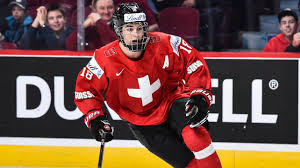
I know you well enough now to know you will gobble up one of the two – I am personally hoping it is the Swiss-born Hischier, who is a little more creative and more responsible, defensively, than the Jeff Carter-like Patrick – and then safely tuck him away for safekeeping in juniors and saying you don’t want to rush things by putting him in the NHL next year.

Unlike some others, I am fairly comfortable you won’t dip into the collection of top-tier defenseman prospects you have carefully curated and trade one way.

You see what I see: pairings of Samuel Morin and Shayne Gostisbehere, Ivan Provorov and Robert Hagg and Travis Sanheim and Philippe Myers.

I also see Patrick or Hischier with last year’s first-round pick, German Rubstov, up the middle.

While I see it by the season after next, you probably see it by the start of the next decade.

You know what, Hexy? I’m good with the patience, and not getting nudged to trade away any of the prospects you and your scouts have artfully collected. But what I’m not good with is being mired in the current purgatory of being just good enough to not be good enough.

The reality is that by the time the prospects all reach the NHL level, particularly on your timeline, the alleged “stars” of this very mediocre team will have less fuel in their tanks than a Hummer traveling on an open road through Nebraska.

Who am I talking about, while risking the hairy eyeball from fellow Flyers’ peeps?

I think you know, but I’ll come right out and say it. Claude Giroux, Jake Voracek and Sean Couturier come readily to mind.

If you have to sweeten the pot, why not do so with Scott Laughton before he has as much value as a Smith-Corona typewriter in an Internet Café.

I can hear it now. Giroux’s contract and no-trade clause (or whatever the heck it is). Voracek’s contract. Couturier is still young and will wake up one day and be a two-way player on a nightly basis.

Spare me.

So let’s forget what you can’t do. Focus on what you can do – getting close to equal value – and doing it do the best of your ability.

If Giroux knows he’s not wanted here, why would he stay? Heck, Hexy, he might be relieved.

The reason you didn’t make the playoffs? Because, on a playoff team, Giroux is not a No. 1 center and is past his expiration date. A good team, which you are not, would love to have him as a No. 2 center. If that means selling low, and getting a late first-round pick along with a mid-round pick, so be it.

And let’s face it, he is a not a captain. That “C” on his jersey has been weighing him down ever since he jumped the line ahead of Kimmo Timonen to get in the first place.

From where I sit, on my recliner in front of the TV, it seems Wayne Simmonds is more of the leader of this team anyway.

Voracek and “Coots” still have value, enough that, in a draft that has some depth but is not going to confuse anyone with 1979 (Ray Borque, Mark Messier, Mike Gartner, Brian Propp, Mike Ramsey, Paul Reinhart, etc.) or 2003 (Shea Weber, Corey Perry, Eric Staal, Ryan Getzlaf, Zach Parise, Brent Burns, Joe Pavelski, etc.), they could get you picks in the middle of the first round.

Maybe you then package these three mid-to-late firsts for two between picks 5 and 10 and get yourself wingers to ride shotgun with whichever center falls to No. 2.

There is Owen Tippett (6-2, 204), who possesses the best shot in the draft and netted 44 goals in juniors last year. There are two Finns, Eeli Tolvanen (a surreal quick release) and the ascending Kristian Vesalainen, who would also help ease the pain of struggling to find the twine for painfully long stretches of a season.

And speaking of Finland, this draft is loaded with the guys who led that country to the Under-18 World title.

Even though, we can’t knock the fact that we had a league-best nine players at the Under-20 World Junior Championships (where Hischier stole the show and single-handedly kept Switzerland competitive), we had not one player from Finland

That has to change. Too much talent coming out that country, as well as Sweden, right now. But I think you know that. You went with the flow of the draft last year and selected a lot of North American power forwards (including Tanner Laczynski, who represented the US) in the middle rounds.

I’m not worried about that.

Swede Oscar Lindblom, a fifth-round pick in 2014, will likely play – and play better than Chris Vandevelde or Michael Raffl – for us next season.

A round earlier in 2014, you took forward Russian Mikhail Vorobyov, who had 10 assists in seven games at the World Juniors and is considered an NHL-prospect, too.

No, unlike Holmgren, your drafts have been superb, top to bottom.

And you will do it again.

I know you will, because I know you better than you know yourself.

Therein lies the problem. Just get what you can get for players of diminishing value now, go with the kids – and also in goal, with whichever of the several prospects shows he wants the job bad enough, just like the Flyers did with you – and use the cap space to add the right veterans to guide them.

It’s not easy, but please don’t take the easy way out.

I’m counting on you.

Respectfully,

Gordon Glantz

Hometown: Gordonville, USA

This column originally appeared at Phillyphanatics.com

Draft 2017: The Future is Not Now

Draft

BY GORDON GLANTZ

@Managing2Edit

GORDONVILLE — On the team’s official Web site, it was labeled “successful” before the fans who didn’t sleep for three days woke up the next day.

On the streets of the city where the most-attended draft ever was held, opinions were more mixed, and those permanently scarred were already giving it a robotic thumbs-down.

From self-labeled “experts,” grades came in ranging from D to B-plus.

A year from now, the same draft guides that become springtime bibles will grade it out on a pass/fail basis, with a heavy emphasis on how much draftees played as a rookies.

Reality?

Here is reality: it can take up to four years, the length of rookie contracts, to evaluate a team’s draft. If a given team is cutting ties with a good portion of that class, then you have your answer.

And in the case of the Eagles, circa 2017, it may take all of those four years to truly know.

For now, I’ll go with a B-minus (bumped up from C-plus based on the undrafted free agent class that remains classified information).

Clearly, they were not drafting to do much more this coming season than to hope for a bounce or a break – or some torn ACLs within the division – and somehow slither into the playoffs at 9-7.

For me, a self-labeled “expert” who barely slept for three days – and enjoyed a recurring dream of a Super Bowl win when I did grab a powerless nap during a Saturday morning ballet – the Eagles again didn’t do what I would have done.

One of these years, by accident, they will.

Until then, I just have to don the proper head gear and bang my head against the wall.

Who am I to say, to question their judgment, you say? Hey, to be fair to myself, they have drafted as many Super Bowl championship teams in my lifetime as I have. And if they had followed my advice many times over the years, who knows?

But it’s not about me – or them. Players, general managers, draft consultants, coaches – and even owners and the stadiums they insist upon – will come and go.

It is about us.

And, in the quest to get us to the Promised Land, this is what we got:

Eagles-Barnett2FIRST ROUND (14th Overall)

DEREK BARNETT, DE, TENESSEE

WHY THEY DID IT: Well, it seemed like this was going to be their guy, no matter what. And, in the first 13 picks, there was a whole lot of “no matter what” going on. If they were so enthralled with the guy who broke Reggie White’s sack record at Tennessee (great propaganda, even though the eras don’t equate, as college teams throw even more than pro teams these days), why not trade back a handful of spots and pick up the Day 2 pick that they so desperately could have used to address cornerback.

WHAT WOULD I HAVE DONE? Well, I think you know, don’t you? Marlon Humphrey, the cornerback from Alabama, was my choice for the Eagles all along. With rape allegations surfacing about Gareon Conley right before the draft, I had legit concerns about Humphrey even lasting to No. 14. Turns out, he and Conley (drafted later in the first by the Raiders) were both there. I still don’t know how anyone who has watched the Eagles – not only in 2017 but in the few years before – can’t see the dire need for corners, especially in a draft frontloaded with them. The idea of adding a guy like Barnett, who I have nothing against other than that he didn’t fit the most obvious need, is that pressure on the quarterback will make life easier on the secondary. In an era where quarterbacks have releases like semi-automatic pistols, this is a rather quaint notion that comes across as the proverbial cart before the horse and a luxury a last-place team can’t afford.

ON NOTICE: The Eagles have other defensive ends on the roster. Chris Long was signed, ostensibly to replace Conner Barwin and play across from Brandon Graham. Vinny Curry remains, as does former first-rounder Marcus Smith and last-year’s seventh-round pick Alex McAlister, who was stashed on IR. There is also Steven Means. Certainly not the Purple People Eaters but it seemed like there was enough here to survive. There will be some tough cuts.

SECOND ROUND (43rd Overall)

SIDNEY JONES, CB, WASHINGTON

WHY THEY DID IT: Before they fixated on Barnett, they likely fixated on Jones. When he tore his Achilles on Washington’s Pro Day, Jones became an official X-Factor. Someone was going to take him on Day 2, and the Eagles – with a medical team that does not have the batting average it thinks it does – pulled the trigger. Again, another luxury pick that points more toward the future than the present.

WHAT WOULD I HAVE DONE? Honestly, I would have stayed with Desmond King, the cornerback/free safety who I had the Eagles taking in my third and final mock draft. I did have Jones going here in my second mock draft, but that was based on the premise that they were taking a healthy corner in the first round.

ON NOTICE: No one, really, since Jones will likely spend the year adding necessary bulk to his 186-pound frame and taking furious mental notes in film sessions, all with the goal of being the No. 1 corner of the future.

THIRD ROUND (99th Overall)

RASUL DOUGLAS, CB, WEST VIRGINIA

WHY THEY DID IT: Well, they will claim they liked him all along, but I’d bet my Bill Bergey autograph (whisper: I have two Bill Bergey autographs) that they sat helplessly while more shovel-ready corners than this one-year starter at what was apparently their most scouted college team were plucked. This was the most agonizing part of the draft, as the Eagles sent their own third-round pick for Baltimore’s compensatory choice at the end of round (essentially an early fourth at No. 99) to acquire Timmy Jernigan, who better turn out to be the second coming of Jim Weatherall (a 1952 Eagles draft pick). Douglas played two years of Junior College ball, was a reserve in 2015 and then came out of nowhere to lead the nation in interceptions with eight last fall. He has desired size (6-foot-1½, 209 pounds). With pedestrian speed for the position (4.59 in the 40), he had better use that size to be physical at the point of attack. Translation: If and when he starts, we’ll need that “cure-all” pass rush.

WHAT WOULD I HAVE DONE? Since King was still on the board, I would have taken King, but what do I know? He didn’t go until the fifth round to the Chargers. Write the name down and we’ll see. Another option would have been Damontae Kazee from San Diego State. A bit smaller (5-10, 185) than Douglas and only a shade faster (4.54), I suppose they deferred to defensive coordinator Jim Schwartz about system fit. They just better hope Schwartz stays for this long-term plan. If not, that screeching sound you hear are the wheels spinning at the NovaCare Complex.

On Notice: Uh, well, the starting corners going into the draft were last year’s seventh-round semi-pleasant surprise Jalen Mills and this year’s recycle-bin free agent Patrick Robinson – with Jaylen Watkins or Ron Brooks, if he is not released after June 1, in the slot. Right now, not much changes. Douglas is safe, so the likes of Aaron Grymes and Dwayne Gratz and C.J. Smith will battle for what will likely be one roster spot. Good thing we got that pass rush going, huh?

FOURTH ROUND (118th Overall)

MACK HOLLINS, WR, NORTH CAROLINA

WHY THEY DID IT: Um, not sure. King and Kazee were still available. That would have put another corner in the mix while Jones dons the shirt of red. The need for a receiver is there, just not as pressing after doing considerably well in free agency with Alshon Jeffrey (albeit on a one-year deal) and Torrey Smith on what is really a series of three one-year deals. Jordan Matthews moves back to the slot, and his success will determine his long-term future here. Nelson Agholor and Dorial Green-Beckham are still scratching the surface of apparent untold potential. Enter Hollins, who is already pegged as a spare set of hands – at least for a year or two – while distinguishing himself on special teams. That latter trait is reportedly what sent him shooting up some draft boards and made the Birds bite on the next Riley Cooper (a fifth-round pick) in the fourth round. The comparison is real, and not meant in a negative way, as Hollins is 6-4 and 220 pounds and, despite a 4.51 40 time, had a knack for big plays (and injuries) throughout his career as a three-year starter.

WHAT WOULD I HAVE DONE? King or Kazee, but maybe that’s just me. Did you write those names down for posterity yet? Let’s see who has a better career.

ON NOTICE: Agholor and Green-Beckham could be on the endangered species list. Because Agholor has Chip Kelly’s DNA on him, while DGB was acquired by this regime (and did a bit more in less snaps last year), my money would be on Agholor to be pushed out. Others in the mix include Bryce Treggs and Paul Turner, who were both on the roster last year. Rasheed Bailey, who was cut by Kelly after a strong training camp in 2015, returns after stints in Canada and practice squad time with the Jaguars and Chargers. David Watford was on the practice squad last year while Marcus Johnson showed enough in camp to get another invite.

Eagles-PumphreyFOURTH ROUND (132nd Overall)

DONNEL PUMPHREY, RB, SAN DIEGO STATE

WHY THEY DID IT: Easy. Darren Sproles is entering what is likely to be the final year of his borderline Hall of Fame career and Pumphrey (left) is a reasonable facsimile. Howie Roseman even pulled a “Howie” and moved up a few slots to secure the services of the NCAA Division I all-time leading rusher. Despite his diminutive stature (5-8, 170), Pumphrey was rarely injured as a three-year starter getting a massive amount of touches. A lot of that can be attributed to 4.48 speed he maintains when making exciting decisive cuts. The presumption is that Pumphrey, also an accomplished receiver, is an electrifying return man. Truth is, if he had done it more, he would have been snatched up on Day 2. With Sproles as a mentor, and Dave Fipp as the Special Teams guru, the hope is that he will be coached up to handle at least some of those chores in 2018.

WHAT WOULD I HAVE DONE? Well, my DBs were still there, but I can’t really argue with this pick.

ON NOTICE: The Eagles have an odd situation in the backfield. If they don’t bring in a veteran like former Chief Jamaal Charles, who was scooped up by the Broncos, we are looking for a committee approach. Sproles and Pumphrey will be joined by last year’s fifth pick Wendell Smallwood. Byron Marshall and Terrell Watson each showed some promise at the end of last season, but Watson has since been released and word on the street is that Marshall might be moved to receiver.

FIFTH ROUND (166th Overall)

SHELTON GIBSON, WR, WEST VIRGINIA

WHY THEY DID IT: Wheeling and dealing left the Eagles picking later in the round. This was a calculated risk, as there were still plenty of juicy names still on the board. Aside from our friends King and Kazee, there was the next wave of corners, such as Miami’s Corn Elder and Temple’s Nate Hairston. Also still undrafted was Michigan tight end Jake Butt, a likely Day 2 pick before a knee injury. As it turned out, Roseman was not smelling like a rose when none of these players were left, so that left a chance to double down at receiver with Gibson. With only pedestrian size (5-10½, 191), they likely saw his production (nearly 24 yards per catch) and rolled the dice that Gibson is the anti-Agholor. That means he plays faster than his 4.5 40 time instead of slower. Like Agholor did, Gibson brings exciting return ability to the mix.

WHAT WOULD I HAVE DONE? If only because Hollins and Gibson create a crowd at a receiver, while not much of an immediate jolt to the offense, I would have stayed on defense with someone like LSU defensive tackle Devon Godchaux or considered myself lucky to see a developmental quarterback like Pitt’s Nathan Peterman still on the board.

ON NOTICE: See Hollins.

FIFTH ROUND (184th Overall)

NATHAN GERRY, SS/LB, NEBRASKA

WHY THEY DID IT: Because, for better or worse, they think they are smarter than everyone else. Not an indictment of the Eagles, but all teams. They see a guy who was a solid college player with tweener size and skill set to stay at the same position. So, the thinking is to add to Gerry’s 210-pound frame and turn him into a situational linebacker. To be fair, teams around the league have had some success in recent years converting in-the-box safeties into undersized linebackers. The most notable is Deone Bucannon of the Arizona Cardinals, but Gerry – though a three-year starter and All-Big 10 selection each year – has nowhere near the same athletic ability.

WHAT WOULD I HAVE DONE? I have been touting San Diego State’s Calvin Munson in my pre-draft mocks, and he was not only available, but made it all the through the draft, only to be inked as an undrafted free agent by the rival Giants. Write the name down. If I’m wrong, I’m wrong.

ON NOTICE: The Eagles already have a safety/linebacker hybrid on the roster in Kamu Grugier-Hill. Unlikely there is room for two, and maybe not one. Let the battle for one of the final roster spots begin.

SIXTH ROUND (214th Overall)

ELIJAH QUALLS, DT, WASHINGTON

WHY THEY DID IT: Simply put, value. At this point, with some of the best-laid plans likely gone awry – despite what they will say publicly – the Eagles saw a productive college player and took a boom-or-bust shot in the dark that he can overcome not having a NFL body type. At barely 6-foot and 313 pounds, Qualls, with a big belly and short arms and small hands, fails to pass the eye test of scouts. Still, he was an active player at Washington who lined up at different spots and was always around the ball or in the face of the quarterback.

WHAT WOULD I HAVE DONE? At this point, to be honest, I would have done the same thing.

ON NOTICE: Beau Allen injured himself working out and went from penciled-in starter to possible fourth tackle, depending on what Qualls can do behind Fletcher Cox and Timmy Jernigan. The Eagles already issued walking papers to Aziz Shittu, who was an undrafted free agent last year and parlayed a strong camp into a spot on the practice squad. Destiny Veaeo, who also made the team last year as an UDFA but faded as the season wore on, will have to have a stellar camp to stick around.

UNDRAFTED FREE AGENTS

Although they have an apparent blind spot for the only Division I football team in the city, the Eagles are always aggressive after the draft ends and are willing to spend – and spend wisely – to get who they want from those left undrafted.

It is a commendable trait, although there eyes were a bit too big for their stomachs in 2017, as they were left having to issue pink slips to current players on the back end of the roster to make room. As a result, the list has not been made officially official.

However, in the Twitter Universe, it is impossible to keep secrets. It seems fairly certain the following “name” players have been inked, and will headline the crop of undrafted hopefuls:

  • Quarterback Jerod Evans, Virginia Tech (Projected Day 3 pick)
  • Running Back Corey Clement, Wisconsin (Projected Late Day 2 or Early Day 3 Pick)
  • Wide Receiver/Tight End Billy Brown, Shepherd (Projected as a Priority Free Agent)
  • Wide Receiver Greg Ward, Houston (Projected as Undrafted Free Agent possibly ticketed for the CFL)
  • Center Tyler Orlosky, West Virginia (Projected as a Day 3 Pick)
  • Safety Randall Goforth, UCLA (Projected as a Priority Free Agent)

Presuming this is accurate, the Eagles deserve kudos for their post-draft work. Clement has a realistic shot to join the fun in a committee approach out of the backfield, and was likely the primary reason Watson was cut. Evans may have hurt himself in the wallet by not staying in school to hone his skills, but brings a pro arm and mobility. Brown dominated at the Division II level as an oversized receiver (6-3, 254) and could end up as a converted tight end down the road. Orlosky is reportedly the highest paid undrafted player in the league, a year after the Eagles spent more than any other team on UDFAs, and could mean less job security for Jason Kelce. (Even if Orlosky is a reserve as a rookie, Stefen Wisniewksi could slide over to center and keep the spot warm.) Goforth’s only issue is his size (5-9½, 176), as he was productive in college (four interceptions last year) and could warrant a look at slot corner while make a name for himself on special teams. Ward was a dual-threat quarterback at Houston, which the Eagles probably knew while watching and dismissing all players from Temple, who is reportedly going to give it a go at wide receiver. At 5-11 and 185 pounds, quarterback is out of the question. However, considering his running ability and sub-4.5 speed, one wonders if he shouldn’t get a look in the backfield, too.


A ‘Super’ Sentiment

tampa-bay

By GORDON GLANTZ

@Managing2Edit

GORDONVILLE — By the time many of you read this, the Super Bowl between the Atlanta Falcons and New England Patriots will have already been played.

Nonetheless, I want to get my pre-kickoff state of mind on the record, should I lose my mind as a result of the game, which I would not be surprised will be a good one (we’ll see if I’m right about that).

For the record, I would only be disturbed if a zebra came out and crapped on the field (i.e. an official altered the outcome, either way, with a bad call).  That aside. I’m not going to lose any sleep over the outcome.

That means none. As in zero.

I’ve been deprived so many beauty winks over the past nearly five decades of being a Philadelphia sports fan — and such an ardent devotee of the Eagles, in particular, to the extreme point where I really don’t even enjoy the games anymore — that I would have looked more like Brad Pitt and less like, well, me if I had been more into making model airplanes on autumn Sundays instead.

Ask me who I think will win today, and I will run in through my personal processor and come out with a New England triumph to the tune of 41-35 (give or take a few points).

I’d like to be right, but I have been known to be wrong on some rare occasions. It would uphold my status as someone who knows something about the sport beyond an excuse to drink and belch and play meaningless taproom pools to stay interested.

But I’d also like to be right for another reason. I know it means I should — and could — be burned at the stake the next time I venture out for a cheese steak, but that’s how I feel.

The reason: I would rather see the Patriots win.

That’s right, I said it.

I can hear the chorus now: B-B-But Falcons’ quarterback Matt Ryan is a local boy.

Yeah, I know. Don’t care.

He is not from Northeast Philly, let alone an alum of Northeast High. He is not from my adopted home ‘hood of Central Montgomery County and did not play for one the schools I covered in my long sports-journalism career.

And he did not stay home and play college ball at Temple, instead going to Boston College.

Ryan is from Exton and played scholastically at Penn Charter (eye roll … like that is a common occurrence … second eye roll … for normal kids paying their own way).

May as well be from Mars and have played on Neptune before going to Jupiter for college ball.

Next, you’ll say: B-B-But it will be someone different, another team winning for a change.

Keep talking, and then keep walking.

Not gonna work here in Gordonville.

If the Falcons win today, they will be something like the eighth team (no, I’m not looking it up to verify!) — just since Jeffrey Lurie has owned the Eagles — to win their franchise’s first Super Bowl while we wait in line.

In many cases, these are rent-a-franchises without histories dating back to the earliest days of pro football.

Talking about Tampa Bay and Carolina.

One more for the winner’s circle?

Screw that.

And don’t try to get political, saying our newly elected dictator’s favorite team is the Patriots.

Sports is the one place where politics and other things that divide us are usually put to the side.

And given the rise of anti-Semitic acts since a certain someone was elected on what I see as an arcane technicality (the electoral college), it would be a strong message — for those who dare to comprehend it — to witness said “president” hanging with Patriots’ Jewish owner Robert Kraft.

Yes, the Falcons have a Jewish owner, too, in Arthur Blank.

The fact is that there probably more Jewish owners in the NFL than there are Jewish players.

And yet, two of those players — Julian Edelman and Nate Ebner — are  not only rostered with the Patriots, but are pretty good. Edelman is the favorite target of Tom Brady and Ebner is an All-Pro special teams guy.

A win will make the Patriots the top dynasty of the league’s Super Bowl era and Tom Brady the Super Bowl quarterback with the most wins (which may get him to retire). Sports doesn’t have enough dynasties anymore, so that’s fine.

I’ve seen them celebrate before, including beating the Eagles in my presence. I am numb to that pain.

A new team? A “somebody else for a change” team? Can’t stomach the idea.

Let it be us, or no one at all.

That’s about enough to give me a rooting interest, and while having me still sleep like a baby — and dreaming that recurring dream of the Eagles winning it all — this Sunday night.


With NMOE Foundation Set, Hadrick Steps Down – But Not Away

tre-pic

By GORDON GLANTZ

Gordonglantz50@gmail.com

@Managing2Edit

In the summer of 2011, Ernest Hadrick III – better known as Tre Hadrick – decided to line up alongside many of his old football teammates at Norristown Area High School and tackle a new challenge: Helping to guide next generation from their hometown to level the playing field in the game of life.

“It was just to help the kids,” he recalled about the group that would come to be known as the Norristown Men of Excellence (www.nmoe19401.org), which achieved 501c3 status as a non-profit organization. “I basically brought the group together. Our mission was a collective effort.”

Considered “core” members are: Sheldon Gray, Milt Williams, Hakim Jones, Troy Swittenburg, Percy Jones, Kirk Berry, Doug White, Brian Webster, Don Milligan and Kenrick Marsh.

“We met in August of 2011, talking about giving back and making a difference.  From there, we continued to grow and put things into place.”

As for expanding the group: “We wanted the best from Norristown. We had a lot of guys, maybe 30 or 40. Some were from out of state but were still doing good things.”

One of those was Alan Grantham, who graduated from Norristown in 2001 and has degrees from Maryland and NYU.

“He supports NMOE financially each year with our Scholarship Fundraiser,” said Hadrick, who referes to Grantham as: “From Willow Street to Wall Street.”

Beyond lofty goals about achievement and greatness, there was a bottom line.

“Just consistency,” Hadrick continued. “Our consistency allowed us to have success.

“Our mission was to give back in any way we could in any way we could. We opened up our visions and broadened our focus.”

Whether it is at the annual banquet or one of the other myriad of programs run by the group, the guidance counselor at Eisenhower Middle School sometimes needs to stop and realize how far it has come in such a short period of time.

“It’s like, ‘wow, we really made it happen,” said Hadrick, who played college football at Auburn and then North Carolina A&T and just completed his first season as an assistant coach at Conestoga High. “It’s been a blessing, a special feeling.”

And the success has allowed Hadrick to make the decision to no longer serve as the NMOE president, effective Dec. 31, with Berry taking over.

“My tenure is up as president,” he confirmed, adding that the term was only meant to be for two years. “I am still very much going to remain a part of the organization. I still want to see things continue with the original vision.”

Now in the process of putting it all into perspective, Hadrick believes he was given the tools to give back while at North Carolina A&T, where he says he “learned through my fraternity guided me to adopt some of the key organizational skills” that helped create the foundation of NMOE, Inc.

“It would be unjust of me not to mention the impact my fraternity, Omega Psi Phi Fraternity, Inc., has had on me: Hard work, perseverance and enthusiasm are some of the tools they encourage,” he said.

Hadrick, the 35-year-old married dad of one, called stepping away from top post “perfect timing” and vowed to remain active, saying he will “still be in the background.”

The move comes in a year of change for Hadrick, who was given the chance to coach high school-level athletes by former Plymouth Whitemarsh standout running back Keyente “Key” Moore at PaSwag (paswag.net), which is best described as the football equivalent of AAU basketball.

From there, Marquis Weeks, who was forming a staff at Conestoga, where he rewrote the records books as a running back before moving on Virginia, reached out to Hadrick to join his staff.

It meant a long-awaited opportunity, but also at a school other than Norristown, which was an initial shock to his sensibilities.

But once he commits, he commits.

And so he did.

The result was an “amazing experience,” that he looks to build upon.

“It was challenging,” said Hadrick, whose job was to coach running backs and linebackers. “I love Norristown. I love the blue and white. It’s nothing I can fake. At the same time, I like to help kids.

“It was, overall, a great experience. The kids all bought into the system. Coaching is a passion. I love sports. It’s part of my nature. It’s what I understand.”

While the NMOE had a sports aspect to it, with lacrosse and football clinics, it was as much about life coaching for youth as it was anything else.

Other programs include Ted Talks, essay contests with cash prizes, turkey drives, after-school programs, fundraisers for the two high school scholarship winners that receive $1,000 and an iPad mini.

It all began with that goal in mind. Easier said than done, but it got done.

Hadrick remembers being told he “looked nervous” before the first banquet, and he admits that his biggest fear was not speaking as much as it was “letting people down.”

He added: “We had higher standards, higher goals. We set the bar high.”

And they stayed consistent under his guidance.

“I always felt that we could pull it off,” he said. “We’ve been blessed with people doing great things in Norristown.

“I am pleased, and my time is up, as of the 31st of December. Hopefully, my efforts left an impact and that I set a foundation.”

Those hopes became reality when, at the first meeting after Hadrick was no longer president, he was presented with an award.

“Shocked, suprised and humbled,” he said. “I didnt see this coming at all. I’m very thankful and appreciative of this award.”


2016 Eagles: Patience Required

doug-pederson-eagles

By GORDON GLANTZ

Gordonglantz50@gmail.com

@Managing2Edit

GORDONVILLE — In many ways, the 2016 Philadelphia Eagles are like a marriage ceremony – with a shotgun included with the rice.

As the invited guests gather around, there is a sense of a beginning taking place.

And, unlike the coordinators – Frank Reich with the offense, Jim Schwartz with the defense and Dave Fipp with special teams – head coach Doug Pederson and starting quarterback Carson Wentz are rookies. When the bell rings this Sunday at Lincoln Financial Field – ironically against the Cleveland Browns team that will get the Eagles’ first-round pick in exchange for the chance to draft Wentz – it will be their first rodeo.

There will be ups and downs, but all we can do is send them off on their mystery ride with the type of warm wishes reserved for wedding videos.

There is the question of whether the Eagles, searching for their first championship since before The Beatles appeared on The Ed Sullivan Show, will finish at or around .500 and are good enough to contend in a weak division or are so bad that the Browns draft in the top 5 right here in Philly. But the 2016 season, the first year of the union, should not be judged in a vacuum.

With that said, Eagles Nation, boo now or forever hold your peace.

And do so knowing that the history of the combination of a first-year head coach and rookie quarterback is not going to put you line to order playoff tickets.

But also do so knowing that a strategic step back could mean the necessary steps forward that the franchise has been unable to make since 1960.

In the meantime, and despite the frustration, try to keep the proper perspective.

And don’t wave the white flag just yet.

There are reasons for optimism:

  • The Eagles, according many outlets that tabulate such things – knowing, full-well, that fortunes rise and fall on a weekly basis – have one of the easier schedules around. Not only in the NFC, but in the entire NFL. The slate begins with two winnable games, even with a rookie with one preseason outing under his belt under center. Week 3 is home against Pittsburgh. Although the Steelers are clearly the more powerful squad, they will be without suspended running back Le’Veon Bell. Next is a bye week. A 2-1 record would set the right tone. And while 1-2 wouldn’t be disastrous, an 0-3 start would only make talk-radio trolls happy.
  • When Schwartz was hired as the defensive coordinator, there were deserved cold sweats and flashbacks to 2012. That’s when Jim Washburn was running a Wide-9 in the trenches while overmatched defensive coordinator Juan Castillo had linebackers on a different wavelength and secondary coach Todd Bowles had the secondary on another. However, if the 4-0 preseason is any guide, dysfunction is not going to be an issue. A strength of the team is its Eagles-Cox with footballdefensive line, with Fletcher Cox (left) almost unblockable inside and a trio of defensive ends – Connor Barwin, Brandon Graham and Vinny Curry – buying into the scheme that seems ideal for their skill sets. The key to the scheme is a middle linebacker who won’t become roadkill the way that Casey Matthews did in 2012 as a rookie thrown to the wolves. Jordan Hicks, on his way to possibly being the league’s top defensive rookie last year before an injury, moves from inside in a 3-4 to the middle in the 4-3. There may be a learning curve, but he has veteran assistance in Stephen Tulloch – the best at running Schwartz’s defense while in his prime – as a mentor. The talented, but oft-injured Mychal Kendricks is on the weak side and Nigel Bradham, a Schwartz disciple, is on the strong side. While the cornerback position is in question, and will rely heavily on the consistency of the pass rush (more so than the raw sack total), the safety tandem of Malcom Jenkins and free agent Rodney McLeod is one of the better combinations in the league.
  • Fipp’s special teams units not only have the chance to be special – pun intended – they are going to need to be among the league’s best if some games are to be stolen. There was some overall slippage last season, but it was hard to match the 2014 campaign when special teams accounted for seven touchdowns (three on blocked punts, two on kickoff returns and two on punt returns) and played a key role in Chip Kelly’s second edition matching the 10-6 mark of the first, despite lacking the same cohesion on offense and defense as 2013. Cody Parkey was a Pro Bowl kicker in 2014 as a rookie, and Darren Sproles made his first Pro Bowl as a return man in 2014 and earned another trip last season. With special teams-first players like Chris Maragos and Bryan Braman leading the way, there is almost no reason not to expect more of the same. Hiring Fipp was one of Kelly’s best moves, and retaining him was equally worthy of plaudits.

But before you start getting delusions of grandeur, consider the following:

  • Wentz may have all the requisite tools of a franchise quarterback – size, smarts, a cannon for an arm, running ability and leadership skills – but he is still a rookie from the Division I-AA level. Yes, North Dakota State is a powerhouse there. Yes, he won two championships there. But he didn’t even grab the starting job until his junior season and missed part of last season with an injury. Even big-time BCS-level quarterbacks with more experience sit for a year, sometimes longer, before taking over the reins of their offenses. What does this mean? He will have moments where natural ability takes over, and an overall strategy tailored for him to manage the game will limit mistakes. Still, there will come times – times late in games and chances need to be taken – when he will need to sink or swim on his own. He will likely swim sometimes, but he will also need a lifeline others. There are also has Eagles-Ertzto be concern that some of the teams better targets, like receiver Jason Matthews and tight end Zach Ertz (left), will get frustrated. There will be weeks where Wentz just won’t get them the ball as much as they want it. All of us – teammates, coaches, front office, media and fans – need to be willing to show patience for not only this season, but into the next. Case in point, there is the groundswell of hope that receiver Dorial Green-Beckham becomes a beast at some point this season. That transformation from raw talent to polished product would have had a better chance of happening with Sam Bradford, or even Chase Daniel, running the offense. Additionally, the downside of starting Wentz from Week 1 will be that will be hard to give him the hook without risking a regression.
  • Even before the trade of Bradford, the Eagles looked to be a ball-control offense without an inside-out passing attack (working the tight ends, the running backs on screens and quick hitches to the receivers). Ryan Mathews will be featured in the running game. While talented enough to be an elite back, he has a long history of injuries. Behind him is Kenjon Barner, who has proven to be the Brian Westbrook of preseason but the Robert Drummond of the regular season. Rookie Wendell Smallwood barely played in the preseason, and enters the opening game coming off a concussion protocol. Ideally, the coaches would rather use Sproles as a Swiss Army Knife more than as a pure running back, but may end up having no choice.
  • The league did the Eagles zero favors by giving no firm answer on the fate of right tackle Lane Johnson, who was presumed suspended for PED use but the punishment never came. The waiting period caused a lot of shuffling of the first-unit line in the preseason in search of the right Plan B. Now, it’s back to Plan A – at least until they hear otherwise. While no team can win anything of consequence without a solid offensive line, it is even more imperative with Wentz under center and the need to run the ball consistently. The Eagles will be predictable; that much is certain. When a line dominates, it generally doesn’t matter much. That chance to do so, at least early on, may have been lost.
  • While the linebackers are talented, depth is a concern. Kendricks is no stranger to the training table. Hicks, while having the talent to be drafted as early as the late first round, lasted until the late third because he missed two full seasons in college. On the north side of 30, Tulloch was on the open market until August. He could have a season left in his tank, but that would pretty much be it. The Eagles signed Kamu Grugier-Hill after final cuts but he is 215 pounds and is considered a linebacker-safety hybrid who mostly will be asked to excel on special teams.

Every season is full of surprises. When it is the first year of a marriage, anything and everything could happen. Don’t be shocked if:

  • The much-maligned Josh Huff finally becomes at least semi-productive, at least enough to not be everyone’s least favorite player. Judging from how he was used in the preseason, Pederson will try to manufacture touches to Huff – screens, quick hitches, reverses – much in the way that the Rams do for Tavon Austin.
  • Sproles and Ertz – or Ertz and then Sproles – are the team’s leaders in receptions. Matthews is likely to top the charts in yards (although getting to 1,000 after just falling short last year might be tough) and also touchdowns, but Wentz will likely rely on security blankets out of the backfield and at tight end.
  • Speaking of tight end, also look for Trey Burton to play a larger role in the offense – finally – after being treated like the ugly girl at the dance by Kelly. It won’t be uncommon for three tight ends to be on the field, and Burton is athletic enough (he’s the emergency QB) to line up in the slot and in the backfield. We saw hints of this in the preseason.
  • The play from the cornerbacks, buoyed by the front seven, may be at least adequate. Leodis McKelvin and Ron Brooks are Schwartz guys and, if nothing else, are not shy about coming up and making a hit in the running game. There are whispers among the players who survived the purge of Kelly’s roster that Nolan Carroll is the most improved player on the squad and ready for a breakout year.
  • General Manager Howie Roseman will continue to be aggressive in shaping the roster, whether it is deals right up to trade deadline or installing a revolving door around the room where the practice squad players hang out.

And now our train has pulled into our final stop, Prediction City:

  • The formula is simple. While the defensive and special teams units hold down the fort and keep games close, the offense will need to worry as much about first downs as touchdowns and complement the other two units by maintaining the field-position edge. Expect games to be scoreless well into the second quarter and still up for grabs into the fourth. It will come down to who does or doesn’t step up to make the key play when it matters. The offense will need to convert in the red zone, especially when set up there by the defense/special teams with turnovers. This is where Wentz needs to develop chemistry with Green-Beckham and Ertz.
  • The division is weak, and weaker with Tony Romo’s career in limbo and the Eagles turning to Wentz a season or two earlier than expected. The main benefactor, though, will be the returning NFC East-champion Redskins, who may go 10-6. Look for the Giants, who are lethal on offense and porous on defense, to go 9-7. The Eagles will be third at 7-9, followed by the Cowboys at 6-10.

Now please return to your tables. We are ready for the first dance.

This preview also appeared at http://www.phillyphanatics.com


Don’t Stop Thinking About Tomorrow

NFL: Preseason-Tampa Bay Buccaneers at Philadelphia Eagles

Aug 11, 2016; Philadelphia, PA, USA; Philadelphia Eagles quarterback Carson Wentz (11) calls a play at the line of scrimmage against the Tampa Bay Buccaneers at Lincoln Financial Field. The Philadelphia Eagles won 17-9. Mandatory Credit: Bill Streicher-USA TODAY Sports

By GORDON GLANTZ

Gordonglantz50@gmail.com

@Managing2Edit

GORDONVILLE — To evaluate the 2016 Philadelphia Eagles, we may need a bit of historical perspective, so let’s take a trip back in time to 1977.

A peanut farmer had just become your president, your choices at the movies included “Star Wars” and “Annie Hall” and Fleetwood Mac’s “Rumours” was the top-selling album – yes, on vinyl – for just about the while year.

Roy Halladay and Juan “Pepe” Sanchez were born, while Joan Crawford and Bing Crosby died.

The Eagles were in Year 2 of the Dick Vermeil era. The team celebrated the Bicentennial by going 4-10. In 1977, they weren’t much better – in terms of won-loss record – at 5-9.

And with the sound of Fleetwood Mac’s Lindsey Buckingham leading his brooding band mates singing “don’t stop thinking about tomorrow” (the chorus of the song “Don’t Stop) blaring from AM radios, a future was coming into view.

The Eagles were getting better – even if it wasn’t reflected in the oft-unforgiving bottom line at the bottom of the standings.

Despite not having a draft pick in the first four rounds, due to short-sighted trades of the prior regime, lemonade was made out of lemons. The draft yielded one of the franchise’s all-time great running backs, Wilbert Montgomery, in the sixth round and future Pro Bowler – and anchor of the 3-4 defense – in nose tackle Charlie Johnson in the seventh. Meanwhile, long-time corner – and future NFL coach – Herman Edwards was the most significant of the undrafted free agents signed.

While only improving by one win, the Eagles were significantly more competitive than the previous season. Despite going 5-9, in what was the final NFL season in which teams played 14 games, the Eagles scored more points (220) than they gave up (207, five fewer than the 12-2 Dallas Cowboys).

They won a few games by wide margins – 28-10 over the New York Giants, 28-7 over the New Orleans Saints and 27-0 over the New York Jets – while only one of their nine setbacks (20-0 against the Los Angeles Rams in the second week of the season) was by more than 10 points, and six were by a touchdown or less.

Many of the games were decided in the fourth quarter, and often by one key play – either by opposition playmakers the Eagles didn’t yet have or by an Eagle making a well-intentioned, but costly, miscue.

It was frustrating, and not for the faint-hearted, but a change was taking place. It was a season of necessary growing pains that, even cast in the context of this current era of quick-fix free agent signings, you still can’t navigate around it and expect to reach the desired destination.

Much like the 1977 Eagles, the 1999 version, which went 5-11 in the first year of the Andy Reid era, stayed competitive with special teams and defense. Both teams featured young quarterbacks (Ron Jaworski in his second year as a starter in 1977 after being plucked from the Rams and rookie Donovan McNabb taking over halfway through the 1999 season) worked through their mistakes.

In 2016, we have prized rookie Carson Wentz slated to start the season opener – in a drastic turn of events after slated starter Sam Bradford was sent packing to Minnesota for first- and fourth-round picks on the eve of the season – so there is reason for guarded optimism about the long-term.

From their humble and character-building beginnings, Vermeil’s and Reid’s Eagles got to Super Bowls.

They lost, yes, but they were there. One undeniable law of the sports universe is that you can’t win a championship unless you are in it.

What seems to be in place are the support systems – the front offices able to see far and wide, as opposed to having the tunnel vision that dooms sports franchises to eternal damnation.

Vermeil had the combination of Jim Murray and Carl Peterson to lean on in the front office. Reid had Tom Modrak. Pederson seems in safe hands with Howie Roseman, who has come back from the wilderness to earn the adoration of the faithful by undoing all that Chip Kelly did went he sent Roseman into exile (while doing his best to fulfill that whole “eternal damnation” prophecy).

If they are to eventually climb that mountain again with new head coach Doug Pederson, who started at quarterback in the first part of 1999 and turned up on Reid’s staff as the quarterbacks coach before moving with him to Kansas City, the coming season could very well be the launching pad.

The parallels are there. Vermeil had Marion Campbell as his defensive coordinator in what was, at the time, an innovative mode of attack with a 3-4 defense. Reid had Jim Johnson and his masked strategies of dictating to the offense, as opposed to letting the offense dictate to him. Pederson has Jim Schwartz and his attacking Wide-9 scheme (a far cry from the disjointed Wide-9 mess in Reid’s final season of 2012).

Special teams? Vermeil needed to come around on the importance of a placekicker (lest we summon the image of Mike Michel’s misses when the Eagles made the playoffs in 1978, a year after the 1977 signs of sunlight through the clouds). However, as evidenced by Vince Papale making the team 1976, the tie-breaker in the battle for backup roster spots was almost always based on kick/punt coverage skills.

While Ken Iman handled both special teams and the offensive line on the staff, it needs to be mentioned that Vermeil was hands-on in that area. He holds the distinction of being the league’s first full-time special teams coach under George Allen with the Rams.

Reid had John Harbaugh, who went to eventually become a head coach and lead the Baltimore Ravens to a championship. And Pederson has wisely retained Dave Fipp from Chip Kelly’s staff.

In conjunction with Schwartz’s take-no-prisoners defense, the special teams could make enough plays – forcing turnovers, blocking punts, setting up long returns, etc. – to make up for an offense that will be driving in the right lane of the highway for long stretches of its 2016 road trip.

Enough so that maybe we could get 1977 all over again. So break out the old turntable, crank up the Fleetwood Mac and don’t stop thinking about tomorrow.

This column also appeared at Phillyphanatics.com


Olympic Shakedown

Handshake

By GORDON GLANTZ

Gordonglantz50@gmail.com

@Managing2Edit

GORDONVILLE — In a perfect world, the now-completed 2016 Summer Olympics in Rio should have been a rallying point in Casa de Glantz.

No more fighting for the remote when it is time to decide between “The Bachelor” or a sporting event. No more zoning out when an obscure topic comes up at the dinner table.

With Sofia now 9, these were to be the first Olympics when she really could fully comprehend what was happening up there on our new 60-inch screen.

And even though I’ve gained the smarts to work the Smart TV, I figured Netflix would have to take a break for the Olympics.

But something happened on the road to Rio (yes, I’m aware of the movie by that name).

HBO’s “Real Sports” kept it “real” and shed light on the dark underbelly that is the whole Olympic syndrome we buy into every two years (Winter Olympics come two years after the summer these days, so that we stay nice and inundated with the concept of good will through sport).

Exposing the exploitation tactics of the International Olympic Committee (IOC), Real Sports confirmed a semi-quelled inkling that sports journalism may now be the standard-bearer of the once great fourth estate.

And it turned me off, just about completely, to any interest in the Rio games, while serving as a stark reminder that an event designed to make the world seem perfect is a delusion.

But then I had to consider my 9-year-old ultra-precocious daughter, Sofia, who was going into the Games buoyed by a Lifetime movie on Gabby Douglas she had seen on Netflix after a long détente over what to watch once the Smart TV riddle rhymed.

She was deeply interested, and asking a lot of questions. When it comes to all things sports, whether I know or not, I’m the Answer Man around here.

As it was, the two most televised sports in the first week were gymnastics and swimming. Sofia, inbound for fourth grade, has been taking gymnastics since the summer after Kindergarten and has been taking more serious 1-on-1 swimming lessons this summer.

She was doing her own “routines” in front to the TV, and pretending to swim back and forth. It was too cute, and too reminiscent of what I used to do – often in full costume – when I watched sports. (Confession: I still watch the Eagles in a jersey and hold a now half-deflated football as a comfort toy.)

So I put all disgust from the “Real Sports” segment on the shelf and watched with her, even when Mommy and Nana slithered away from the scene.

This is what we Dads do.

Sofia was cheering for Douglas, after seeing the aforementioned movie, but I reminded my half-Jewish daughter that she needed to hold a warm thought for team captain Aly Raisman. We also cheered for Michael Phelps to make history, were amazed by Katie Ledecky and couldn’t understand how and why Sweden would be formidable in swimming when the other more “winter” countries (Norway, Switzerland, Denmark, Austria, Finland, etc.) were struggling to get on the radar in any event.

It brought back memories of my first real Olympics experience: the Munich Games of 1972.

I was 7, and my whole world was sports. I remember watching from the couch for much of Mark Spitz’s exploits. I also remember being on “vacation” in Washington, D.C. for the end of the Games, and trying to understand – as much as I could at that age – what was going on when the Israeli athletes were taken hostage and murdered by Palestinian terrorists.

At the time, I thought the subsequent theft of the basketball gold medal from the U.S. men’s basketball team was more egregious, but I soon came to learn that it paled in comparison. It came full-circle when I read a Doug Collins interview stating that what had happened to the Israelis pretty much dampened the spirits of the team and that they “just wanted to go home” as much as play that gold medal game against the former Soviet Union.

Olympic officials tried to separate sports from politics, but they were proven – just as Hitler’s Berlin Games of 1936 and the black power salute of Tommie Smith and John Carlos on a Mexico City medal stand in 1968 or the mass boycott of the Moscow Games of 1980 did – to be impossibly intertwined.

That’s the one aspect of the modern Olympic Games in which the spirit of the ancient Greek Olympiad cannot be recaptured. In those days of yore, with the likes of Plato and Socrates among the honored spectators, there was a mandatory cessation of regional hostilities to allow for safe passage of soldiers to travel and be able to compete.

How and why could that have been the case in a supposedly less-evolved time in history? Maybe because the ancient Olympics also had a spiritual side.

They believed the Gods were watching.

These Gods probably looked away in disgust sometime between the full-time modern revival in Athens in 1896 and the stripping of Jim Thorpe’s 1912 gold medals in 1913.

Although smoke-and-mirror productions – like the grandiose opening ceremony in Rio –  can put a proverbial bandage on a gunshot wound, the internal bleeding had already begun behind the scenes.

And it was clear there was no cessation of regional hostilities to allow safe passage – even to the opening extravaganza.

That night in Rio, members of the Lebanese delegation refused to share a bus with the Israeli team.

And so it began.

And continued.

A female representing Saudia Arabia, which has a poor record on women’s rights, withdrew from the judo competition rather than risk having to compete in the second round against an Israeli, Gili Cohen. (If the Saudi didn’t want to compete, her name doesn’t deserve to be mentioned.)

On the men’s side, in judo, Israel’s Or Sasson was graced in competition by Egypt’s Islam El-Shehaby. After Sasson scored what is the sport’s version of a knockout (or pin), Sasson’s fervent attempt at a handshake was rebuffed. While the crowd jeered, the referee ordered Shehaby to take the customary bow and eventually got a feeble nod.

The action was a post-script in most places. Given the volatile nature of the Middle East, who wants to take sides, right? Decried in the Israeli press and met with passing disgust in the U.S., excuses were initially made by officials (the IOC has a history of anti-Semitism going back to Hitler’s games).

In a delayed move, El Shehaby was sent home by his own country – likely to a hero’s welcome, which he will need to avoid the shame of losing to a Jew.

And make no mistake about it, this is what this all about.

Recognition, and treatment of the Palestinians, are just easy excuses. It is the same reason Israel has a harder time qualifying for the World Cup in soccer or the Olympics in basketball. Instead of competing against nations from its own region, it has to compete against European nations because neighboring countries refuse to compete.

Meanwhile, the “Real Sports” report delved into safety in Rio. During the games, there have been incidents, up to and including U.S. swimmer Ryan Lochte and teammates half-concocted their story about being held up at gunpoint (it was kinda sorta true, but not really, and yet another controversy that got a ridiculous amount of mainstream media coverage while Louisiana literally floated away).

According to Associated Press, these other incidents include the following:

  • An Olympic security officer was fatally shot after he and two others got lost near a slum near the airport.
  • A pair of Australian rowing coaches were robbed at knifepoint Friday in Ipanema. A day later, also in Ipanema, Portugal’s education minister was robbed at knifepoint.
  • Stray bullets have twice flown into the Olympic sports complex in Deodoro.
  • Two windows were shattered on a bus carrying journalists (local official say rocks, but those on the bus think bullets).
  • Bomb squads have set off several controlled explosions after finding unattended items such as the backpack near the basketball arena. Detonations also have happened near the finish line of a cycling race and of a Copacabana Palace hotel.

While all these actions pale in comparison to what happened in Munich, just think of the mileage – the positive international press – that would be generated if the animosity was dropped, like when there was a cessation in battle in the ancient games, if something as simple as a shared bus ride and a handshake and man-hug occurred.

We know that would play well in, say, the UK or Canada or Australia or the Netherlands. But it would be seen as a national disgrace in places like Lebanon and Saudi Araba and, yes, Egypt (treaty or not).

How do I explain all of this to Sofia, when she is watching with the same wide eyes I once had?

I want to tell her all, and one day I will, but Olympic moments – like the so-called 1980 Miracle on Ice (I personally don’t think it was quite the miracle it was made out to be) – should be coveted before her innocence is lost.

For now, I suppose I’ll keep it simple.

And do what we Dads sometimes have to do.

I’ll lie.

I’ll say the Gods are watching.

Hitchin’ A Ride On Route 53


doug-pederson-eagles

By GORDON GLANTZ

Gordonglantz50@gmail.com

@Managing2Edit

GORDONVILLE — The NBA and NHL drafts are in the books. The Phillies, well, maybe next year – or the year after that.

What does all this mean? Football, baby, football.

And in Philly, with all due respect to the Temple Owls, their landlords at Lincoln Financial Field – the Eagles – are emerging as the talk of the town again.

With a new coach, Doug Pederson, there will be a new scheme and a fair share of new faces to go along with some familiar ones.

We are still in the getting-to-know-you phase with Pederson, but early indications are that he is a fairly forthright dude.

Ask him a question and, while not divulging any state secrets and fulfilling his requirement for coachspeak, he will give a straight answer.

He admitted that he has a continual 53-man roster in his cranium that, depending on training camp and preseason and unforeseen injuries and players popping free from other rosters, he is ready to lead into battle.

The preseason will be the best chance to cast our eyes upon that countenance that is Carson Wentz, the quarterback for whom the ranch and most of the usable cattle and acreage was swapped, getting extended snaps in an offense that is vastly different than the one that was often too frenetic for its own good under previous coach Chip Kelly.

If it is true that Pederson pretty much has a 53-man roster that he is comfortable with, and we have no reason yet to believe he has a touch of Pinocchio in him, then we can at least fast forward through the preseason – and the highly unlikely event that injuries won’t wreak at least minor havoc with the best-laid plans – and take an educated guess at your 2016 Philadelphia Eagles.

(Starters designated with an asterisk, jobs up for grabs designated with a “u”)

OFFENSE

Quarterback (3): *Sam Bradford, Chase Daniel and Wentz.

Summary: This was rather easy, since only three quarterbacks are on the roster, meaning there isn’t even a fourth guinea pig for mop-up duty in the early preseason games. All that time will go to Wentz, so you better run your DVRs then. If the prized rookie – drafted second overall out of North Dakota State – plays any snaps outside of the fourth quarter of a blowout, something has gone horribly wrong. The reason the Eagles wanted Bradford back is because they believed he can at least get them in that 7-9 to 9-7 range and have a fighting chance in a mediocre NFC East. If – or maybe when – he goes down to injury, Daniel will be next in line. There is zero benefit to “tanking,” as the Cleveland Browns own the Eagles’ first-round pick.

Running Back (4): *Ryan Mathews, Darren Sproles, Kenjon Barner, Wendell Smallwood

Summary: Mathews is Bradford Lite. He hasn’t been hurt as much, or as severely, but has had a hard time finishing a season intact. Like Bradford, the former first-round pick of the San Diego Chargers is a skilled player and fingers Eagles-Sprolesare crossed he can be the main ball-carrier. Barner was the star of last year’s preseason, earning a roster spot. He seemed to play well enough, albeit in limited snaps, to stake a claim to replace Sproles (left) as the third-down back/return man of the future. But the Eagles doubled down in both the draft, and post-draft free agency, with West Virginia scatback Wendell Smallwood in the fifth round and Oregon’s Byron Marshall as a priority free agent. Marshall had a 1,000-yard season at Oregon as a running back and a 1,000-yard season as a receiver. It remains unclear which position, or both, he will be tried at in the preseason. A dark horse could be Cedric O’Neal, who shattered records at Valdosta State, although a solid preseason could land him on the practice squad.

Fullback/H-Back (1): Trey Burton

Summary: Pederson has let it be known that Burton is learning multiple positions, which will best utilize a skill set for a guy is too small (6-foot-2½-inches, 235 pounds) to play tight end and too slow (approximately 4.65 in the 40) to play outside receiver, but too versatile and athletic to not keep in permanent moth balls as a special teams guy. It remains to be seen how much a fullback will be used, but one snap will be one snap more than Kelly used one in nearly three seasons. Burton can also line up in the slot and as a motion tight end (and also serving as the emergency quarterback). While he won’t be the second coming of Keith Byars, expect him to be matched up against a linebacker from time to time.

Tight End (2): Brent Celek, Zach Ertz

Summary: The snaps will be split, and both will likely be on the field a lot at the same time, especially if Ertz gets time in the slot while Celek stays in as a blocker. If Pederson’s offense is going to reflect that of his mentor, Andy Reid, then take this moment to recall how overachiever Chad Lewis and underachiever L.J. Smith were equally integral in the “time’s yours” era. Chris Pantale, on the practice squad last year, has reportedly impressed in two-hand touch part of the offseason, so he could at least make a case for himself – or not be a reason for total panic if Ertz or Celek are injured.

Wide Receiver (5): *Jordan Matthews, *Rueben Randle, *Nelson Agholor, Josh Huff and Chris Givens.

Summary: Only five? Well, without a receiver drafted, there is no major investment in anyone else. And Pederson will not want upset the apple cart and force defensive coordinator Jim Schwartz into keeping only 24 players on his side of the ball. The presumption here is that Pederson will want to keep 10 offensive linemen, so five receivers – at least on the opening-day active roster – it is. And remember, Burton and Ertz will likely be used in the slot. In addition to Marshall, whose role remains nebulous, the Eagles harvested some potential diamonds in the rough after the draft. That group includes Cayleb Jones (Arizona) and Hunter Sharp (Utah State). Jonathan Krause, who was activated off the practice squad at the end of the last season (1 catch, 4 yards), is also still in the mix.

Still, this is about production at the top. Matthews will move from strictly in the slot and be moved all around as the clear-cut No. 1. Randle, while a bit of an underachiever – given his pedigree – with the rival Giants, will be an upgrade over the dearly departed Riley Cooper. This will be particularly true in the place where games are won and lost – the red zone. Agholor had a dismal rookie season after being selected in the first round last year, but there is still hope he can achieve the potential the last regime saw in him. Huff has a chance to make his mark in the slot and as a return man while Givens is the best deep threat of this group – making him the prettiest girl in Boys Town – and had a bit of good thing going with Bradford when both were with the Rams.

Offensive Line (10): *Jason Peters, u-Allen Barbre, *Jason Kelce, *Brandon Brooks, *Lane Johnson, Isaac Seumalo, Halapoulivanti Vatai, Stefen Wisniewski, Darrell Greene, Matt Tobin.

Summary: With the massive Brooks (6-5, 346) in the fold via free agency, and Peters purportedly eager to play in a more traditional offense, four jobs are set. Barbre’s left guard spot is his to lose, but the likely five backup jobs are up for grabs. While 10 will likely be kept (an Andy Reid staple for a final roster), Pederson would love to only dress eight – or even seven – on game day to free up another spry body for special teams. This is where versatility comes into play. Seumalo (third round) and Vaitai (fifth) are locks because they are draft picks, but being game-day guys may not be immediate roles for them. Seumalo missed the mini-camps to finish school at Oregon State, but he has played all three positions on the line and projects as the left guard in the long-term picture. In the short term, Wisniewski – a grizzled veteran – is likely to push Barbre at left guard and even get consideration at center if Kelce doesn’t get back into Pro Bowl form. Vaitai plays both tackle positions but his likely more raw than some roster holdovers.

That means the likes of tackle-guards Andrew Gardner, Dennis Kelly and Tobin are likely battling for one spot. Greene was a hot commodity – as far as undrafted players are “hot” – after the draft, and the Eagles had to outbid other teams to get him. Placing him on the practice squad would likely mean him being poached by one of those other teams they out-bid. Still, the San Diego State product may be too raw to count on for game days. He will also have to distinguish himself from the likes of Malcom Bunche (last year’s version of Greene) and Josh Andrews (the 2014 version of Greene). Andrews can play guard and center, but so can Rimington Trophy winner Barrett Jones, who played for offensive line coach Jeff Stoutland at Alabama. The fact that Stoutland remains from Kelly’s coaching staff is significant is that a lot of the backup candidates, not counting the two rookies and Wisniewski, have been his pet projects for several years and his opinion may be valued when it comes to the last spot or two.

DEFENSE

Defensive Line (10): *Connor Barwin, *Bennie Logan, *Fletcher Cox, *Brandon Graham, Vinny Curry, Mike Martin, Alex McAlister, Bryan Braman, Travis Long, Marcus Smith.

Summary: This will be an interesting spot to watch, and a lot remains unclear as to how Schwartz will make all the pieces fit. Curry may not start but could wind up playing the second-most snaps – behind Cox, who is considered one of the league’s best inside forces – as he can rotate with Barwin and Graham at end and slide inside next to Cox on passing downs. The last time Graham played in a Wide-9 front, it was the tail-end of the ill-fated 2012 season and he Eagles-Barwin excitedproved to be a lone highlight. He moved to outside linebacker in Billy Davis’ 3-4 defense, and did well enough, but he will be most at home again now at defensive end. Barwin (left), an assignment-sound OLB, has bulked up in preparation to playing defensive end, but remains an option to play linebacker again if there are injuries, as the depth there (see below) is rail thin. Martin, a third-round pick of the Tennessee Titans in 2012, was a quiet free agent signing. He is familiar to Schwartz, and fits the system better than 2014 draft picks Beau Allen and Taylor Hart, neither of whom is likely to stick. While Allen has always given good effort as a backup nose tackle, he is a pure nose tackle. Hart lacks the girth for inside and quicks for outside in an attacking 4-3 alignment.

McAlister, the seventh-round pick out of Florida, comes in with more potential than production. He will likely make the team but not the game-day roster. With Dave Fipp staying on to coach special teams, it is unlikely Braman goes. He is getting a shot to play defensive end, his college position, but could end up at linebacker. Long, who has had nothing but hard luck with serious injuries, has shown enough to never be an injury buyout and could be if the feel-good story of the preseason – if he stays healthy. He – and 2014 first-round pick Marcus Smith, who may be riding in his last rodeo before being branded as a complete bust – add the theoretical ability to swing between defensive end and linebacker. There are three undrafted defensive tackles – Aziz Shittu (Stanford), Connor Wujciak (Boston College) and Destiny Veao (Washington State) – who can either make a case to keep one less DE/OLB on the active roster or to land on the practice squad.

Linebacker (5): *Nigel Bradham, *Jordan Hicks, *Mychal Kendricks, Najee Goode, Joe Walker

Summary: Bradham is one of several players hand-picked by Schwartz and should fit in well alongside rising stars Kendricks and Hicks, who was in line to win Defensive Rookie of the Year last year before a season-ending pectoral injury. Hicks’ loss was a contributing factor in the team’s downward spiral as last season progressed, and he moves the epicenter of the defense now as the middle linebacker. Kendricks’ kryptonite has been nagging injuries. Otherwise, he is another playmaker likely to thrive with Schwartz calling the shots. The issue is depth, as Goode is the only other linebacker currently on the roster who has stepped on a NFL field. Joe Walker was drafted in the seventh round and should earn a one-year draftee pass onto the roster. A three-down inside linebacker at Oregon, he is likely to be worked in at all three spots. Unless someone like undrafted rookie Myke Tavarres – after putting up surreal numbers at a school called Incarnate Wood – makes the team, expect the depth to come from either a veteran castoff yet to be revealed or one of the several projected defensive ends mention above (Barwin, Long, Smith, Braman).

Defensive Back (10): *Nolan Carroll, u-Eric Rowe, *Malcolm Jenkins, *Rodney McLeod, Leodis McKelvin, Ron Brooks, Jalen Mills, Chris Maragos, Blake Countess, Ed Reynolds

Summary: The Achilles Heel of the defense for what seems like an eternity is hopefully about to get a boost from a consistent pass rush, linebackers who excel in coverage and the combination of substantive veteran additions and the natural growth of roster holdovers. There will be fierce competition here, not only for roster spots, but for a starting job at outside corner and at slot corner. Rowe, a second-round pick last year, seemed to play well enough as the world around him fell apart last season to solidify a starting job. However, nothing is being handed to him. As it stands now, “Schwartz guys” – McKelvin and Brooks – are listed ahead of him at both outside and the slot, but that may be just to get Rowe in synch with the new defense. Carroll will have to hang onto his job as well. On the back end, the signing of McLeod in free agency and placing him alongside Jenkins may give the Eagles one of the better safety tandems they have had in years. Meanwhile, seventh-round pick, Mills, has been the darling of the coaching staff and is getting long looks at corner, slot corner and safety.

Beyond those seven, the other three jobs are up for grabs. Maragos, like Braman and Burton, is a special teams standout. He had a shot to be the third safety last year, but was replaced in the second half of the season by the more athletic – but less physical – Reynolds. Countess is tough and versatile, and the fact that he is an incoming sixth-round pick helps his chances. For now, we’ll give the final three slots to Maragos, Reynolds and Countess but the situation remains fluid. A year ago, the coaches were so enthralled by sixth-round pick JaCorey Shepherd that they handed him the slot corner job and traded away Brandon Boykin. Right on cue, Shepherd tore his ACL, and the Eagles lost games because they were badly exploited in the slot. Randall Evans was also a 2015 sixth-round pick who didn’t elevate himself to active roster until the last game of the season. Denzel Rice was the only undrafted rookie to make the team last year, but was rarely used after a strong preseason. Another player in the mix is Jaylen Watkins, formerly a fourth-round pick of the Eagles who was cut and then re-signed off of Buffalo’s practice squad. He was forced into emergency duty last year at corner and held his own. He is getting a look at safety this year, which could put heat on either Maragos or Reynolds.

Longsnapper (1): u-Jon Dorenbos

Summary: If the new coaching staff wanted to hand the job to the tenured Dorenbos, who is nearly flawless on snaps but may be losing a step getting downfield in coverage, then why would they have undrafted rookie Chris DePalma on the roster?

Punter (1): Donnie Jones.

Summary: Jones may not be Ray Guy, or even Sean Landeta, but he is a steady pro. He is also the holder, although Daniel can handle those chores as well.

Kicker (1): u-Cody Parkey.

Summary: Who would have thought that Parkey, a Pro Bowl kicker as a rookie in 2014, would be locked in a battle for his job with the guy who replaced him when went down for the count early in the season? That guy would be Caleb Sturgis, whose college resume at Florida was impressive enough for the Miami Dolphins to invest a fifth-round pick in him in 2013. His inconsistency forced them to release him last preseason, but he found his form with the Eagles – after some early shakiness – and is now being given a chance to unseat Parkey. Based on the eye test, and the presumption he is healthy, the nod goes to Parkey. This will be one of the more interesting sub-plots – along with analyzing every breath Wentz takes and watching 6-4, 295-pound undrafted Dillon Gordon (LSU) play tight end – during the preseason.

This analysis also appeared at http://www.phillyphanatics.com